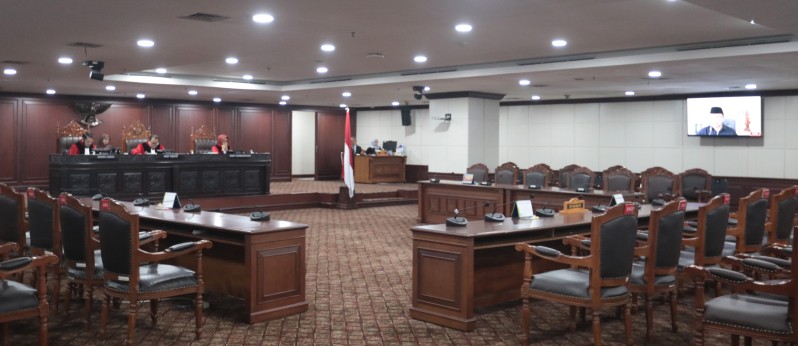
The second judicial review hearing of Law No. 2 of 2025 on Mineral and Coal Mining to examine the revisions to the petition, Tuesday (9/23/2025). Photo by MKRI/Ilham W.M.
JAKARTA (MKRI) — The Constitutional Court (MK) held the second hearing for the material judicial review of Article 51B paragraph (1) and Article 60B paragraph (1) of Law No. 2 of 2025 on the Fourth Amendment to Law No. 4 of 2009 on Mineral and Coal Mining, also known as Minerba Law, on Tuesday, September 23, 2025. Businessman Stepanus Febyan Babaro attended the petition revision hearing for case No. 157/PUU-XXIII/2025 remotely.
Before Constitutional Justices Arief Hidayat (chair), Anwar Usman, and Enny Nurbaningsih, the Petitioner stated that improvements had been made to the petition, particularly concerning the constitutional losses suffered as a result of the contested provisions. He argued that he faces potential harm because the articles in question grant special treatment to BUMN or state-owned enterprises (SOEs) and BUMD or region-owned enterprises (ROEs) in obtaining mining business permit (IUP). This, he contended, undermines his rights guaranteed under Article 28D paragraph (1) of the 1945 Constitution.
“As a result, [I] do not have equal access if engaged in the mining sector and will find it extremely difficult to obtain an IUP, since there is a potential priority given to BUMNs and BUMDs. This potential disparity in treatment will obstruct [my] business, raising serious concerns over this inequality, which is deeply regrettable,” the Petitioner explained.
In addition, the Petitioner argued that the potential preferential treatment afforded to BUMNs and BUMDs in obtaining IUPs would also hinder the private business climate, as access to licenses becomes increasingly difficult. This concern, he added, runs counter to President Prabowo’s pledge to improve the business environment.
The Petitioner also refined the grounds of the petition by asserting that the contested articles conflict with Article 28D paragraph (1) of the 1945 Constitution. Moreover, the provisions have resulted in legal uncertainty, discrimination, and injustice; potentially hinder regional investment growth; limit access to the management of natural resources; create dependency on BUMNs and BUMDs; reduce transparency in the granting of IUPs; open the door to corrupt practices; and risk sparking social conflict.
Also read: Mining Permits Priority for SOEs Questioned
At the preliminary hearing, the Petitioner argued the provisions could potentially allow preferential treatment for state-owned (BUMN) and regionally-owned enterprises (BUMD) in obtaining WIUPs (mining business permit areas) on a priority basis. This, in his view, infringes upon his constitutional rights guaranteed under Article 28D paragraph (1) of the 1945 Constitution. Should he, at some point, engage in the mining business, he would face obstacles as WIUPs would be prioritized for BUMNs/BUMDs. Consequently, the contested norms also create the risk of impeding his business prospects by denying equal access in the licensing process.
He argued that the provision of “priority” without clear parameters leaves room for subjective interpretation and potential abuse of authority by licensing officials. This contravenes the principles of a state based on law, which demand transparency, accountability, and the protection of citizens’ rights. Proper governance requires transparency, accountability, and participation. Yet, by granting priority exclusively to BUMNs/BUMDs, the regulation risks undermining transparency and shutting out private sector participation in licensing. As a result, the constitutional right of citizens to obtain equal opportunity in the management of natural resources is unfairly obstructed.
Furthermore, prioritizing BUMNs/BUMDs also imposes restrictions on private and foreign companies, thereby weakening national competitiveness in terms of technology, management, and capital. In fact, synergy between the State and the private sector is essential to strengthening the energy and mining sectors in the era of globalization. In practice, BUMNs and BUMDs often enjoy privileged access to WIUPs, yet their operations have at times generated environmental and social problems. This demonstrates that granting priority to BUMNs/BUMDs does not automatically ensure the attainment of public welfare.
Author : Sri Pujiati
Editor : Lulu Anjarsari P.
PR : Raisa Ayuditha M.
Translator : Yuniar Widiastuti (NL)
Disclaimer: The original version of the news is in Indonesian. In case of any differences between the English and the Indonesian versions, the Indonesian version will prevail.
Tuesday, September 23, 2025 | 15:35 WIB 184