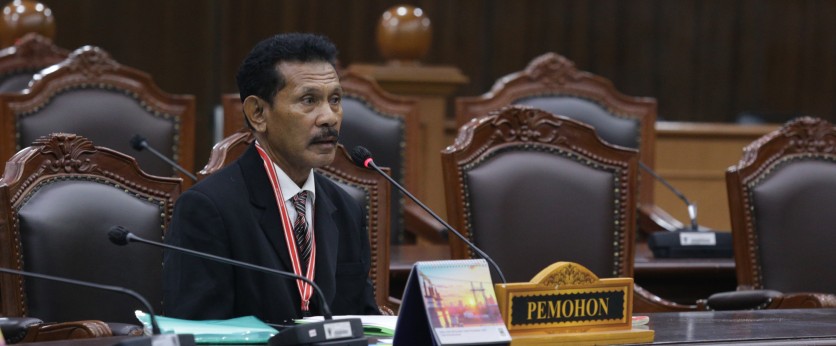
Petitioner attending the Revised Petition Examination Hearing of Case No. 152/PUU-XXIII/2025 on the material judicial review of Law No. 12 of 2011 on the Lawmaking, Monday (22/9). Photo by MKRI/Bay.
Jakarta (MKRI) – The Constitutional Court (MK) resumed the hearing of Cases No. 151/PUU-XXIII/2025 and 152/PUU-XXIII/2025 on the material judicial review of Law No. 12 of 2011 on the Lawmaking (Lawmaking Law) on Monday, September 22, 2025. The hearing was scheduled to examine the revised petitions submitted by Isak Siprianus Kota, who questioned the norm regarding Pancasila as a legal source.
During the Panel Hearing presided over by Chief Justice Suhartoyo, Isak conveyed the withdrawal of Case No. 152/PUU-XXIII/2025. Meanwhile, a revision on the petition of Case No. 151/PUU-XXIII/2025 has been made based on the justices’ advice, as provided in the Constitutional Court Regulation regarding the petition systematics.
“It is added in the posita regarding the articles, if the elucidation of Article 2 is followed, then it will contravene articles in the 1945 Constitution. For example, freedom of religion, which cannot be discounted in any situation,” Isak stated.
Moreover, in the petitum, Isak added an argument related to the preamble of the 1945 Constitution, which he deemed not to have legal reference.
Also read:
Petitioner of Lawmaking Law Review Fails to Attend Online Hearing
Petitioners of Lawmaking Law Review Challenge Pancasila’s Position as Legal Source
In his petition, Isak Siprianus Kota stated his objection to Article 2 of the Lawmaking Law, which affirms that “Pancasila is the source of the state’s legal sources.” He argued that the phrase is not in accordance with the fourth paragraph of the 1945 Constitution Preamble, which uses the term “the state structure of the Republic of Indonesia.”
In the previous hearing, Isak expressed his objections against the Elucidation of Article 2 of the Lawmaking Law, which places Pancasila not only as the basis and ideology of the state, but also as the philosophical basis. He believed that the phrase imposes an interpretation that the “One and Almighty God” – the first point of Pancasila – also serves as the state’s ideology and philosophical basis.
“Putting Pancasila as the state’s ideology and basis of philosophy imposes 'the One and Almighty God' as the state’s ideology and philosophical basis,” Isak said in front of the Panel of Justices.
He considered that this imposition objectively means giving the concept of God as the state’s ideology and philosophical basis, which, in the end, may be interpreted as the state’s philosophy.
In addition, Isak objected to Article 2 of the Lawmaking Law, which states that “Pancasila is the source of all sources of state law”. According to him, the phrase is not in accordance with the fourth paragraph of the 1945 Constitution Preamble, which uses the term “structure of the Republic of Indonesia”.
Isak opined that the removal of the word “structure” may shift the meaning, namely Pancasila, which only binds the society as a social group, instead of the whole state organization, which has structure and function from the center to regions. He added that he has the potential to create discrimination because officials or the state apparatus are not obliged to use Pancasila as a legal source.
Moreover, the Petitioner affirmed that the law cannot contradict the 1945 Constitution. Therefore, he requested the Court to declare Article 2 of the Lawmaking Law contrary to the Constitution or at least provide a constitutional interpretation that the correct formulation is “Pancasila is the source of all sources of law within the structure of the Republic of Indonesia”.
Author: Utami Argawati.
Editor: N. Rosi.
PR: Tiara Agustina.
Translator: Rizky Kurnia Chaesario
Disclaimer: The original version of the news is in Indonesian. In case of any differences between the English and the Indonesian versions, the Indonesian version will prevail.
Monday, September 22, 2025 | 15:38 WIB 207