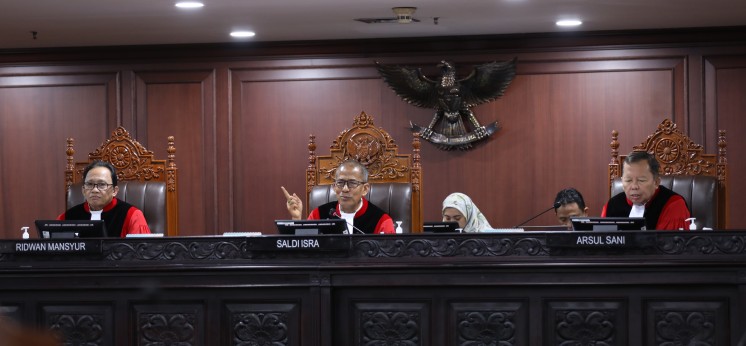
Deputy Chief Justice Saldi Isra, along with Justice Arsul Sani and Justice Ridwan Mansyur, presided over a preliminary panel hearing of material judicial review of Law No. 17 of 2014 on the People's Consultative Assembly, House of Representatives, Regional Representative Council, and Regional House of Representatives, Thursday (18/9). Photo by MKRI/Ifa.
Jakarta (MKRI) – Two students from the Constitutional Law Program of Syaria and Law Faculty of the Universitas Islam Negeri Sunan Ampel Surabaya, Dian Prahara Batubara and Moch. Jian Niam Al Kamil filed a material judicial review of Article 170 paragraph (4) lettera of Law No. 17 of 2014 on the People's Consultative Assembly, House of Representatives, Regional Representative Council, and Regional House of Representatives (MD3 Law) against the 1945 Constitution of the Republic of Indonesia to the Constitutional Court (MK). The Petitioners believed that the use of “factions” in the article does not reflect the House of Representatives as the people's representative directly.
“The provision requiring views to be expressed through party factions essentially obscures the original intent, causing regional aspirations to remain incomplete because they must pass through the political filter of the factions,” Dian Prahara Batubara said during the preliminary hearing for Case Number 159/PUU-XXII/2025 on Thursday, September 18, 2025.
The Petitioners explained that it is a collective understanding in a constitutional democracy that power should originate from the people and be exercised for the people's benefit, as guaranteed under Article 1 paragraph (2) of the 1945 Constitution. However, Article 170 paragraph (4) letter a of the MD3 Law, which stipulates that “the DPR’s views in the deliberation of a draft law at the first level shall be presented through factions,” effectively shifts legislative authority from the people’s elected representatives to political parties, through their factions.
The Petitioners argued that the application of Article 170 paragraph (4) letter a of the MD3 Law, by introducing the term “faction,” impedes regional development since the resulting policies and regulations are not always aligned with the actual needs of the regions. This would not occur if the opinions expressed in the regulatory process, which the DPR is authorized to shape, were carried out through a system based on electoral districts.
This situation is considered a form of hegemony: control over the sphere of ideas and public policy by the dominant group—in this case, political parties—through legally permissible means. Parliamentary factions serve as instruments for political parties to dominate political decision-making, including legislation, which should be grounded in the voices and aspirations of the electoral districts.
The transfer of authority from people’s representatives, who are constitutionally elected, to factions (which are not directly chosen by the people) constitutes ideological dominance that undermines the principle of popular sovereignty as affirmed in Article 1 paragraph (2) of the 1945 Constitution. This domination is structural and systemic, potentially hindering the principles of participatory democracy that form the foundation of Indonesia’s constitutional framework.
By allowing faction-based opinions in Article 170 paragraph (4) letter a of the MD3 Law, the Petitioners claimed, it may create potential constitutional harm, as the negative consequence of faction-based decision-making is the obscuring of party and member positions, making them oblivious to constituents. The moral and political accountability of DPR members—whose authority is delegated by voters in their electoral districts—cannot be guaranteed, since the decisions they make become the collective expression of their party’s faction rather than the authentic representation of their constituents.
Faction-based views also risk producing legislation that fails to address local issues, as representatives from a given region should ideally understand and advocate for their local interests. The Petitioners propose replacing “faction-based opinion” with educating voters to make rational choices in future elections, based on candidates’ capacity and understanding of their electoral districts.
In their petitum, the Petitioners requested the Court to declare Article 170 paragraph (4) letter a of the MD3 Law, as last amended by Law No. 13 of 2019, to be inconsistent with Article 1 paragraph (2) and Article 28E paragraph (3) of the 1945 Constitution and to have no binding legal force unless interpreted to mean “Electoral District Opinion,” representing a tangible mandate from the people in the representative democracy system. They also asked the Court to instruct the DPR and other relevant authorities to adjust their internal structure and working mechanisms. Hence, all commissions and complementary organs uphold the principle of electoral district representation that logically follows the change of the term from “Faction” to “Electoral District.”
Justices’ Advice
The case was heard by a Panel of Justices led by Deputy Chief Justice Saldi Isra, accompanied by Justice Ridwan Mansyur and Justice Arsul Sani. During the advice session, Justice Arsul noted that the term “faction” does not occur in just one article under review but is found in numerous articles throughout the MD3 Law. If only one article is interpreted differently, while the term in other articles is given another meaning, it would undermine the coherence of the MD3 Law itself.
“The constitutional duties and functions of the DPR—beyond legislation—also include two other key functions. In the budgeting function, the term ‘faction’ also appears. If only this article were changed, wouldn’t the law become inconsistent? Budgeting also communicates regional aspirations when there are local budget proposals, and the same applies in the oversight function. This must all be reconsidered,” Justice Arsul explained.
Before adjourning the hearing, Deputy Chief Justice Saldi allowed the Petitioners to revise their petition within 14 days. The revised document must be submitted to the Court no later than October 1, 2025, by 12:00 p.m. local time.
Read more:
Petition No. 159/PUU-XXIII/2025 in Indonesian
Author: Mimi Kartika
Editor: N. Rosi.
PR: Fauzan.
Translator: Rizky Kurnia Chaesario
Disclaimer: The original version of the news is in Indonesian. In case of any differences between the English and the Indonesian versions, the Indonesian version will prevail.
Thursday, September 18, 2025 | 14:16 WIB 177