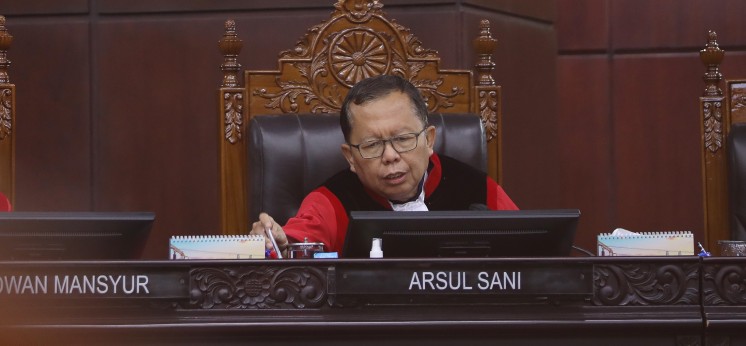
Constitutional Justice Arsul Sani delivers the Court’s legal considerations during the pronouncement of the judgment on the judicial review of Law Number 22 of 2009 on Road Traffic and Transportation, Wednesday (09/17/2025) in the Constitutional Court courtroom. Photo by MKRI/Ifa.
JAKARTA, (MKRI) – The provisions of Article 1 point 19 and Article 25 paragraph (1) letter c of Law Number 22 of 2009 on Road Traffic and Transportation (UU LLAJ) do not create unequal treatment, violate equality before the law, or cause discrimination, nor do they endanger safety and welfare. Such was the Constitutional Court’s legal consideration in Decision Number 149/PUU-XXIII/2025 on the petition filed by Singgih Wiryono and Yosafat Diva Bayu Wisesa. The ruling was read out in a plenary session on Wednesday (09/17/2025).
Constitutional Justice Arsul Sani delivered the Court’s legal reasoning, explaining that the petitioners had requested a conditional unconstitutionality ruling on Article 1 point 19 of the UU LLAJ, seeking that traffic signal devices be required to accommodate persons with color-vision deficiencies—by altering color, shape, or spacing of lights. Arsul clarified that Article 1 point 19 forms part of the general provisions of the law, which provide definitions and key terms that apply to the subsequent articles. Therefore, if the petitioners’ request were granted, it would affect the validity of all provisions in the law that rely on these general definitions and could disrupt the structure of the statute as a whole. Consequently, the Court found the petitioners’ argument regarding Article 1 point 19 legally groundless.
Regarding Article 25 paragraph (1) letter c, the Court observed that this article already imposes a duty on government agencies to provide protection and safety for all citizens, including persons with disabilities such as those with partial color blindness. Moreover, since the enactment of Law 8/2016 on Persons with Disabilities, this responsibility should be taken even more seriously.
The Court emphasized that the issue raised by the petitioners concerns the implementation of the law rather than its constitutionality. Nevertheless, both central and local governments must continue to improve public facilities and infrastructure to ensure equal access and protection for all, including traffic signals that accommodate color-vision deficiencies.
Accordingly, the Court underscored the obligation of relevant authorities to guarantee equal opportunity and protection for people with disabilities of all types, including those with partial color blindness, by providing traffic signal devices that ensure safety for everyone. “The Court declares the second petitioner’s application inadmissible and rejects the first petitioner’s application in its entirety,” stated Chief Justice Suhartoyo when reading the verdict in the Constitutional Court’s plenary courtroom.
Read also:
Partially Color-Blind Journalists Challenge Discriminatory Traffic Light Signals
Petitioners Provide Example of Traffic Light Signals for Color Deficient Individuals in Several Countries
Earlier, the petitioners—who are partially color-blind journalists frequently reporting from the Constitutional Court—argued that the provisions on Traffic Signal Devices (APILL) relying solely on color signals amount to indirect discrimination, benefiting only those with normal color vision. The APILL definition focuses exclusively on red, yellow, and green signals, which are not easily distinguishable by persons with color-vision deficiencies. As a result, they may inadvertently violate traffic rules, placing them in a vulnerable position.
Author : Sri Pujianti
Editor : Lulu Anjarsari P.
PR : Fauzan Febriyan
Translator: Agusweka Poltak Siregar
Disclaimer: The original version of the news is in Indonesian. In case of any differences between the English and the Indonesian versions, the Indonesian version prevails.
The full decision is available at the following link: Decision Number 149/PUU-XXIII/2025.
Wednesday, September 17, 2025 | 15:41 WIB 287