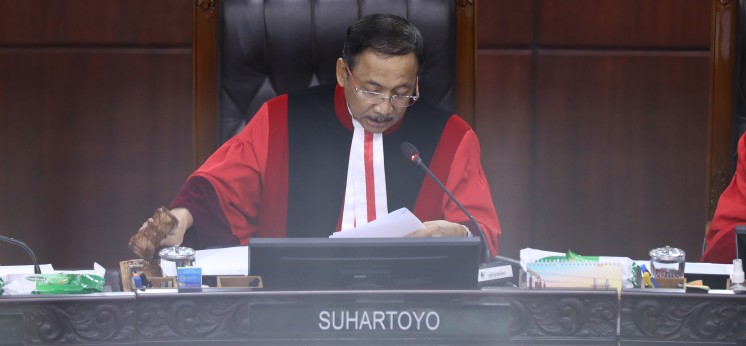
Chief Justice Suhartoyo Delivers Verdict on Judicial Review of Law No. 2 of 2002 Concerning the Indonesian National Police on Wednesday (17/09) at the Constitutional Court. Photo: Humas/Ifa
JAKARTA (MKRI) – The Constitutional Court has declared the petition for judicial review of Article 21 paragraph (1) letter d of Law No. 2 of 2002 on the Indonesian National Police inadmissible. The ruling, issued under Decision Number 133/PUU-XXIII/2025, was read by Chief Justice Suhartoyo on Wednesday, 17 September 2025, during a plenary session of the Court.
In further elaboration of the Court’s reasoning, Constitutional Justice Enny Nurbaningsih presented the legal considerations of the Court. She explained that Petitioner I, Leon Maulana Mirza Pasha, and Petitioner II, Zidane Azharian Kemalpasha, had described themselves as Indonesian citizens, one an advocate and the other a university student, had asserted that their constitutional rights under the 1945 Constitution of the Republic of Indonesia (UUD NRI 1945) were at stake.
However, the Court found that neither petitioner demonstrated a specific constitutional loss caused by the enactment of the challenged legal norm. As such, Justice Enny concluded that the petitioners did not possess legal standing to file the petition.
"Although the Court has the authority to adjudicate the petition, because the petitioners lack legal standing to submit the case, the Court will not further examine the substance of the petition," said Constitutional Justice Enny.
Also read:
Minimum Requirements of Senior High School Graduate for Police Officers Challenged
Previously, the petitioners had challenged the constitutionality of a provision that sets senior high school (or equivalent) as the minimum educational requirement for candidates applying to join the police force. They argued that this provision neglects the essential correlation between educational background and the substantive competencies required to perform police duties professionally and responsibly.
According to the petitioners, the role of the police force has evolved beyond merely physical or administrative tasks. It now demands specialized knowledge in fields such as law, criminology, psychology, sociology, information technology,and public communication, areas typically addressed in an undergraduate (Bachelor's) education.
The petitioners emphasized that, as law enforcers, police officers should meet appropriate academic standards, comparable to those required of other key pillars of the justice system. They asserted that maintaining the status quo would conflict with Article 30 paragraph (4) of the 1945 Constitution, which mandates that the police serve as a state instrument responsible for maintaining public order and security, protecting and serving the community, and upholding the law.
While the petitioners acknowledged that high school graduates are not inherently unqualified, they argued that such an educational background is not sufficient to shoulder the complex responsibilities of modern policing. High school curricula, they noted, tend to emphasize civic education, national institutions, and moral values, but do not delve into comparative law, constitutional rights, criminal offense analysis, and similar areas of legal study.
Author : Sri Pujianti
Editor : Lulu Anjarsari P.
PR : Fauzan Febriyan
Translator : SO
Disclaimer: The original version of the news is in Indonesian. In case of any differences between the English and the Indonesian versions, the Indonesian version will prevail.
Wednesday, September 17, 2025 | 15:39 WIB 104