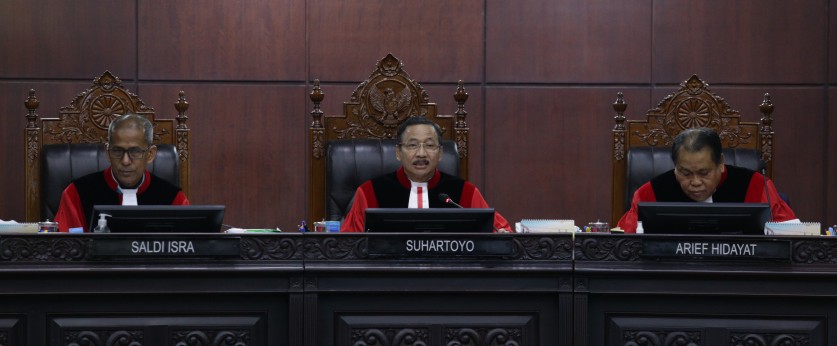
Delivering the decree for case No. 153/PUU-XXIII/2025 on the judicial review of Law No. 39 of 2008 on the Ministry of State as amended by Law No. 61 of 2024 on the Amendment to Law No. 39 of 2008 on the Ministry of State, Wednesday (9/17/2025). Photo by MKRI/Bay.
JAKARTA (MKRI) — The Constitutional Court (MK) granted the withdrawal of the petition for the judicial review of Article 23 letter b of Law No. 39 of 2008 on the Ministry of State, as amended by Law No. 61 of 2024, against the 1945 Constitution of the Republic of Indonesia in case No. 153/PUU-XXIII/2025. The Court considered the withdrawal to be accompanied by valid reasons, thus legally warranted.
“[The Court] grants the Petitioners’ request to withdraw the petition,” said Chief Justice Suhartoyo, delivering the decree for case No. 153/PUU-XXIII/2025 on Wednesday, September 17, 2025, in the plenary courtroom of the Constitutional Court, Jakarta.
The Court had received the withdrawal letter and clarified it in a hearing, during which the Petitioners, through their legal counsel, confirmed the withdrawal. Accordingly, the Court declared that the Petitioners could not refile their petition.
Also read: Court Affirms Ban on Dual Posts for Deputy Ministers, Petition Withdrawn
At the preliminary hearing on Monday, September 1, 2025, the Petitioners’ legal counsel had already confirmed the withdrawal. He argued that the petition had lost its object, as the Court had affirmed the prohibition of dual office for deputy ministers (wamen) under the very article in Decision No. 128/PUU-XXIII/2025, handed down on Thursday, August 28, 2025.
“This petition has lost its object and is therefore no longer relevant to pursue, as it has been accommodated in the aforementioned ruling, Your Honor,” said the Petitioners’ legal counsel, Marselinus Edwin Hardhian, online. The subject matter of the petition was essentially identical to that in case No. 128/PUU-XXIII/2025, as both challenged Article 23 letter b of the Ministry of State Law.
The Court, in that decision, had already provided a new interpretation of the provision, prompting the Petitioners to deem their petition moot. The case was filed by three advocates, one legal administrator, and a private-sector employee, who argued that there should be an explicit prohibition against deputy ministers holding concurrent offices.
Currently, at least 30 deputy ministers in the 2024–2029 Cabinet also serve as commissioners or members of the supervisory board of various strategic state-owned enterprises (SOEs). Among them are Deputy Minister of Housing and Residential Areas Fahri Hamzah (Commissioner of PT Bank Tabungan Negara), Deputy Minister of Women’s Empowerment and Child Protection Veronica Tan (Commissioner of PT Citilink Indonesia), Deputy Minister of Culture Giring Ganesha (Commissioner of PT Garuda Maintenance Facility), Deputy Minister of Villages and Underdeveloped Regions Ahmad Riza Patria, and Deputy Minister of Manpower Immanuel Ebenezer Gerungan (Commissioner of PT Pupuk Indonesia).
The Petitioners argued that such dual office practices by deputy ministers inherently contravene the fundamental principles of clean state governance and sound administration. They asserted that the practice violated the spirit and provisions of Law No. 28 of 1999 on a State Free from Corruption, Collusion, and Nepotism, while creating systemic conflicts of interest.
They maintained that a deputy minister’s primary duty is to assist the minister in formulating and implementing public policies. By contrast, an SOE commissioner is bound by fiduciary duties to oversee the board of directors in the best interests of a profit-oriented corporation. These roles, they said, pursue different loyalties and often clash.
The Petitioners also countered the government’s claim that the absence of an explicit prohibition for deputy ministers permits dual office-holding, arguing instead that existing statutory norms prohibit it. Thus, all restrictions on concurrent office-holding imposed on ministers under Article 23 of Law No. 39 of 2008 should equally apply to deputy ministers.
Such an application, they contended, ensures that deputy ministers remain focused on the substantial workload that necessitated their appointment in the first place. They deemed the dual office-holding of deputy ministers in SOEs a manifestation of power arrogance, exacerbating political undertones.
In their petitum, the Petitioners asked the Court to declare Article 23, letter b of the Ministry of State Law, unconstitutional and not legally binding insofar as the term “Minister” is not interpreted to include “Minister and Deputy Minister.”
Meanwhile, in Decision No. 128/PUU-XXIII/2025, the Court declared Article 23 of Law No. 39 of 2008 unconstitutional and not legally binding, unless interpreted to mean that “Ministers and Deputy Ministers are prohibited from concurrently holding office as: a. other state officials under statutory laws and regulations; b. commissioners or directors of state-owned enterprises or private companies; or c. heads of organizations funded by the state or regional budgets.”
Author: Mimi Kartika
Editor: Lulu Anjarsari P.
PR: Andhini S. F.
Translator: Yuanna Sisilia
Disclaimer: The original version of the news is in Indonesian. In case of any differences between the English and the Indonesian versions, the Indonesian version will prevail.
The full decision can be accessed at the following link: Decision for Case No. 153/PUU-XXIII/2025
Wednesday, September 17, 2025 | 14:32 WIB 215