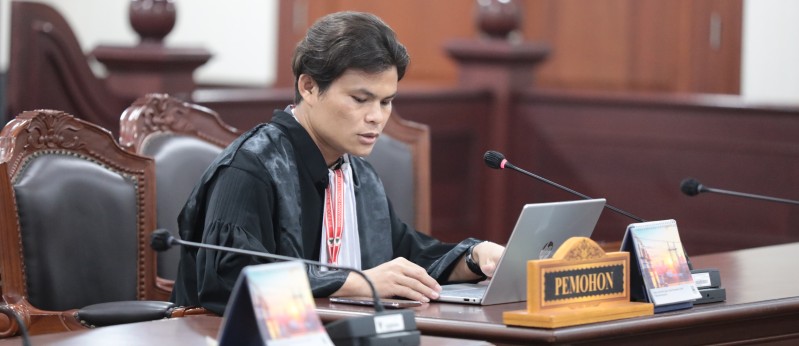
Petitioner Hanter Oriko Siregar delivering the main points of his revised petition on the judicial review of the General Election Law and the Regional Election Law. Photo by MKRI/IlhamWM.
Jakarta (MKRI) – The Constitutional Court (MK) resumed the hearing of Case No. 154/PUU-XXIII/2025 on the petition to challenge the minimum requirement for the candidates for president, vice president, regional head, and legislative member on Tuesday, September 16, 2025. On the hearing scheduled to hear the revised petition, Hanter stated that he added a touchstone, namely Article 1 paragraph (2) of the 1945 Constitution of the Republic of Indonesia, revised the legal standing, and petition reasoning.
“The petition is not ne bis in idem because the reasoning and the legal basis are different. I mentioned the massive corruption as proof of the government's failure as a result of weak leadership and the state’s official capacity at all levels of positions, which harms the state’s budget by trillions of rupiah. The state failed to establish a selection mechanism and a leadership candidate screening, allowing individuals without the capacity to hold public office,” Hanter explained during the Panel Hearing presided over by Justice Arief Hidayat, along with Justice Anwar Usman and Justice Enny Nurbaningsih.
For these reasons, on the revised petitum, the Petitioners requested the Court to declare Article 169 letter r, Article 182 letter e, and Article 240 paragraph (1) letter e of the General Election Law conditionally contrary to the 1945 Constitution and not legally binding as long as it is not interpreted as: in Article 169 letter r of the General Election Law reads, “having at least a Bachelor’s degree or equivalent.” Article 182 letter e of the General Election Law reads, “having at least a Bachelor’s degree or equivalent.” Article 240 paragraph (1) letter e of the Election Law reads, “having at least a Bachelor’s degree or equivalent.”
The Court was also requested to declare Article 7 paragraph (2) letter c of the Regional Election Law conditionally constitutional against the 1945 Constitution and has no legally binding force as long as it is not interpreted as “having at least a Bachelor’s degree or equivalent.”
Also read:
Education Requirements for Presidential, VP, Regional Head, and Legislative Candidates Questioned
The Petitioner of Case No. 154/PUU-XXIII/2025 filed for material judicial review of Article 169 letter r, Article 182 letter e, Article 240 paragraph (1) letter e of the General Election Law, and Article 7 paragraph (2) letter c of the Regional Election Law. The provision, as stipulated in Law No. 7 of 2017 on the General Election Law, in conjunction with Law No. 10 of 2016 on the Second Amendment to Law No. 1 of 2015 on the Stipulation of the Government Regulation in Lieu of Law into Law, is submitted to the Constitutional Court for review.
According to the Petitioner, these articles were contradictory to Article 22E paragraph (1); Article 28G paragraph (1); Article 28I paragraph (4) of the 1945 Constitution of the Republic of Indonesia. As a citizen, the Petitioner has the right to be led by the President, Vice President, and other officials who are capable, have integrity, and have adequate intellect to manage the state. The Petitioner affirms that these norms set minimum standards that are too low for the highest position in state administration, and all the policy and law-making positions. This directly affects the petitioner’s social life and future. Meanwhile, the state requires elementary school teachers to have at least a bachelor’s degree.
Author: Sri Pujianti
Editor: Lulu Anjarsari P.
PR: Fauzan Febriyan
Translator: Rizky Kurnia Chaesario
Disclaimer: The original version of the news is in Indonesian. In case of any differences between the English and the Indonesian versions, the Indonesian version will prevail.
Tuesday, September 16, 2025 | 15:26 WIB 243