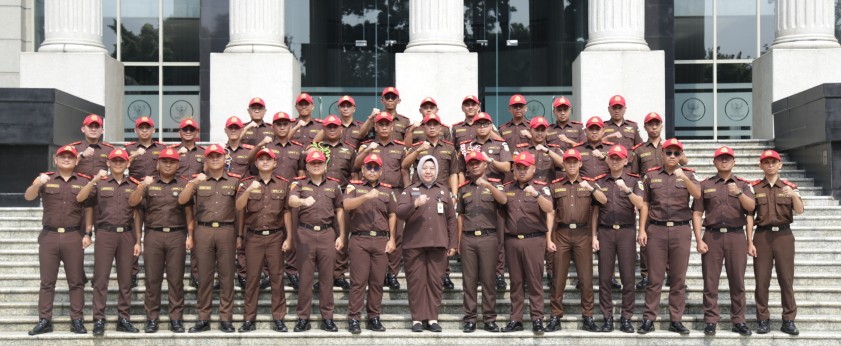
Participants of the Education and Training Program for Prosecutor Formation (PPPJ) of the Attorney General’s Office of the Republic of Indonesia visiting the Constitutional Court building, 9/16/2025. Photo by MKRI/Bay.
JAKARTA (MKRI) — Participants of the Education and Training Program for Prosecutor Formation (PPPJ) of the Attorney General’s Office of the Republic of Indonesia visited the Constitutional Court (MK) on Tuesday, September 16, 2025. The visit formed part of the field law lecture series designed for prospective prosecutors.
The delegation was received by the Court’s Associate Legal Analyst, Syamsudin Noer in the Auditorium of Building I. In his presentation, Syamsudin elaborated on the Court’s pivotal role as the final interpreter of the Constitution and the guardian of the constitutionality of laws in Indonesia.
He also outlined the appointment process of the nine constitutional justices, each of whom is nominated respectively by the Supreme Court, the House of Representatives (DPR), and the President.
Syamsudin went on to explain the procedures for filing a judicial review petition with the Court. These include the petitioner’s identity requirements, the Court’s jurisdiction, legal standing, and the drafting of arguments (posita) and requests (petitum). “Everything must be prepared and presented with clarity,” he emphasized.
He further highlighted that the Court has now begun adopting a digital ruling system. With this initiative, decisions are no longer printed on paper as in the past. “At the Court, rulings are no longer printed on paper but delivered in digital format,” Syamsudin remarked.
This shift aligns with ongoing efforts to modernize and enhance institutional efficiency, while also promoting environmentally friendly practices. Digitalization of rulings is expected to enhance public access to legal information and expedite the distribution of the Court’s official documents.
In addition, Syamsudin reminded that as a high state institution, the Court’s decisions are final and binding. Therefore, no party may disregard or manipulate them, as they are binding on all state institutions and citizens of Indonesia.
For context, PPPJ is an education program managed by the Education and Training Agency (Badiklat) of the Attorney General’s Office. Based on the Regulation of the Attorney General of the Republic of Indonesia No. Per-006/A/JA/07/2017, Badiklat is mandated to conduct planning, training, and evaluation of education programs for prosecutorial officials, as well as to establish cooperation with various institutions both domestically and abroad.
Author: Utami Argawati
Editor: Lulu Anjarsari P.
Translator: Jessica Rivena Meilania/Yuanna Sisilia
Disclaimer: The original version of the news is in Indonesian. In case of any differences between the English and the Indonesian versions, the Indonesian version will prevail.
Tuesday, September 16, 2025 | 16:54 WIB 162