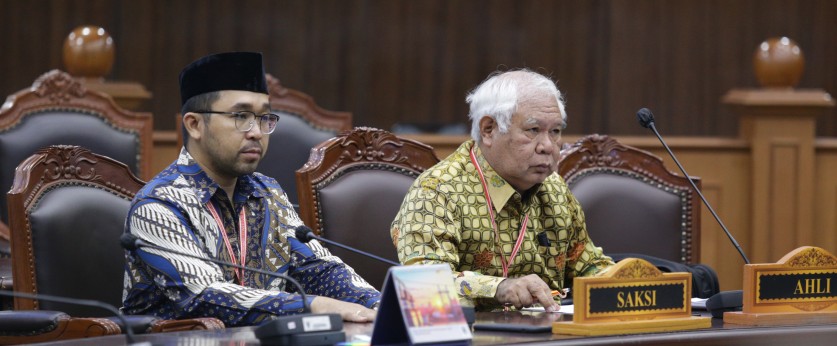
The Petitioners’ expert and witness at a hearing for case No. 114/PUU-XXIII/2025 on the judicial review of Law No. 2 of 2002 on the National Police, Monday (9/15/2025). Photo by MKRI/Bayu.
JAKARTA (MKRI) — The reciprocal principle concerns the legality of appointments of members of the national police (Polri) or the armed forces (TNI) within the civil service (ASN). This has been regulated under Article 19 of Law No. 20 of 2023 on the State Civil Apparatus (ASN Law) to maintain balance and continuity in appointments in line with the objectives of ASN transformation.
The statement was made by I Wayan Sudirta on behalf of the House of Representatives (DPR) at the fifth hearing for the material judicial review of Article 28 paragraph (3) of Law No. 2 of 2002 on the Indonesian National Police and its elucidation. The hearing for case No. 114/PUU-XXIII/2025, chaired by Chief Justice Suhartoyo, took place in the plenary courtroom on Monday, September 15, 2025.
I Wayan explained that in addition to this reciprocity principle, there is also the merit system as stipulated under Article 1 paragraph (15) of Law No. 20 of 2023. The merit system constitutes the administration of the ASN system in accordance with the principle of meritocracy, namely an organizational political system in which authority and positions are granted based on an individual’s ability, achievements, and performance, rather than on wealth, social class, or family background. The advantage of this system is to improve performance and guarantee the professionalism of every ASN, including police officers and army members who may hold office.
Regulated by Government Regulations
Meanwhile, Article 19 paragraph (3) of the 2023 Law limits managerial appointments of police officers to the central government level. I Wayan clarified that the procedure on appointment of police officers within civil service is regulated in a government regulation. Under Article 75 of Law No. 20 of 2023, the implementing regulations of Law No. 5 of 2014 on ASN remain in force so long as they do not conflict with Law No. 20 of 2023. Accordingly, Government Regulation No. 11 of 2017 on Civil Servant Management, as amended by Government Regulation No. 17 of 2020, continues to serve as the technical regulation for Law No. 20 of 2023.
I Wayan explained that for arrangements concerning police officers occupying managerial positions, Article 14 of Law No. 20 of 2023, Articles 157 and 159 of Government Regulation No. 11 of 2017, as well as the provisions issued by the army commander and the national police chief requires attention. Pursuant to Article 160 of Government Regulation No. 11 of 2017, the Police Chief Regulation (Perkap) No. 4 of 2017 on the assignment of police personnel outside the police structure has been issued.
“If one examines the substance of this regulation, it comprehensively concerns assignments, requirements, rank and career development, rights and obligations, and other matters. Based on rank and position, the provisions on the filling of ASN positions by army/police personnel are consistent with Article 28 paragraph (3) of Law No. 2 of 2002. It can therefore be concluded that police officers, including active-duty ones, may occupy ASN positions, provided they meet the requirements stipulated in Law No. 2 of 2002 and comply with the merit system under Law No. 20 of 2023,” stated I Wayan at the hearing chaired by Chief Justice Suhartoyo.
Considerations on Police’s Functions and Duties
On the issue of police officers in civil service, I Wayan also mentioned Constitutional Court Decision No. 15/PUU-XX/2022, which may serve as a reference. The decision allowed such appointments so long as the ASN positions in question are intermediate high-ranking posts at the central government level. Although the Court’s reasoning was based primarily on Law No. 5 of 2014 on ASN, the same norms remain codified in Law No. 20 of 2023.
Therefore, police officers may assume positions within civil service in accordance with prevailing legislation. Given that ASNs are required to adhere to political neutrality, Law No. 2 of 2002 also mandates that police officers remain free from political interference. This is provided under Article 28 paragraph (1) of Law No. 2 of 2002, while neutrality for ASNs are enshrined in Article 2 letter f and Article 24 paragraph (1) letter b of Law No. 20 of 2023.
“Thus, the Petitioners’ concern that police involvement in ASN appointments would undermine neutrality is unfounded. Based on the transcripts on the drafting of Law No. 2 of 2002, regarding the interpretation of the provision in question and the intended scope of police personnel serving outside the police force, the overall framework of laws and regulations is coherent and consistent, enabling police officers to occupy ASN positions with due regard to police’s functions and duties,” explained I Wayan.
Institutional Conflict Risks
In his testimony as an expert for the Petitioners, retired Rear Admiral Soleman B. Ponto expressed concerns regarding the judicial review of Article 28 paragraph (3) of Law No. 2 of 2002 on the National Police and its elucidation, particularly the phrase “… or not based on assignments by the Chief of Police.” He asserted that this phrase poses serious problems because it allows for the assignment of active-duty police officers by external parties without the knowledge of the chief of police. Such a provision, he argued, could create legal uncertainty, dual authority, and potential abuse of power, thereby undermining the integrity of the police as a state apparatus.
He further emphasized that this contradicts the principle of a single command system within the police as mandated by Article 11 of Law No. 2 of 2002, which stipulates that the police force is answers to the president and led by a chief. Allowing assignments without the chief’s knowledge could create institutional conflicts, for example between the chief of police and the coordinating minister for political, legal, and security affairs; between the chief of police and ministries requesting assignments; or between the police and civilian institutions. If unchecked, such a pattern could disrupt national security coordination and potentially threaten state stability.
Without Status Transfer
Ponto also noted that under Article 30 of the 1945 Constitution, the army and the police are both state instruments of equal standing, with the army responsible for national defense and the police responsible for public security and order. However, in practice, different treatment exists: armed personnel must transfer status if they wish to occupy civilian posts under Article 47 of Law No. 34 of 2004, while police personnel may occupy civilian posts without a status transfer due to the elucidation to the provision under review.
“This unequal treatment of two state institutions equally recognized by the Constitution amounts to normative discrimination and legal uncertainty, contrary to Article 28D paragraph (3) of the 1945 Constitution on equality before the law,” Ponto stated.
Unequal Opportunities to Compete
The Court also heard testimony from the Petitioners’ witness Stepanus Febyan Babaro, who described the practical impacts of active-duty police officers occupying civilian positions. As an Indonesian citizen with expertise in information technology and in investigating alleged corruption crimes, he testified that his opportunities to develop his abilities and to compete for government posts had been foreclosed by positions being filled by police officials.
“Based on my experience, there has been unequal treatment in opportunities to compete and to enter government service, even though my true intention is to serve this country. This has created a sense of injustice and worsened socio-economic conditions, as I lost the opportunity for a fair and transparent process,” Babaro recounted.
Also read:
Advocate Objects to Active-Duty Police Officers Holding Civil Positions
Petitioners Argue Constitutional Loss Due to Active-Duty Police in Civil Positions
House, Govt Not Ready to Testify in Case on Police in Civil Positions
Govt: Not All Positions in Civil Service Can Be Filled by Police Members
The petition for case No. 114/PUU-XXIII/2025 was filed by Syamsul Jahidin, an advocate and doctoral student, and Christian Adrianus Sihite, an unemployed law school graduate. They challenge Article 28 paragraph (3) of Law No. 2 of 2002 on the Indonesian National Police and its elucidation.
Article 28 paragraph (3) of the Police Law reads, “Members of the Indonesian National Police may occupy positions outside the police force after resigning or retiring from police service.” The elucidation of the provision further states, “The term ‘positions outside the police force’ refers to posts unrelated to police duties or not based on assignments by the Chief of Police.”
At the preliminary hearing on Tuesday, July 29, Syamsul said several active police officers have been appointed to civil posts outside the Police institutional structure without first resigning or retiring. These include roles such as chairperson of the Corruption Eradication Commission (KPK), secretary-general of the Ministry of Maritime Affairs and Fisheries, head of the National Narcotics Agency (BNN), deputy head of the National Cyber and Encryption Agency (BSSN), and head of the National Counterterrorism Agency (BNPT). This, he argued, violates the principle of public service neutrality and meritocracy, as well as harms the Petitioners’ constitutional right as citizens and professionals to equal protection under the law and equal opportunity in public governance.
The Petitioners believe that the legal provision and its elucidation lack clear limitations, allowing room for interpretation and loopholes that enable active-duty police officers to hold civilian positions without formally relinquishing their status. They argue that substantively, the provision has established a dual-function for the Police, enabling police officers not only to serve as law enforcement agents but also to take part in administrative, political, and social spheres.
Therefore, the Petitioners request that the Court declare the phrase “or not based on assignments by the Chief of Police” in the elucidation to Article 28 paragraph (3) of the Police Law unconstitutional and not legally binding.
Author : Sri Pujianti
Editor : N. Rosi
PR : Fauzan Febriyan
Translator : Yuniar Widiastuti (NL)
Disclaimer: The original version of the news is in Indonesian. In case of any differences between the English and the Indonesian versions, the Indonesian version will prevail.
Monday, September 15, 2025 | 15:20 WIB 886