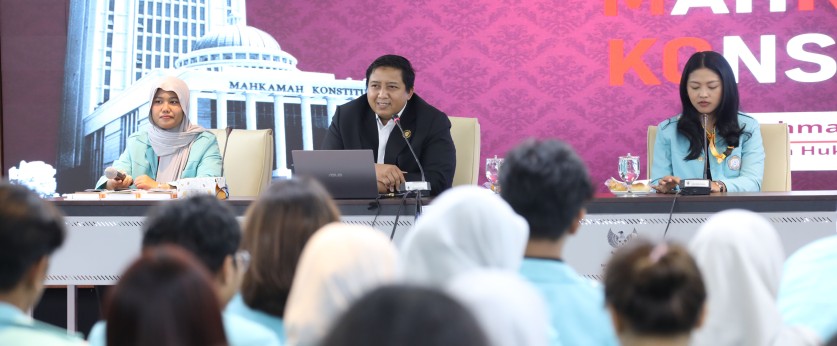
Legal Educator Ahmad Junaedi receiving a study visit from the Student Executive Board (BEM) of the Faculty of Law, Sebelas Maret University (FH UNS) Surakarta, Monday (9/15/2025). Photo by MKRI/Ifa.
JAKARTA (MKRI) — The Constitutional Court (MK) welcomed a study visit from the Student Executive Board (BEM) of the Faculty of Law, Sebelas Maret University (FH UNS) Surakarta on Monday, September 15, 2025. The visit was received directly by Legal Educator Ahmad Junaedi.
Before 80 participating students, Junaedi explained the Court’s duties and authorities as stipulated in the 1945 Constitution, namely to conduct judicial review of laws against the Constitution, to settle disputes over authorities between state institutions whose authorities are granted by the Constitution, to decide on the dissolution of political parties, to resolve disputes over general election results, and to adjudicate the House of Representatives’ (DPR) opinion regarding alleged violations by the President and/or Vice President.
Junaedi went on to highlight that the nine constitutional justices are nominated by three state institutions: the House of Representatives (DPR), the President, and the Supreme Court (MA), with three representatives from each, symbolizing the three branches of power: legislative, executive, and judicial.
He further outlined the process and stages of judicial review, in which petitions may be filed by individual citizens, indigenous law communities, public or private legal entities whose constitutional rights are factually or potentially impaired by the enforcement of a statutory provision. Junaedi explained that in such hearings, the President or his legal representative and the DPR serve as testifiers, while relevant parties are those with interests connected to the challenged norm. In disputes over the authority of state institutions, the petitioners are state institutions whose authority is regulated by the Constitution vis-à-vis other institutions.
Junaedi also informed that the Court provides remote hearing facilities by collaborating with several universities across Indonesia to establish “mini courtrooms” for online hearings and academic activities. Not only can hearings be conducted virtually, but petition filing can also be completed online.
Additionally, Junaedi shared information on internship opportunities at the Court. He noted that the Court also offers thesis assistance for students conducting research on constitutional matters by providing access to reference materials to support academic writing. “If you are writing your thesis on the Constitutional Court and need our assistance, you may submit a research request through the Court’s website,” Junaedi said.
He emphasized that this support is also extended to students working on master’s theses and doctoral dissertations, with the Court ensuring the availability of relevant literature resources.
Author: Ilham Wiryadi Muhammad
Editor: N. Rosi
Translator: Yuanna Sisilia
Disclaimer: The original version of the news is in Indonesian. In case of any differences between the English and the Indonesian versions, the Indonesian version will prevail.
Monday, September 15, 2025 | 15:48 WIB 185