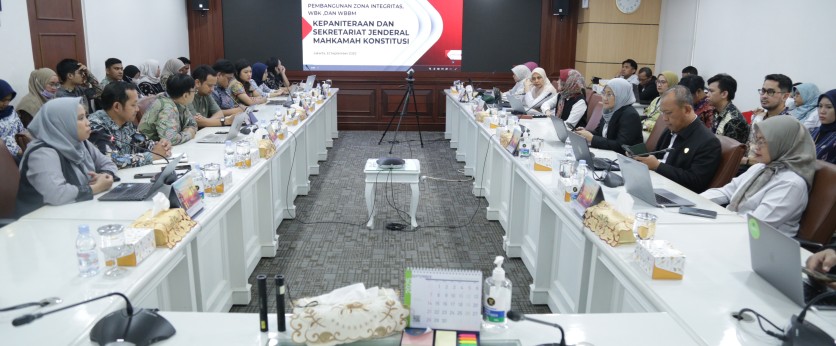
Benchmarking the Integrity Zone Development of the Ministry of MSMEs at the Court, Thursday (9/11/2025). Photo by MKRI/Bay.
JAKARTA (MKRI) — The Ministry of Micro, Small, and Medium Enterprises of the Republic of Indonesia (the Ministry of MSMEs), represented by Head of the Bureau of Organization, Human Resources, and Law Reza Fikri Febriansyah, together with his team, conducted a benchmarking visit to the Constitutional Court (the Court) on Thursday, September 11, 2025. The visit was intended to learn from the Court’s successful development of Integrity Zones (IZ) toward Corruption-Free Zones (WBK) and Clean and Serving Bureaucracy Zones (WBBM).
Reza emphasized that the best practices of the Court, which have achieved both WBK and WBBM titles, could be adopted and adapted in building integrity zones within the Ministry of MSMEs.
“We chose the Court for this benchmarking because it is a constitutional body enshrined in the 1945 Constitution with an excellent public image, particularly in service and bureaucratic environment,” Reza remarked in the 10th Floor Meeting Room of the Main Building in Jakarta.
The delegation was received by Head of the Human Resources and Organization Bureau Sri Handayani, Inspectorate Sigit Purnomo, Head of Planning and Finance Bureau (Renkeu) Tatang Garjito, and Head of the Center for Case Research and Study and Library Management (Puslitka) Kurniasih Panti Rahayu, along with their respective staff.
Sri Handayani, also known as Yani, explained that the Court initiated IZ development in 2020. That year, the Pancasila and Constitution Education Center (Pusdik) was proposed as the IZ pilot unit and successfully obtained the WBK title. In the following years, the ICT Center (2021), the Legal and Registrar Administration Bureau (HAK, 2022), and Puslitka (2023) also attained WBK titles.
Two years after receiving WBK, the ICT Center earned WBBM status in 2024. This year, the Court has proposed two units for WBK, the Public Relations and Protocol Bureau and the Planning and Finance Bureau, and three units for WBBM: HAK, Pusdik, and Puslitka.
Yani elaborated that the Court’s IZ development strategy began with setting bureaucratic reform as the institution’s key performance target, cascaded down to the implementing level. WBK and WBBM development became part of the performance agreements of echelon-2 work units. Another key strategy was the leadership’s commitment, demonstrated through monthly evaluation meetings on bureaucratic reform, chaired by the Secretary-General and involving all echelon-2 heads. Additionally, units were required to submit action plans and evidence for IZ development via the Evaluation Worksheet (LKE) microsite on the Court’s website.
Another essential strategy, she added, was intensive coordination between the HR and Organization Bureau and the Inspectorate to monitor proposed IZ units. Above all, the Court’s effective use of technology to enhance public service and accountability was a decisive factor in achieving WBK and WBBM.
“In my view, the most impactful aspect was the digitalization of manual processes,” Yani stated.
This perspective was echoed by Inspectorate Sigit Purnomo, who stressed that the essence of WBK and WBBM lies in innovation across six core areas: Change Management, Governance Streamlining, HR Management System Reform, Performance Accountability, Oversight Reinforcement, and Service Quality Improvement. These innovations were further strengthened by technology-based initiatives, such as the intranet-based Dynamic Archives Information System (SIKD) for managing records.
The Court also developed the Employee Talent Management Information System (SIMANTAP) to systematically assess staff performance, especially in talent management and recruitment. SIMANTAP integrates data from multiple sources, including self-assessments, and features evaluation of potential, competency, track records, and the Nine Box Value (NBV) ranking recap.
Sharing his experience, Sigit, who formerly led the ICT Center, recalled the evaluation process when the ICT Center was proposed for WBBM. The evaluators highlighted the Court’s use of the Electronic Case Management Information System (SIMPEL).
Through SIMPEL, parties can electronically file petitions in real time, monitor their case progress, and access various services, including hearing schedules, summons, case transcripts, and rulings. The web-based system provides direct access for parties and the public to the Court’s case management.
Author: Mimi Kartika
Editor: N. Rosi
Translator: Yuanna Sisilia
Disclaimer: The original version of the news is in Indonesian. In case of any differences between the English and the Indonesian versions, the Indonesian version will prevail.
Thursday, September 11, 2025 | 15:35 WIB 211