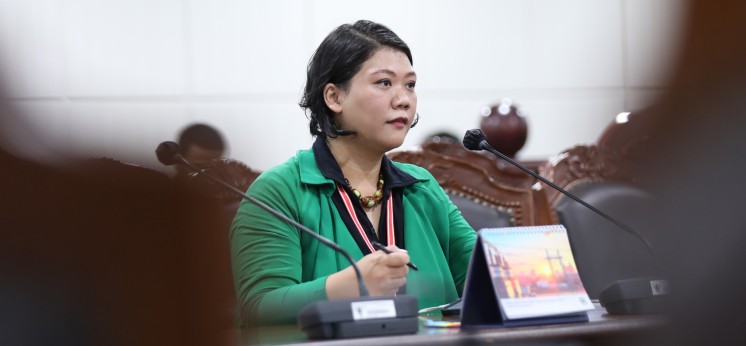
Petitioner Cindy Allyssa delivering the revisions to the petition at a hearing for the judicial review of the Police Law, Tuesday (9/9/2025). Photo by MKRI/Ifa.
JAKARTA (MKRI) — Private employee Cindy Allyssa and advocate Syamsul Jahidin conveyed the revisions to the material judicial review petition of Article 11 paragraph (2) of Law No. 2 of 2002 on the National Police and its elucidation to the Constitutional Court (MK). The Petitioners of case No. 147/PUU-XXIII/2025 argued that the provision on the term of office of the National Police Chief (Kapolri) is unclear, thus requires limitation.
“Term limits constitute a safeguard for the rights of others. Without such a limitation, a chief of police could remain in power for too long, thereby obstructing opportunities for other senior officers to hold the position,” said Cindy at the petition revision hearing on Tuesday, September 9, 2025.
She added that such a limitation is necessary on moral, security, and public order grounds. Concentration of power in the hands of a single individual for an extended period risks fostering a cult of personality and diminishing the professionalism of the police force. Term limits, she argued, are consistent with moral considerations and the principles of good governance. From the perspective of security and public order, rotation in the leadership of the National Police is essential to maintaining public trust and preventing abuse of power.
This position, Cindy added, is also consistent with the established practice of limiting the terms of other high offices such as the president, regional heads, and even the commander of the armed forces, whose tenures are restricted by law. Without similar limits on the chief of police, an imbalance and discrimination among state officials would arise.
“Therefore, imposing a term limit on the chief of police is in fact consistent with Article 28J paragraph (2) as a democratic mechanism,” Cindy concluded.
Also read: Provisions on Appointment, Dismissal of National Police Chief Disputed Again
At the preliminary hearing on Wednesday, August 27, the Petitioners contended that the unclear tenure of the chief of police has led to legal uncertainty, thereby violating Article 28D paragraph (1) and Article 28J of the 1945 Constitution, which guarantees everyone’s right to recognition, guarantees, protection, and fair legal certainty.
Article 11 paragraph (2) of the Police Law reads: “The proposal for the appointment and dismissal of the National Police Chief shall be submitted by the President to the House of Representatives along with its reasons.” Meanwhile, its elucidation reads: “The approval of the House of Representative of the Republic of Indonesia regarding the proposal for the appointment and dismissal of the National Police Chief shall be in accordance with prevailing provisions within the House. The proposal for the dismissal of the National Police Chief shall be submitted by the President along with valid reasons such as the end of the office term of the National Police Chief concerned, based on a request of the person concerned, entry into retirement, permanent incapacity, and a criminal conviction with final and binding legal force. If the House rejects the proposal for dismissal, the President shall withdraw the proposal and may resubmit the request for approval in a subsequent session.”
The Petitioners argued that because the elucidation to the norm formulates substantive norms, it creates legal uncertainty, violating the principles of consistency, harmony, and coherence between the body of the law and its elucidation. Moreover, this drafting practice contravenes the legislative drafting techniques mandated under Law No. 12 of 2011 on Lawmaking and its amendments.
Petitioner I Cindy explained that while the elucidation lists legitimate grounds for dismissal—such as the expiration of the term of office, resignation, entry into retirement age, permanent incapacity, or a criminal conviction—the law itself fails to specify when the term of office of the police chief ends. As a result, one of the main grounds for dismissal becomes inapplicable.
Petitioner II Syamsul Jahidin further stated that the enforcement of Article 11 paragraph (2) and its elucidation has infringed upon the Petitioners’ constitutional rights to guarantees, protection, and legal certainty as enshrined in Article 1 paragraph (3) and Article 28D paragraph (1) of the 1945 Constitution. He argued that the inconsistent and ambiguous formulation of the challenged provision, coupled with its problematic implementation, has caused both actual and potential constitutional harm to the Petitioners.
In their petitums, the Petitioners requested the Court to declare Article 11 paragraph (2) of the Police Law unconstitutional and not legally binding insofar as it is not interpreted as follows: “The proposal for the appointment and dismissal of the Chief of Police shall be submitted by the President to the House of Representatives, accompanied by valid reasons: a. expiration of the Police Chief’s five-year term of office; b. dismissal during the term of office by the President within the relevant period with the approval of the House of Representatives; c. resignation; d. reaching retirement age; e. permanent incapacity; f. a criminal conviction with final and binding legal force.” They also asked the Court to declare the elucidation to Article 11 paragraph (2) unconstitutional and not legally binding.
Author : Mimi Kartika
Editor : Lulu Anjarsari P.
PR : Fauzan Febriyan
Translator : Yuniar Widiastuti (NL)
Disclaimer: The original version of the news is in Indonesian. In case of any differences between the English and the Indonesian versions, the Indonesian version will prevail.
Tuesday, September 09, 2025 | 16:28 WIB 226