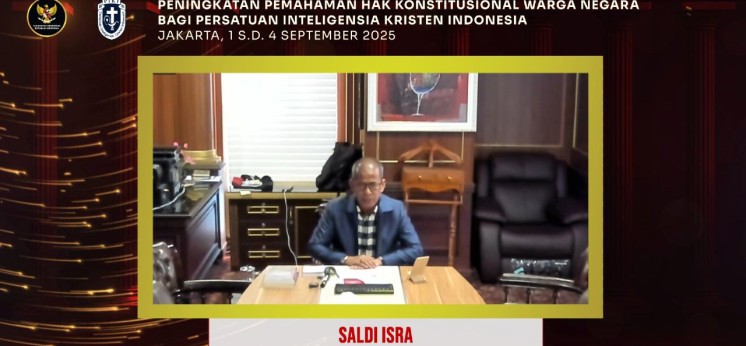
Deputy Chief Justice Saldi Isra delivered his presentation virtually at the event on Enhancing the Understanding of Citizens’ Constitutional Rights for the Indonesian Christian Intellectuals Association (PIKI), Tuesday (09/02/2025). Photo by MKRI.
JAKARTA, (MKRI) – The Constitutional Court (MK) continues to promote public awareness regarding citizens’ constitutional rights. This effort was carried out through the program Enhancing the Understanding of Citizens’ Constitutional Rights for the Indonesian Christian Intellectuals Association (PIKI), held virtually on Tuesday (09/02/2025).
The event featured Deputy Chief Justice Saldi Isra and Constitutional Justice Enny Nurbaningsih as speakers, with participants joining from various regions across Indonesia.
In his presentation, Saldi Isra explained that a constitution is designed to outline the fundamental framework of the state in a minimalist manner. He emphasized five essential elements that should be regulated in a constitution: the main state institutions, the relationship between the central and regional governments, the form of the state, the constitutional rights of citizens, and the relationship between the state and its citizens.
“Our Constitution no longer places the MPR as the highest state institution. All state institutions now hold equal standing, distinguished only by their respective duties and functions as stipulated in the Constitution,” said Saldi.
Saldi also highlighted the distinction between the authorities of the Supreme Court and the Constitutional Court. Both exercise judicial power, but with different competencies. The Constitutional Court is authorized to review laws against the 1945 Constitution, while the Supreme Court reviews regulations below the level of law.
Meanwhile, Constitutional Justice Enny Nurbaningsih delivered a presentation entitled “Guarantees of Citizens’ Constitutional Rights in the 1945 Constitution of the Republic of Indonesia.” She stressed that the Constitution serves not only as the foundation of the state but also as the primary instrument for guaranteeing the protection of human rights (HAM).
“After the Reform era, Indonesia placed itself under the supremacy of the Constitution. Previously, the 1945 Constitution was positioned under the supremacy of the MPR. Reform changed all of that,” Enny explained.
According to her, the amendments to the 1945 Constitution significantly strengthened human rights protections, which were previously very limited. “With these constitutional amendments, human rights provisions became deeply entrenched in the 1945 Constitution itself. This was a major leap in our constitutional history,” she emphasized.
Enny added that the 1999 amendments to the 1945 Constitution introduced 21 norms and 43 principles of human rights, spanning from Article 28A paragraph (1) to Article 28J paragraph (2). These provisions employ various terms such as “every person,” “all citizens,” and “each citizen.”
“As long as one is a human being, rights are recognized and protected by the state. Meanwhile, as an Indonesian citizen, constitutional rights are also guaranteed,” Enny stated.
She underscored that constitutional rights are those rights that are guaranteed, recognized, and regulated within the Constitution. Not all human rights are explicitly set out—some are derived from existing provisions (enumerated rights and implied rights). Human rights beyond the Constitution are accommodated through statutory law as legal rights.
Author : Utami Argawati.
Editor : Lulu Anjarsari P.
Translator: Agusweka Poltak Siregar
Disclaimer: The original version of the news is in Indonesian. In case of any differences between the English and the Indonesian versions, the Indonesian version prevails.
Tuesday, September 02, 2025 | 17:04 WIB 169