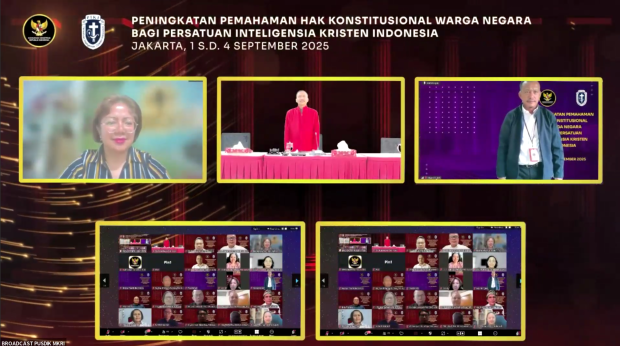
Chief Justice Suhartoyo (center) opening the online constitution awareness program for PIKI leaders and members, alongside the head of the Pancasila and Constitution Education Center Mundiri, Monday (9/1/2025). Photo by MKRI.
JAKARTA, MKRI — The Indonesian Christian Intellectuals Association (PIKI) can serve as an agent in promoting the values of Pancasila more widely within communities and society. This was emphasized by Constitutional Court (MK) Chief Justice Suhartoyo in his keynote address at the opening of the constitution awareness program for PIKI leaders and members on Monday, September 1, 2025 online.
“Through this program, the Indonesian Christian Intellectuals Association can also engage in dialogue and deepen its understanding of matters related to citizens’ constitutional rights. In this way, both PIKI and the Court can develop a shared comprehension, not only of the Court’s duties and functions but also of Pancasila, the Constitution, and constitutional rights in greater depth,” he stated.
Implementing Pancasila
In her opening remarks, PIKI chairperson Badikenita P. Sitepu expressed gratitude for the program, which was a follow-up on the collaboration between the Constitutional Court’s Pancasila and Constitution Education Center (Pusdik) and PIKI. “Through this activity, we hope all PIKI members will benefit, and in the coming years this cooperation will continue to strengthen, with this program becoming a meaningful part of implementing the Pancasila and the 1945 Constitution of the Republic of Indonesia,” Sitepu said. The program was attended by 200 PIKI leaders and members across Indonesia.
Implementing Pancasila Values
In the first session, which focused on the re-actualization of the implementation of Pancasila values, Constitutional Justice Arief Hidayat emphasized the need for all citizens to implement Pancasila in their daily lives. He underlined that Indonesia is a highly diverse nation, making it essential to foster strong civic awareness to prevent potential problems such as authoritarianism, totalitarianism, and political oligarchy.
“One of the key challenges in implementing Pancasila is overcoming social and economic inequalities. Nowadays, the trend of ‘flexing’ reflects a shift that runs counter to the values of Pancasila. In fact, Pancasila contains many values that can be applied to reduce socio-economic disparities, build political ethics, and strengthen social solidarity—issues that have been increasingly relevant in Indonesia in recent times," Justice Arief explained from his chamber.
Judicial Review
During the Q&A session, a participant raised a question regarding joint ministerial decrees (SKB), noting that such regulations often fail to provide equal opportunities for citizens, particularly minority groups.
“If there is dissatisfaction with a policy that has been formalized into legislation, a judicial review may be pursued as a mechanism for checks and balances. In legal theory, lawmakers often face competing interests during the drafting process, which may result in flawed provisions from the outset. Therefore, implementation must be monitored by institutions, including in the case of the SKB,” Justice Arief responded.
The program will run for four days, from Monday to Thursday (September 1–4, 2025), with all participants joining virtually. On the second day, the second session will cover the Constitution and Indonesian constitutionalism, delivered by advisor to constitutional justices Irfan Nur Rachman, followed by the third session on the state administration system under the 1945 Constitution, presented by Deputy Chief Justice Saldi Isra, and the fourth session on guarantees of citizens’ constitutional rights in the 1945 Constitution, delivered by Constitutional Justice Enny Nurbaningsih.
On the third day, the fifth session will present the Constitutional Court and procedural law on judicial review of legislation against the 1945 Constitution, delivered by Chief Justice Suhartoyo. The fourth day will include the sixth session on techniques and practice in drafting judicial review petitions, facilitated by constitutional registrars or advisors to constitutional justices, and the seventh session, where the Court’s IT experts will share insights on the court’s electronic case management system. The program will conclude with a practical evaluation session on drafting judicial review petitions, also guided by constitutional registrars or advisors to constitutional justices.
The Indonesian Christian Intellectuals Association (PIKI) is a faith-based social organization founded on December 19, 1964. Its mission is to study and support the development of Christianity in Indonesia across areas such as institutional growth, economy, infrastructure, security, and welfare of Christian communities. PIKI has also been a pioneering organization behind the establishment of several universities in Indonesia, including Maranatha Christian University in Bandung—founded by PIKI in cooperation with the Synod of the Indonesian Christian Church and the Indonesian Pasundan Church—and Paulus Christian University in Makassar, which was established by PIKI in collaboration with local church synods.
Author : Sri Pujianti
Editor : N. Rosi
Translator : Jessica Rivena Meilania/YW
Disclaimer: The original version of the news is in Indonesian. In case of any differences between the English and the Indonesian versions, the Indonesian version will prevail.
Monday, September 01, 2025 | 17:30 WIB 481