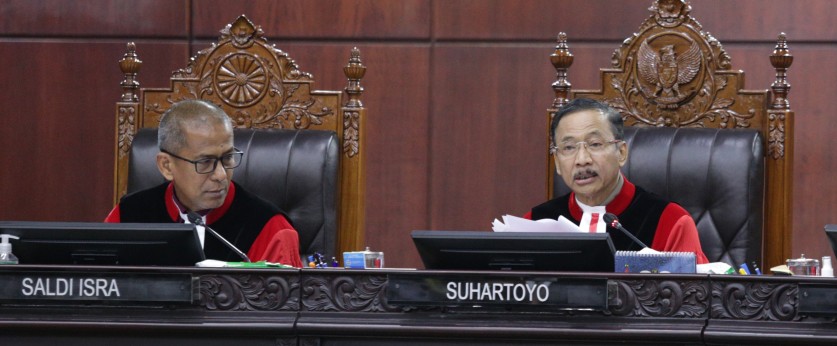
Ruling Hearing for Case Number 125/PUU-XXIII/2025, Thursday (28/8/2025). Public Relations/Bay
JAKARTA (MKRI) - The Constitutional Court (Mahkamah Konstitusi, MK) has declared that it cannot accept a petition for judicial review of Article 18 paragraph (1) of Law Number 31 of 1999 on the Eradication of Criminal Acts of Corruption, as amended by Law Number 20 of 2001. The petition was submitted by Iwan Ratman.
The Court’s ruling, registered as Decision Number 125/PUU-XXIII/2025, was read in a plenary session held on Thursday, August 28, 2025, in the Constitutional Court’s main courtroom.
Chief Justice Suhartoyo, delivering the Court’s legal reasoning, stated that the petition was unclear and internally contradictory. The Petitioner had requested that Article 18 paragraph (1) of the Corruption Law be declared conditionally unconstitutional. However, the proposed conditional interpretations were found to be inconsistent and conflicting.
“This means that the petition requested a conditional interpretation of Article 18 paragraph (1) of the Corruption Law, presenting multiple options without including conjunctions such as ‘or’ between them. This results in ambiguity and conflicting interpretations between the meanings the Petitioner intended to convey,” said Suhartoyo.
Due to these internal inconsistencies, the Court found it impossible to determine the Petitioner’s actual position or interpretation of the constitutional issue being raised regarding the legal norm in question.
“Therefore, the Court cannot understand the Petitioner’s true interpretation of the petition regarding the norms of Article 18 paragraph (1) of the Corruption Law,” Suhartoyo concluded.
As a result, the Court declared the petition inadmissible, not on the merits of the constitutional challenge, but because the Petition failed to meet the clarity and consistency required for judicial review proceedings.
Also read:
Petitioner Challenges Provision on Confiscation of Assets Not Proven Tied to Corruption
Petitioner Revises Petition on Confiscation of Assets Unrelated to Corruption
Previously, in his petition, Iwan considered that the provision of Article 18, paragraph (1) of the Anti-Corruption Law may harm his constitutional rights, especially related to the confiscation of assets that are not proven to be related to corruption. He highlighted that the provision is often implemented against assets that are not tied to crimes, even belonging to third parties who are not involved, such as spouses and children.
“The petitioner carries out the criminal [punishment] based on a legally binding court decision. However, the Petitioner suffers direct constitutional losses due to confiscation of assets that are not proven to be tied to the corruption, including those belonging to third parties who are not involved, and act in good faith,” Iwan stated.
Moreover, Iwan mentioned that Article 18 paragraph (1) of the Anti-Corruption Law opens the opportunity to confiscate assets gained before the occurrence of the crime. It does not provide a clear boundary between the primary and additional crimes. He argued that this may create double punishments: additional punishment by asset recovery and physical punishment, without a clear proportional limitation mechanism.
"This provision does not provide a clear delineation between the principal and additional penalties. As a result, assets are confiscated that are not the proceeds of crime and do not belong to the convict," he stressed.
The petitioner also believes the application of this provision violates the principles of justice, the principle of ultimum remedium, and the principle of proportionality in sentencing. He requested that the Court interpret Article 18 paragraph (1) of the Corruption Law constitutionally so that it is not used as a basis for confiscating assets that have not been proven to originate from a crime and do not belong to the perpetrator.
In his petitum, Iwan requested the Court to declare Article 18 paragraph (1) of the Anti-Corruption Law contrary to the 1945 Constitution of the Republic of Indonesia and to be interpreted so that it applies to third parties’ assets who exhibit good faith or assets that are not proven to originate from the proceeds of corruption.
Additionally, Iwan asked that the provision be declared not to have legally binding force conditionally (conditionally unconstitutional), unless it is interpreted that confiscation may be carried out of assets that are legally and convincingly proven to have originated from corruption. Moreover, additional punishment in the form of replacement money cannot be imposed together with physical punishment unless it is proven that the perpetrator concealed or disguised the proceeds of crime.
Author: Utami Argawati
Editor: N Rosi.
PR: Fauzan F.
Translator: SO
Read more:
Decision No. 125/PUU-XXIII/2025 in Indonesian
Disclaimer: The original version of the news is in Indonesian. In case of any differences between the English and the Indonesian versions, the Indonesian version will prevail.
Thursday, August 28, 2025 | 15:02 WIB 99