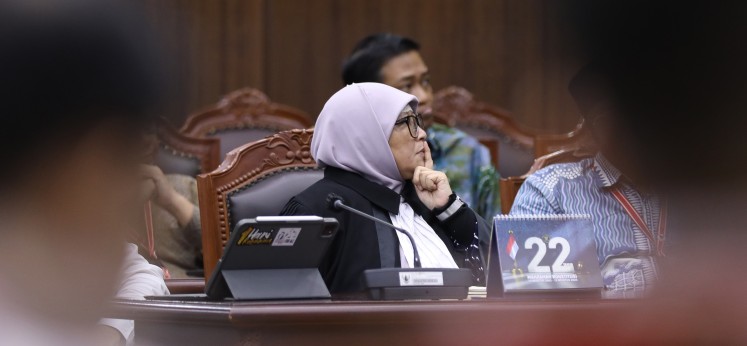
The Petitioners’ legal counsel at the ruling hearing for the material judicial review of the Zakat Management Law, Thursday (8/28/2025). Photo by MKRI/Bayu.
JAKARTA (MKRI) — The Constitutional Court (MK) urged the legislature to revise Law No. 23 of 2011 on Zakat Management within two years since the pronouncement of Decision No. 97/PUU-XXII/2024 on Thursday, August 28, 2025. This measure is intended to strengthen zakat management by ensuring fair legal protection and certainty for all parties, in accordance with the Constitutional Court’s ruling.
“Moreover, the planned amendment to Law No. 23 of 2011 has already been included in the National Legislation Program for 2025–2029 as item number 18,” said Constitutional Justice Enny Nurbaningsih as she delivered the Court’s legal considerations during the pronouncement of the ruling in Case No. 97/PUU-XXII/2024 in the plenary courtroom.
The proposed amendment is to be carried out by, among other things: distinguishing the authority, duties, and functions of regulation, guidance, and supervision (by the government) from those of implementation and operation (by the National Zakat Board or BAZNAS and zakat management institutions or LAZs); granting zakat contributors (muzaki) the freedom to choose the institution they trust to channel their zakat; ensuring equal opportunities for all zakat management operators to develop fairly and optimally without subordination between institutions; requiring zakat management to embody the principles of good zakat governance; and guaranteeing meaningful participation of stakeholders, including zakat management organizations that have been factually engaged in zakat administration, throughout the legislative amendment process.
Nevertheless, the Court found the Petitioners’ arguments to be entirely without legal merit. In its verdict, the Court dismissed the petition in Case No. 97/PUU-XXII/2024 in its entirety.
Constitutional Justice Arsul Sani elaborated that the Petitioners’ challenge essentially revolved around the constitutionality of BAZNAS’s authority and functions under Law No. 23 of 2011. They argued that BAZNAS operates as a “superbody,” simultaneously acting as regulator, operator, controller, and auditor, thereby creating inequality, hindering the Applicants’ institutional growth, and generating conflicts of interest with a tendency toward abuse of power. They contended that BAZNAS should only serve as an implementing body in zakat management, while authority over planning, control, reporting, and accountability should rest with the Ministry of Religious Affairs.
He further explained that the Court has affirmed the existence of LAZs, which were established by the community—some even prior to BAZNAS’s establishment—to work in synergy with one another to achieve the objectives of zakat management, including improving public welfare and alleviating poverty. This reflects the principle of utility in zakat management, underscoring that zakat must be managed to maximize benefits for the mustahik (beneficiaries).
With respect to the principle of integration, Justice Arsul emphasized that it cannot be narrowly interpreted as centralization solely under BAZNAS to the exclusion of community rights. Rather, zakat management must aim to enhance the collection, distribution, and utilization of zakat in a responsible and accountable manner, in line with its purpose of promoting social welfare and poverty alleviation. Integration must also be understood as strengthening networks to foster positive collaboration among LAZs, thereby advancing the broader objective of zakat management as part of the strategy to realize the common good (maslahah) for humanity.
Accordingly, there must be no room for the misuse of zakat beyond its intended objectives, including for partisan political purposes or other narrow interests incompatible with the principles of the Unitary State of the Republic of Indonesia, founded upon Pancasila and the 1945 Constitution. Any such misuse, if allowed to persist, whether consciously or unconsciously, would undermine the sense of justice among beneficiaries and obstruct the state’s objective of promoting social welfare and alleviating poverty.
Also read:
Dompet Dhuafa, Jakarta Zakat Forum Challenge Zakat Management Law
Dompet Dhuafa and Forum Zakat Revise Petition on Zakat Management Law Review
Govt: BAZNAS and LAZ Complement the Zakat Management System
LAZISNU Argues the Enactment of Zakat Management Law Improves Public Trust
IDEAS: Zakat Management Law Causes Harms to Mustahik and Muzaki
Constitutional Law Expert: Zakat Management a Communal Right of the Muslim Community
Petitioners’ Expert: State Should Not Intervene in Zakat Governance
President’s Expert: BAZNAZ Must Improve LAZs’ Performance
The Petitioners are Dompet Dhuafa Republika Foundation, the Jakarta Zakat Forum Association, and Arif Rahmadi Haryono. All three of them actively engage in zakat management. For this case, they are represented by legal counsels Bambang Widjojanto and Denny Indrayana.
As zakat contributors (muzaki), the Petitioners claimed to have suffered harm due to the provisions on zakat management under several articles of Law No. 23 of 2011. Community-based LAZs have long been engaging in public education, campaigns, and awareness-raising concerning zakat, infaq, and sadaqah (ZIS).
LAZs, which have existed for a long time, hoped that BAZNAS and LAZs would have equal roles and duties. They cited the regulation regarding state and private banks, which are equal, as well as the role of the Bank of Indonesia, which is responsible for monetary policy, regulating and supervising the financial system, and maintaining the stability of the rupiah.
The Petitioners argued that Article 5 paragraph (1) implicitly and explicitly shows that the main purpose of the establishment of BAZNAS is to take over the collection of zakat from the community to the State and negate the history of community management of zakat. In fact, when BAZNAS was newly established, to foster BAZNAS, BAZNAS and Dompet Dhuafa Republika Foundation cooperated in the management of zakat in a program known as BAZNAS Dompet Dhuafa, given that BAZNAS had no prior experience in managing zakat.
The Petitioners contended that the provision has denied this history. For example, it excluded the zakat management institutions that have existed before BAZNAS from the drafting of regulations on zakat management. The Law also does not facilitate community-based zakat management organizations.
In the petitums, the Petitioners pleaded with the Court to declare Article 38 and Article 43 paragraph (4) unconstitutional and not legally binding. They also asked the Court to reinterpret Article 5 paragraph (1), Article 6 paragraph (1), Article 7 paragraph (1), Article 16 paragraph (1), Article 17, Article 18 paragraph (2), Article 19, Article 20, Article 41, and Article 43 paragraph (3) as per their request.
Author : Mimi Kartika
Editor : N. Rosi
Translator : Yuniar Widiastuti (NL)
Disclaimer: The original version of the news is in Indonesian. In case of any differences between the English and the Indonesian versions, the Indonesian version will prevail.
Thursday, August 28, 2025 | 21:04 WIB 313