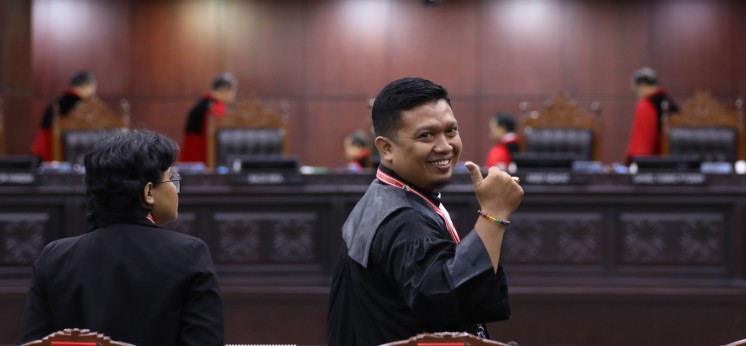
The ruling hearing for Decision No. 128/PUU-XXIII/2025 on the material judicial review of the State Ministry Law, Thursday (8/28/2025). Photo by MKRI.
JAKARTA (MKRI) — The Constitutional Court (MK) ruled that the prohibition against holding concurrent positions, as stipulated in Article 23 of Law No. 39 of 2008 on State Ministries, also applies to deputy ministers. The Decision No. 128/PUU-XXIII/2025 was delivered at an open plenary hearing on Thursday, August 28, 2025
This case was brought by Viktor Santoso Tandiasa and Didi Supandi, who requested that prohibition against dual mandate imposed on ministers also be imposed on deputy ministers. The Petitioners submitted the petition because they believe the Government has disobeyed the Constitutional Court’s previous decisions and appointed deputy ministers as commissioners in State-Owned Enterprises (BUMN).
“[Verdict: The Court] has adjudicated, to grant the petitum of Petitioner I in part,” said Chief Justice Suhartoyo delivering the verdict.
In its verdict, the Court ruled to:
- To grant the petitums of Petitioner I in part
- To declare Article 23 of Law No. 39 of 2008 on State Ministries (State Gazette of the Republic of Indonesia of 2008 No. 166, Supplement to the State Gazette of the Republic of Indonesia No. 4916) inconsistent with the 1945 Constitution of the Republic of Indonesia and conditionally unconstitutional insofar as it is not interpreted to mean: “Ministers and Deputy Ministers shall be prohibited from concurrently holding positions as:
- Other state officials in accordance with statutory regulations;
- Commissioners or directors in state-owned enterprises or private corporations; or
- Leaders of organizations funded by the State Budget and/or Regional Budgets”
3. To order that this ruling be published in the State Gazette of the Republic of Indonesia
4. To declare the petitums of Petitioner II inadmissible
5. To dismiss the petition in all other respects
In its legal considerations, delivered by Constitutional Justice Enny Nurbaningsih, the Court emphasized that Constitutional Court Decision No. 80/PUU-XVII/2019 had already made it clear that all prohibitions on holding concurrent positions applicable to ministers also apply to deputy ministers. Such legal reasoning is binding because it forms part of the Court’s ruling, which is final and inseparable from the verdict.
“The Court holds that the legal considerations in Constitutional Court Decision No. 80/PUU-XVII/2019 have clearly and unequivocally affirmed that all prohibitions against holding concurrent positions applicable to ministers under Article 23 of Law No. 39 of 2008 also apply to deputy ministers. Legally, such reasoning carries binding authority as part of a Constitutional Court ruling, which is constitutionally final. A Constitutional Court ruling is not limited to its verdict but also includes the ruling’s identity, the statement of facts, the legal considerations, and the verdict itself—even the minutes of the hearing—all of which form an inseparable whole. This includes Constitutional Court Decision No. 80/PUU-XVII/2019, which declared ‘the petition of the Petitioners inadmissible,’ but whose legal considerations, as ratio decidendi, contained a judicial order placing the position of deputy minister on equal footing with that of minister as a state official,” Justice Enny explained.
Justice Enny further noted that such legal considerations should have been implemented since the pronouncement of Decision No. 80/PUU-XVII/2019. The prohibition on deputy ministers holding concurrent positions is based on the consideration that, as state officials, deputy ministers must concentrate on the heavy workload requiring special attention within the ministry. This same reasoning justifies the appointment of deputy ministers in certain ministries, thereby precluding them from holding concurrent positions under Article 23 of Law No. 39 of 2008. At the same time, the shared status of ministers and deputy ministers as state officials does not risk creating dual leadership within ministries. Consequently, as the Court had reasoned in Decision No. 80/PUU-XVII/2019, deputy ministers, as state officials, are entitled to facilities proportionate to their office.
The prohibition on deputy ministers serving as SOE commissioners, as argued by the Petitioners, is consistent with Article 33 letter b of Law No. 19 of 2003 on State-Owned Enterprises (BUMN Law). Although Article 33 of Law No. 19 of 2003 was repealed by Law No. 1 of 2025 on the Third Amendment to Law No. 19 of 2003 on State-Owned Enterprises, the substance was retained—prohibiting commissioners from concurrently holding “other positions as stipulated by statutory regulations.”
Within reasonable interpretation, one such statutory regulation is Law No. 39 of 2008. Accordingly, the Court found it necessary to reaffirm in the present ruling the prohibition on deputy ministers holding concurrent positions, including as commissioners, in order to ensure they focus on ministerial duties. Similarly, the role of commissioner also requires sufficient time commitment, as confirmed by the Regulation of the Minister of State-Owned Enterprises of the Republic of Indonesia No. PER-3/MBU/03/2023, which requires members of BUMN boards of commissioners or supervisory boards to “be able to devote sufficient time to carrying out their duties.” The prohibition also aligns with the principles of clean governance, freedom from conflicts of interest, and the implementation of sound public administration.
Also read:
Double Position Prohibition of Deputy Ministers in SOEs Emphasized
Ride-Hailing Driver Joins in Petition on Deputy Ministers’ Concurrent Positions
Grace Period
In light of the foregoing, to prevent any legal vacuum or uncertainty in the implementation of Article 23 of Law No. 39 of 2008 as reinterpreted by the Court—specifically regarding the term “deputy minister”—the Court deemed it necessary to provide a grace period for the Government to adjust the relevant provisions.
The Court thus considered it appropriate to grant a maximum adjustment period of two years from the pronouncement of this ruling. This ensures adequate time for the Government to replace those concurrently holding positions with individuals possessing the necessary expertise and professionalism to manage state enterprises in accordance with statutory regulations.
Based on these considerations, the Petitioners’ arguments were deemed legally valid in part. The Court found that Article 23 of Law No. 39 of 2008 is conditionally inconsistent with the rule of law and with the principle that every person is entitled to recognition, guarantees, protection, and fair legal certainty, as well as equal treatment before the law, as provided in Article 1 paragraph (3) and Article 28D paragraph (1) of the 1945 Constitution. However, since Petitioner II lacked legal standing to bring the petition, the Court granted the petition only in part.
Author : Utami Argawati
Editor : Nur R.
PR : Andhini S.F.
Translator : Yuniar Widiastuti (NL)
Disclaimer: The original version of the news is in Indonesian. In case of any differences between the English and the Indonesian versions, the Indonesian version will prevail.
Thursday, August 28, 2025 | 18:10 WIB 3054