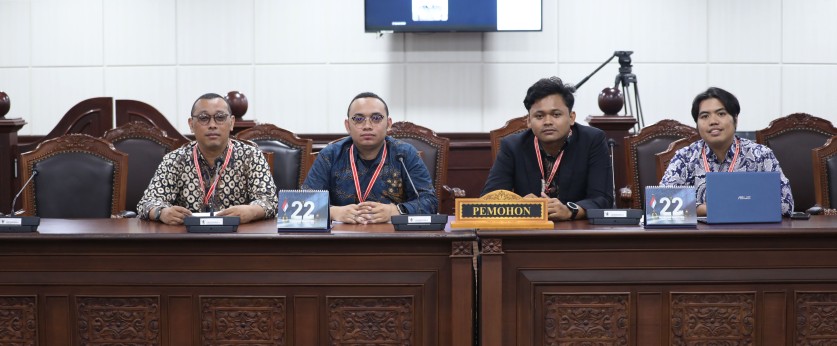
Muhammad Rezfah Omar, Muhammad Ainul Yaqin, Ahmad Azhar Ramadhan, and Galang Bagus Dwi Yuniarto, four private sector employees, presenting their petition on State Treasury Law, on Wednesday (8/27/2025). Photo by MKRI/Panji.
Jakarta (MKRI) – Four private sector employees have filed a petition to challenge Article 50 of Law No. 1 of 2004 on the State Treasury (State Treasury Law) against the 1945 Constitution of the Republic of Indonesia (UUD NRI) to the Court (MK). They are Muhammad Rezfah Omar, Muhammad Ainul Yaqin, Ahmad Azhar Ramadhan, and Galang Bagus Dwi Yuniarto.
The Petitioners questioned the clarity of who constituted the third party controlling or storing state assets as referred to in Article 50. They felt there was a misunderstanding and potential harm if the state assets that had been combined by a third party were referred to as State-Owned Enterprises (BUMN) and/or Regional-Owned Enterprises (BUMD), as referred to in Article 50 of the State Treasury Law.
"The State Treasury Law does not define who is meant by a third party," said Muhammad Ainul Yaqin in the preliminary hearing for Case No. 144/PUU-XXIII/2025 on Wednesday, August 27, 2025 in the Courtroom, Jakarta.
Article 50 of the State Treasury Law states, "Any party is prohibited from confiscating: a. money or securities belonging to the state/region, whether held by government agencies or third parties; b. money that must be deposited by third parties to the state/region; c. movable property belonging to the state/region, whether held by government agencies or third parties; d. immovable property and other property rights belonging to the state/region; e. property belonging to third parties controlled by the state/region that is required for the implementation of government duties."
In the Indonesian civil law system, asset seizure is a legal mechanism used to guarantee creditors' rights against defaulting debtors. If Article 50 of the State Treasury Law refers to a state-owned enterprise (BUMN) and/or regionally-owned enterprise (BUMD) that is in arrears and has not demonstrated good faith in fulfilling its obligations, asset seizure should remain a legal option available to the injured party. From the perspective of justice and legal certainty, exemptions from asset seizure for third parties could create moral hazard, where these entities could easily avoid financial obligations without clear consequences.
According to the Petitioners, this clearly contradicts the principle of balance, which requires each party to the agreement to bear risks proportionately. Therefore, regulations protecting third parties from asset seizure must be strictly interpreted and should not be used as a shield to avoid commercial obligations. If a third party operating as a business entity fails to fulfill its obligations, it should be subject to fair legal rules, including the possibility of asset seizure as a form of protection for creditors' rights.
The Petitioners argue that if the third parties in question are state-owned enterprises (BUMN) and/or regionally-owned enterprises (BUMD) that are given excessive protection, preventing their assets from being seized despite clear breaches of contract, this will create legal inequality that violates the principle of justice and undermines the rule of law. Excessive protection of state entities can create a moral hazard, where third parties feel they have no real consequences for violating their contractual obligations.
Therefore, in order to uphold the principle of equality before the law as mandated by the 1945 Constitution, third parties referred to in Article 50 of the State Treasury Law operating as business entities and defaulting must still be subject to asset seizure mechanisms, like other legal entities. If this principle is ignored, trust in the legal system will be weakened, which could ultimately negatively impact the business world and investment climate in Indonesia.
Thus, in their petitum, the Petitioners request the Court to declare Article 50 of the State Treasury Law to be in conflict with the 1945 Constitution of the Republic of Indonesia and to have no conditionally binding legal force (conditionally unconstitutional), namely insofar as the phrase "third party" therein is interpreted to include State-Owned Enterprises (BUMN) and/or Regional-Owned Enterprises (BUMD) in the context of disputes arising from civil legal relations of a commercial nature.
The case was heard by a panel of justices chaired by Constitutional Justice Arief Hidayat, and by Constitutional Justices Anwar Usman and Enny Nurbaningsih. Justice Enny stated that each petitioner must outline their qualifications, which will then be linked to an explanation of whether they meet the requirements for constitutional impairment due to the validity of the challenged article.
"This must be explained one by one. Only then can you show what rights the constitution grants," said Justice Enny.
Before closing the hearing, Justice Arief stated that the Petitioners have 14 days to revise their petition. The revised petition must be received by the Court no later than Tuesday, September 9, 2025, at 12:00 WIB.
Author : Mimi Kartika.
Editor : N Rosi.
Translator : Donny Yuniarto
Disclaimer: The original version of the news is in Indonesian. In case of any differences between the English and the Indonesian versions, the Indonesian version will prevail.
Wednesday, August 27, 2025 | 18:17 WIB 205