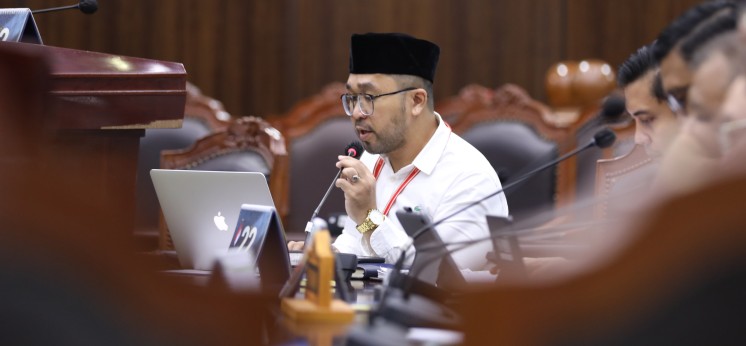
Petitioner Stepanus Fenyan Bararo reading out the main points of the petition at the preliminary hearing of the judicial review of Law No. 15 of 1997 on Transmigration, Wednesday (8/27/2025). Photo by MKRI/Ifa.
JAKARTA (MKRI) — The Constitutional Court (MK) held a preliminary hearing of case No. 148/PUU-XXIII/2025 on the judicial review of Law No. 15 of 1997 on Transmigration against the 1945 Constitution. The hearing took place in the Constitutional Court courtroom on Wednesday, August 27, 2025.
Petitioner Stepanus Fenyan Bararo argued that Article 24 paragraph (3) of the Transmigration Law, which stipulates that land allocated to transmigrants is granted under ownership rights, has frequently triggered disputes with local communities. He cited, among others, the Rempang Eco City project in Riau Islands and an agrarian conflict in Konawe Selatan Regency, Southeast Sulawesi, both of which sparked land disputes between transmigrants and local residents.
“The granting of ownership rights to transmigrants often causes unrest with local communities. For instance, the National Strategic Project Rempang Eco City, by virtue of Article 24 paragraph (3) of Law No. 15 of 1997 on Transmigration, stating that ‘land designated for transmigrants is granted under ownership rights’, has given rise to overlapping claims with forest areas. This provision, when implemented, leads to uncertainty and recurrent agrarian disputes, as seen in the conflicts involving transmigrants in Konawe Selatan, Southeast Sulawesi,” he explained.
He further asserted that Article 24 paragraph (3) benefits transmigrants exclusively, while denying similar recognition to indigenous/local communities who have long inhabited and cultivated the land. Such a policy, he argued, risks creating structural inequality and discriminatory treatment toward local residents, as they do not automatically acquire ownership rights over ancestral lands. This situation, in turn, may ignite horizontal conflicts between transmigrants and indigenous/local communities.
In addition, the Petitioner highlighted Article 16 of the Transmigration Law, which he deemed problematic as it does not impose obligations on transmigrants to uphold public order, tolerance, and harmony with local communities. This, he contended, amplifies the risk of social frictions, as seen in the Sampit conflict of 2001 and the recent rejection of a church construction in Kubu Raya, West Kalimantan, in July 2025.
Stepanus argued that the absence of such normative obligations contravenes Article 28D paragraph (1), Article 28H paragraph (1), and Article 28I paragraph (3) of the 1945 Constitution, which guarantee legal certainty, the right to a healthy environment, and the protection of indigenous peoples. Therefore, he petitioned the Court to declare Article 24 paragraph (3) and Article 16 of the Transmigration Law unconstitutional and not legally binding.
Updated Court Regulation
Responding to the petition, Constitutional Justice Daniel Yusmic P. Foekh advised the Petitioner to structure the petition in line with Constitutional Court Regulation (PMK) No. 7 of 2025 on Procedures for Judicial Review. “This is the new PMK, so please use it as a reference,” Foekh remarked. He further suggested that the Petitioner elaborate more on the alleged constitutional impairment, whether it is specific, actual, or potential.
At the close of the hearing, the panel of justices granted the Petitioner 14 days to revise the petition. The revision must be submitted to the Court no later than September 9, 2025.
Author: Utami Argawati
Editor: Nur R.
PR: Andhini SF.
Translator: Yuanna Sisilia
Disclaimer: The original version of the news is in Indonesian. In case of any differences between the English and the Indonesian versions, the Indonesian version will prevail.
Wednesday, August 27, 2025 | 17:56 WIB 228