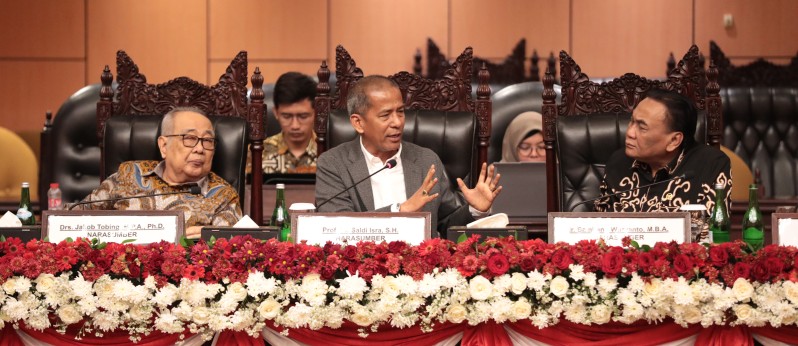
Deputy Chief Justice of the Constitutional Court Saldi Isra was a keynote speaker at the Constitutional Seminar “Dialectics of the Constitution: A Reflection on the 1945 Constitution of the Republic of Indonesia,” Thursday (08/21/2025), held at the Nusantara V Building, MPR/DPR/DPD Complex. Photo by MKRI/IlhamWM.
JAKARTA, (MKRI) — Deputy Chief Justice of the Constitutional Court of the Republic of Indonesia (MKRI), Saldi Isra, emphasized that constitutional amendments are not the only way to address issues arising from gaps within the 1945 Constitution (UUD 1945). According to him, Indonesia can develop a positive tradition through constitutional conventions to fill legal vacuums or provide interpretations of existing constitutional norms.
“Usually, a positive tradition is established, which is known as constitutional conventions,” Saldi explained during the Constitutional Seminar titled Dialectics of the Constitution: A Reflection on the 1945 Constitution of the Republic of Indonesia Ahead of 25 Years of Constitutional Reform, hosted by the People’s Consultative Assembly (MPR) on Thursday (08/21/2025) at the Nusantara V Building, Parliament Complex, Central Jakarta.
Saldi pointed out that no matter how comprehensive a constitution is drafted, it cannot fully anticipate the development of Indonesia’s constitutional system. If the Constitution were amended repeatedly, he said, it would lose its distinction from ordinary legislation.
As an alternative, Saldi suggested that constitutional conventions could take the form of regular meetings among state branches or institutions. Such meetings may not be explicitly stipulated in the Constitution, but if established and sustained, they could serve to close gaps in the constitutional framework.
In addition, Saldi noted another alternative to amendments—judicial interpretation. The Constitutional Court, he explained, does not only declare laws constitutional or unconstitutional but also actively provides normative interpretations as a way to adapt to evolving constitutional practices. If the Court were to merely strike down unconstitutional provisions, it could create legal vacuums that lead to new problems. Instead, the Court offers constitutional interpretations so that laws remain valid, provided those interpretations are observed.
Thus, constitutional gaps that do not reflect the full aspirations of all stakeholders may be complemented by subordinate regulations. Laws inconsistent with the Constitution can be reviewed by the Constitutional Court, while regulations inconsistent with laws may be reviewed by the Supreme Court.
“If there are weaknesses in the Constitution—and surely there are—we must start building traditions to address them without immediately thinking about amendments,” Saldi stated.
He further encouraged citizens to develop a comprehensive understanding of the Constitution, from the original 1945 text to the four amendment stages: the First Amendment (1999), the Second Amendment (2000), the Third Amendment (2001), and the Fourth Amendment (2002). He stressed that constitutional literacy requires studying these stages in sequence, not merely relying on the consolidated text of the amended Constitution.
“It is wrong to assume that the 1945 Constitution is just the result of amendments in a single document,” Saldi explained.
Meanwhile, constitutional law scholar Jimly Asshiddiqie highlighted the need for a comprehensive evaluation of the results of constitutional reform, covering both the substance of the Constitution and its derivative laws, as well as their implementation in governance since 1999–2002. With current global shifts in economics, politics, society, and culture, he argued, Indonesia requires a serious plan for sustainable transformation—beginning with a potential Fifth Amendment to the Constitution.
However, Jimly cautioned against overly broad or drastic changes. Amendments, he suggested, could be limited but still meaningful, for example, by reintroducing the Broad Outlines of State Policy (GBHN) or National Policy Guidelines (PPHN), as discussed in previous MPR sessions. He also identified several strategic issues warranting constitutional reform, such as restructuring the MPR, DPR, and DPD; reviewing presidential and regional election systems; strengthening leadership free from pragmatic political bargaining; restructuring the Judicial Commission and forming a National Ethics Court; reforming the judiciary and strengthening oversight; as well as reinforcing the Pancasila economic ideology and securing national airspace. He noted, however, that such initiatives ultimately depend on minimum consensus among political parties in the MPR.
On the same occasion, MPR Chair Ahmad Muzani reaffirmed that the MPR holds the constitutional authority to amend the 1945 Constitution. Therefore, the MPR must continuously listen, reflect, and carefully deliberate whether constitutional amendments are indeed necessary.
“Many academics, public figures, and other groups have voiced calls for constitutional reform. These perspectives must be heard. This Constitutional Seminar is part of our efforts to listen and understand what the people truly expect,” Muzani said when opening the seminar, which was part of the Constitution Day commemoration held annually on August 18.
The seminar was also attended by MPR Deputy Speaker Bambang Wuryanto, who also spoke at the event, as well as Rusdi Kirana and Hidayat Nur Wahid. Other speakers included constitutional scholar Jimly Asshiddiqie, Deputy Chief Justice of the Constitutional Court Saldi Isra, and Jacob Tobing, former Chair of the MPR’s Working Committee I. The event was also attended by parliamentary leaders, members of the DPD, budget and constitutional committees, as well as lecturers and students from various universities. (*)
Author : Mimi Kartika.
Editor : Lulu Anjarsari P.
Translator : Agusweka Poltak Siregar.
Disclaimer: The original version of the news is in Indonesian. In case of any differences between the English and the Indonesian versions, the Indonesian version prevails.
Thursday, August 21, 2025 | 15:21 WIB 1019