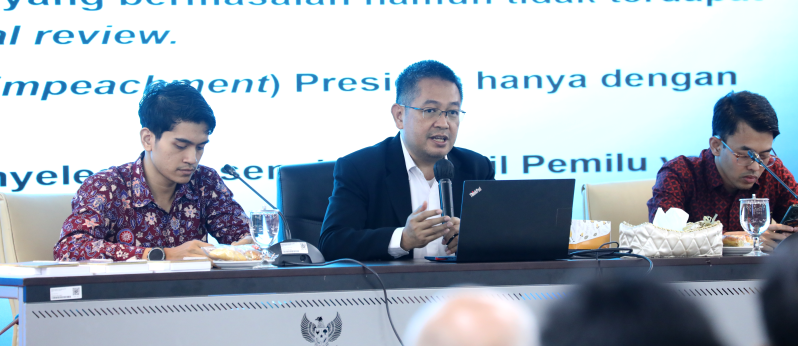
The Faculty of Law and Social Sciences (FHIS) of UMKO students visiting Court, welcomed by Court Legal Analyst Rio Tri Juli Putranto (center). Photo by MKRI/Fauzan.
JAKARTA (MKRI) — Ninety-five students from the Faculty of Law and Social Sciences (FHIS) at Muhammadiyah University of Kotabumi (UMKO) conducted an academic visit to the Constitutional Court (MK) on Thursday, August 21, 2025. The group consisted of students from the Law and Communication Studies Programs, accompanied by their lecturer, Ibrahim Fikma Edrisy.
"This visit provides an opportunity for students to better understand the role and authority of the Court. In the future, we hope to receive more information directly from the Court," said Ibrahim.
The group was received by Court Legal Analyst Rio Tri Juli Putranto. In his presentation, Rio explained the history of the Court's formation and the institution's role in upholding the constitution.
According to Rio, before the Court was established, many laws were problematic because there was no institution authorized to test their constitutionality. He cited the establishment of the Court as an example of the need for a forum for resolving election disputes and a presidential impeachment mechanism, as was the case during the reign of President Abdurrahman Wahid (Gus Dur). "Since then, the Court has been present as the guardian of the constitution and the constitutional rights of citizens," Rio explained.
Rio explained that the Court's existence is regulated in Article 24C of the 1945 Constitution and is strengthened by the Law on Judicial Power and the Constitutional Court Law. The Court has several primary powers, including reviewing laws against the 1945 Constitution, resolving disputes over authority between state institutions, ruling on the dissolution of political parties, and handling disputes over election results. Furthermore, the Court also has the authority to decide on the House of Representatives' opinion regarding alleged violations committed by the President and/or Vice President.
Rio added that parties eligible to file a petition to the Court include Indonesian citizens, indigenous communities, private legal entities, and state institutions. The petition must contain the petitioner's identity, a description of the basis for the petition, including the Court's authority, the petitioner's legal standing, and the reasons for the petition. "Currently, quite a number of students are actively filing judicial reviews of laws, and most of their petitions are granted, particularly regarding election laws," he said.
During a discussion session, a student asked about the differences in authority between the Constitutional Court (MK) and the Supreme Court (MA). Rio explained that the MA's authority is limited to reviewing laws and regulations under the law, such as Government Regulations (PP), Presidential Regulations (Perpres), and Governor's Regulations, based on the law. Meanwhile, in the MK, laws are reviewed based on the 1945 Constitution of the Republic of Indonesia (UUD 1945). Thus, it is clear that the Constitutional Court has higher authority because it acts as the final interpreter of the constitution.
At the end of the visit, participants were invited to the Constitutional History Center located on the 5th and 6th floors of Building I of the Court, and had the opportunity to watch the hearing live from the courtroom.(*)
Author : Utami Argawati
Editor : Lulu Anjarsari P.
Translator : Donny Yuniarto
Disclaimer: The original version of the news is in Indonesian. In case of any differences between the English and the Indonesian versions, the Indonesian version will prevail.
Thursday, August 21, 2025 | 15:20 WIB 89