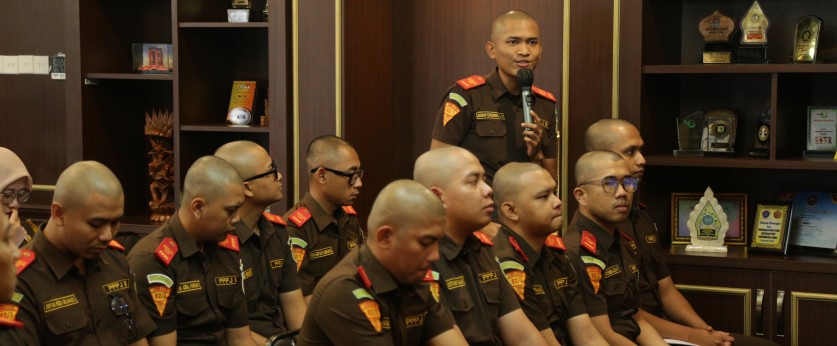
Prosecutor Candidates of the 82nd Batch, Class III, First Cohort of the Prosecutor Formation Training Program visited the Constitutional Court, Wednesday (08/20/2025).
JAKARTA, (MKRI) - Candidates of the 2025 Prosecutor Formation Training Program (PPPJ), 82nd Batch, Class III, First Cohort, visited the Constitutional Court (the Court) on Wednesday (08/20/2025). They were welcomed by Pan Mohamad Faiz, Head of the Court’s Bureau of Public Relations and Protocol, who guided them around the Court building, including the panel and plenary courtrooms.
The prosecutor candidates then held a discussion with Aditya Yuniarti, Junior Legal Analyst at the Court, regarding the role and functions of the Constitutional Court. Aditya began his presentation by explaining that the establishment of the Court was prompted by numerous problematic laws, while no mechanism for constitutional review previously existed.
“The Supreme Court may review regulations below the level of law, whereas laws passed by the government and the House of Representatives are often problematic and may threaten citizens’ constitutional rights. Therefore, such laws must also be subject to review against the Constitution (UUD 1945),” explained Aditya in the Delegation Room, 4th Floor, Building I of the Court, Central Jakarta.
Aditya further noted that the establishment of the Court was also driven by instances of presidential impeachment based solely on political grounds, as well as the dissolution of political parties by the Supreme Court through unclear procedures. Since the Court’s establishment, however, neither presidential impeachment nor party dissolution has ever been carried out.
Additionally, the Court was formed because conflicts among state institutions or government bodies had often been resolved merely under the President’s authority, with no clear forum for resolving disputes over election results.
Today, the Court has five authorities as stipulated in the 1945 Constitution: reviewing laws against the Constitution, resolving disputes between state institutions, deciding on the dissolution of political parties, resolving disputes over election results, and adjudicating the House of Representatives’ opinion regarding alleged constitutional violations by the president or vice president. In its development, the Court has also gained the authority to review government regulations in lieu of law (perppu), given that perppu establish new legal norms with the same binding force as law.
Aditya emphasized that Constitutional Court decisions are legally binding immediately upon their pronouncement in open plenary session. There are at least four possible rulings: the petition is declared inadmissible (Niet Onvankelijk Verklaard/NO), the petition is granted in whole or in part, the petition is rejected, or the petition is conditionally granted, including the possibility of delaying the effect of the ruling.
After the discussion, the prosecutor candidates were invited to visit the Constitutional History Center (Puskon) on the 4th and 6th Floors of Building I. The Puskon serves as a documentation and learning center on the historical development of Indonesia’s constitution. (*)
Author : Mimi Kartika.
Editor : Lulu Anjarsari P.
Translator : Agusweka Poltak Siregar.
Disclaimer: The original version of the news is in Indonesian. In case of any differences between the English and the Indonesian versions, the Indonesian version prevails.
Wednesday, August 20, 2025 | 13:39 WIB 323