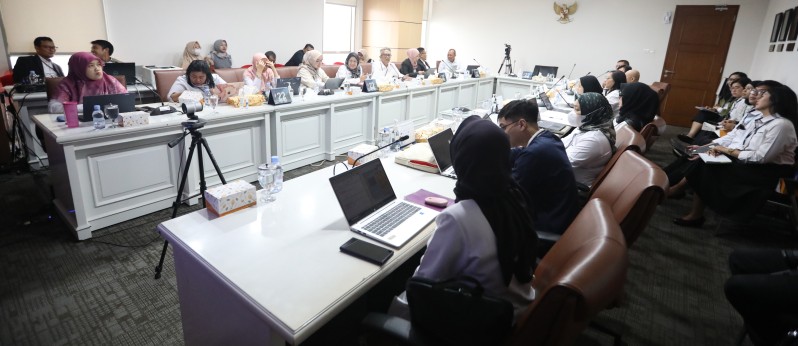
Several Corruption Eradication Commission (KPK) employees conducting a comparative study of the development of Integrity Zones, Corruption-Free Areas, and Clean and Serving Bureaucratic Areas on Wednesday (8/20/2025). Photo by MKRI/IlhamWM.
JAKARTA (MKRI) — The Constitutional Court (MK) is one of the institutions that has successfully implemented best practices in developing an Integrity Zone (ZI) towards a Corruption-Free Area (WBK) within its work units. This serves as a model for other institutions to follow suit. To support the implementation of Bureaucratic Reform and the development of ZI towards WBK within the Corruption Eradication Commission (KPK), 15 KPK employees conducted a comparative study at the Constitutional Court (MK) on Wednesday, August 20, 2025.
In his presentation, Constitutional Court Inspector Sigit Purnomo outlined several achievements the Constitutional Court has achieved in developing the ZI (Integrated Service Zone), WBK (Wide-Body-Centered Area), and Clean and Serving Bureaucracy (WBBM). For example, the ZI WBK achievement timeline includes the Center for Pancasila and Constitutional Education in 2020, the Center for Information and Technology (IT) in 2021, the Bureau of Legal Administration and the Registrar's Office in 2022, the Center for Case Study and Library in 2023, and the Center for Information and Technology in 2024.
"In 2025, the Court proposed two units for the WBK proposal, namely the Public Relations and Protocol Bureau and the Planning and Finance Bureau. As for the ZI development strategy, the Court has implemented several steps and efforts, namely establishing bureaucratic reform as an institutional performance target, leadership commitment through holding routine evaluation meetings, completing action plans, and intensive coordination between bureaus," explained Sigit in an event attended by the Head of the Constitutional Court's Finance and Planning Bureau Tatang Garjito, the Head of the Constitutional Court's ICT Center (Pustik) Nanang Subekti, and several Constitutional Court employees, in the 10th Floor Meeting Room, Building 1 of the Court.
Development of the WBK ZI
Furthermore, the Head of the Constitutional Court's ICT Center, Nanang Subekti, explained the development of the WBK ZI at the Court. Nanang stated that the core of WBK and WBBM is innovation in every area. For example, the Pustik (Information and Communication Center) at that time improved public services. Specifically, the Court, in handling cases, issues court summons to parties in litigation digitally via WhatsApp (WA) and/or email, along with information about the courtroom's seating arrangements for those attending the hearing.
"So, summons officers no longer have to issue summonses manually. In short, there are no barriers to the public being unable to learn everything about the Court, from the performance of each unit to the access parties have to submit requests. Currently, the Court's Center for Investigation is developing AI to connect all business activities within the Court with AI technology, and we are also preparing ethical guidelines for the use of AI within the Court," Nanang explained.
In this comparative study, representatives from the Corruption Eradication Commission (KPK) exchanged views with the Court (MK) to gain insights, inspiration, and implementable strategies that can be adapted in the internal context, in order to accelerate the achievement of the ZI WBK development targets within the KPK. Several things reviewed in this event included identifying and studying good practices that have been successfully implemented by the Court in building a work culture with integrity, accountability, and a focus on public service, especially in each lever area which is a component of the determining factor in achieving the ZI WBK development target.
As is known, the Corruption Eradication Commission (KPK) is a state institution mandated to eradicate corruption professionally, intensively, and sustainably. The KPK is part of a state institution within the executive branch of government, and in carrying out its duties and authorities, it is independent and free from the influence of any other power. The KPK exists as a stimulus to make corruption eradication efforts by existing institutions more effective and efficient. In its efforts to eradicate and prevent corruption, the KPK adheres firmly to its vision, mission, and principles, which include legal certainty, transparancy, accountability, public interest, proportionality, and respect for human rights.
Author : Sri Pujianti
Editor : N. Rosi.
Translator : Donny Yuniarto
Disclaimer: The original version of the news is in Indonesian. In case of any differences between the English and the Indonesian versions, the Indonesian version will prevail.
Wednesday, August 20, 2025 | 14:47 WIB 260