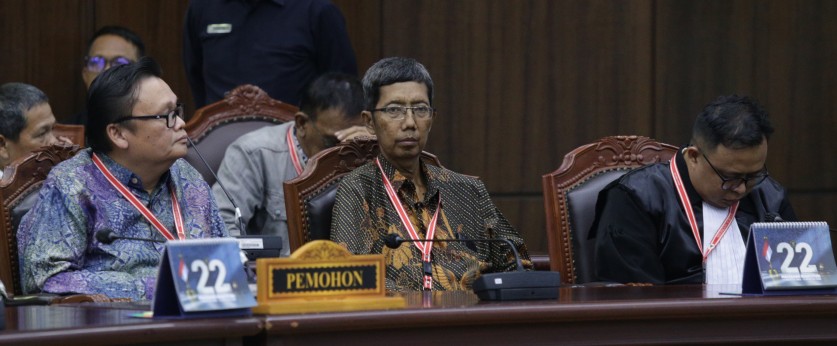
Petitioners attending the decision pronouncement hearing of Case No. 113/PUU-XXIII/2025 on the material judicial review of Law No. 2 of 2017 on the Construction Service, Thursday (14/8). Photo by MKRI/Bay.
Jakarta (MKRI) – The Constitutional Court (MK) declared the case submitted by the All Indonesian Constructors Association (Asosiasi Kontraktor Seluruh Indonesia, AKSI) and the Indonesian Technical Expert Association (Perhimpunan Ahli Teknik Indonesia, PATI) inadmissible. Decision Pronouncement Hearing of Case No. 113/PUU-XXIII/2025 was held on Thursday, August 14, 2025, at the Plenary Courtroom.
The petitioners challenged Article 5 paragraph (1) (c) (d) (e), Article 30 paragraph (2) (4) (5) (6) (7), Article 31 paragraph (5), Article 68 paragraph (4), Article 69 paragraph (5) (6) (7), Article 70 paragraph (4), Article 71 paragraph (2) (3) (4) (5) (6), Article 72 paragraph (1) (4), Article 84 paragraph (2) (5) (6) (9) of Law No. 2 of 2017 on Construction Service.
Reading the legal considerations, Deputy Chief Justice Saldi stated that the Petitioners did not clearly elaborate on the reason for the contradiction of each norm and/or article against Article 27 paragraph (2) of the 1945 Constitution of the Republic of Indonesia. As a result, the Court cannot ensure the contradiction of the articles being tested.
Because the explanation related to the grounds for the requested review is a fundamental requirement in the judicial review of laws at the Court. The petitioners further elaborate on concrete cases, as the impact of the enforcement of Law No. 2 of 2017 on the activities of the petitioners’ associations. Meanwhile, the main issue that should be elaborated in the reasons for the petition is the constitutional grounds that the tested norm conflicts with Article 27 paragraph (2) of the 1945 Constitution of the Republic of Indonesia.
“Without explaining the contradiction between norms being tested against the touchstone, it is difficult for the Court to determine whether the norm contradicts the 1945 Constitution,” Deputy Chief Justice Saldi Isra read out the legal consideration.
Therefore, the absence of legal argumentation leads to a contradiction of norms related to the issue of its constitutionality, rendering the petition unclear. Based on the entire legal considerations, although the Court has the authority to decide on the case, because the petition is unclear or vague, the Court does not consider the legal standing and subject matter of the petition further.
“Decide and declare the petitioners’ petition for Case No. 113/PUU-XXIII/2025 cannot be accepted,” Chief Justice Suhartoyo read the verdict.
Read more:
AKSI and PATI Reveal the Absence of Construction Service Development Agency Consequences
AKSI and PATI Emphasize Constitutional Losses on Construction Service Development Agency’s Independence Review
During the preliminiary hearing on Tuesday, July 22, 2025, Yanuar stated that the government has enacted Law No. 2 of 2017 to replace Law No. 18 of 1999, which mentions the Construction Service Development Agency (Lembaga Pengembangan Jasa Konstruksi, LPJK) as an independent and self-reliant entity, so that it can promote the construction service community. However, in reality, Law No. 2 of 2017 does not make LPJK independent and self-reliant, as it is established by the Minister of Public Works and Housing.
Simply put, the Minister has taken over constitutional rights by bureaucratizing the process, and has taken over the implementation of issuing business entity certificates, business entity accreditation, and registration functions that have previously been carried out by the LPJK. This has impacted and caused losses to the Petitioners, which are also considered contrary to Article 27 paragraph (2), Article 28C paragraph (2), and Article 33 paragraphs (1) and (4) of the 1945 Constitution. According to the Petitioners, the nine articles under review harm the Construction Service Community because they usurp the community's role in Accreditation, Certification, Licensing, Training of Business Associations, and Professional Associations.
“As a result, many Business Associations and Professional Associations have closed and ceased functioning as organizations at the central, provincial, and district/city levels. In addition, the closure of the Provincial Construction Service Development Agency (LPJKP) in 34 provinces has led many people to lose their jobs in construction services due to the difficulty of obtaining those certificates, which has caused massive unemployment in the construction service sector,” Yanuar explained to the panel of judges.
The government agencies involved include the Ministry of Transportation, Ministry of Manpower, Ministry of Education, Ministry of Health, Ministry of Public Works and Housing (PUPR), and Ministry of Energy and Mineral Resources (ESDM). This group of government institutions involves not only the Ministry of PUPR but crosses multiple ministries. Previously, the selection process for LPJK management candidates was conducted through a selection phase organized by the Community Element Group of the Construction Service, consisting of representatives from the Construction Service Company Associations, Professional Associations of Construction Services, and the Business Partner Goods and Services Associations related to Construction Services. The LPJK management carried out their duties and functions independently and autonomously, being responsible to the construction service community under the guidance of the Minister of Public Works and Housing (PUPR).
Author: Sri Pujianti.
Editor: N. Rosi.
Translator: Rizky Kurnia Chaesario
Disclaimer: The original version of the news is in Indonesian. In case of any differences between the English and the Indonesian versions, the Indonesian version will prevail.
Thursday, August 14, 2025 | 16:51 WIB 179