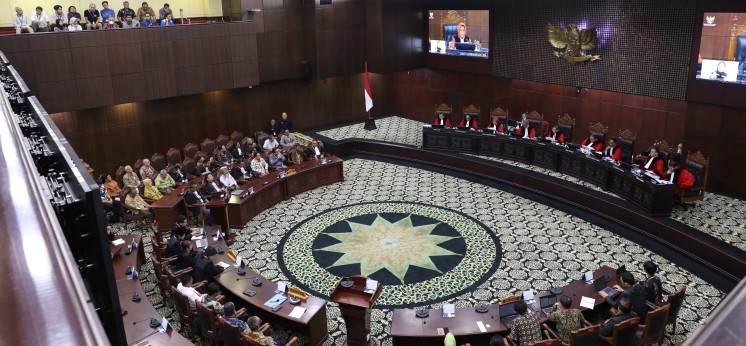
The ruling hearing for the judicial review petition of Law No. 2 of 2002 on the National Police for case No. 116/PUU-XXIII/2025, Thursday (8/14/2025). Photo by MKRI.
JAKARTA (MKRI) — The Constitutional Court (MK) rejected the entire material judicial review petition of Law No. 2 of 2002 on the National Police through Decision No. 116/PUU-XXIII/2025. The ruling was delivered on Thursday, August 14, 2025. The petition was filed by Syamsul Jahidin, an advocate.
The Petitioner questioned the constitutionality of Article 40 of the Police Law, which regulates the source of funding for the National Police Commission (Kompolnas). He argued that the law does not regulate the source of funding for the Indonesian National Police. The Constitutional Court affirmed that, although not stipulated in the Police Law, the police budget is subject to the principles of state financial management as regulated in Law No. 17 of 2003 on State Finances.
In its legal considerations, read by Constitutional Justice Daniel Yusmic P. Foekh, the Court stated that, with regard to the Petitioner’s argument challenging the constitutionality of Article 40 of Law No. 2 of 2002—which regulates the source of funding for the National Police Commission—while the budget or source of funding for the Police is not regulated in said Law, such matters must be understood within the framework of state financial management under the Indonesian administration system. In this context, matters concerning state finance, in general, must comply with Law No. 17 of 2003 on State Finances.
“For example, Article 11 paragraph (1) of Law No. 17 of 2003 stipulates that ‘The State Budget (APBN) is the realization of state financial management established annually by law.’ In relation to this, Article 12 paragraph (1) of Law No. 17 of 2003 provides that ‘The State Budget shall be prepared in accordance with the needs of state administration and the ability to raise state revenues,’” Justice Foekh explained.
Furthermore, Article 14 paragraph (1) of Law No. 17 of 2003 states: “In preparing the draft State Budget, ministers/heads of agencies, as budget users/items users, shall prepare the work plan and budget of their respective ministries/agencies for the following year.” In essence, as reflected in the cited provisions of Law No. 17 of 2003, the budget for the Police—being that of a state organ in the field of national security—must adhere to the principles of state financial management, including originating from a lawful cause and in conformity with statutory provisions.
Justice Foekh added that, based on the foregoing considerations and in relation to the Petitioner’s arguments, the provision sought to be conditionally declared unconstitutional was Article 40 of Law No. 2 of 2002. Systematically, it falls under Chapter VI on the National Police Institution, which comprises four articles—Articles 37 through 40. Essentially, Chapter VI of Law No. 2 of 2002 regulates the status, duties, authority, membership, and funding sources of the National Police Commission. Referring to item 63 of Appendix II of Law No. 12 of 2011 on Lawmaking, the grouping of substantive provisions in legislation must be done comprehensively in accordance with the similarity of subject matter. Any material content that is necessary but cannot be grouped within the existing regulatory scope shall be placed under the miscellaneous chapter.
Based on the guidelines in Law No. 12 of 2011, and in relation to the Petitioner’s request, the substance of Chapter VI of Law No. 2 of 2002 concerns the National Police Commission, which, under Article 37 paragraph (1) of Law No. 2 of 2002, is placed under and accountable to the President. In such a position, it is not, and does not form part of, the organizational structure of the Police. When considered alongside Article 8 paragraph (1) and Article 37 paragraph (1) of Law No. 2 of 2002, the Police and the National Police Commission occupy different organizational structures, although both are under the President. With such separate structures, the legislature needs to regulate the funding sources to support the National Police Commission’s performance of its duties. In contrast to the Police, even though not regulated in Law No. 2 of 2002, as previously considered above, the Police budget is determined, prepared, and subject to regulation under the state finance regime.
On the basis of the foregoing considerations, the Petitioner’s request to have the Police budget regulated in Article 40 of Law No. 2 of 2002 by inserting the phrase “the Indonesian National Police and” so that the provision would read “All expenses necessary to support the performance of the Indonesian National Police and the National Police Commission shall be charged to the State Budget (APBN)” is systematically inappropriate, as it is inconsistent with the subject-matter grouping of Article 40 of Law No. 2 of 2002. Since Article 40 of Law No. 2 of 2002 is situated in the chapter regulating the National Police Commission, it would be neither appropriate nor relevant to insert said phrase. In addition to potentially disrupting the structure of Article 40 of Law No. 2 of 2002, the phrase’s insertion could also undermine the formulation of the Police budget, which must comply with the principles governing the determination and preparation of state institution budgets in the State Budget.
He added that, within logical reasoning, if the meaning requested by the Petitioner were implemented under Article 40 of Law No. 2 of 2002, it could actually create legal uncertainty, as if the Police budget were part of the National Police Commission’s budget.
Based on the above considerations, the Petitioner’s argument—essentially that Article 40 of Law No. 2 of 2002 is conditionally unconstitutional insofar as it is not construed to mean “all expenses necessary to support the performance of the Indonesian National Police and the National Police Commission shall be charged to the State Budget (APBN)”—was unfounded and must therefore be declared without legal merit.
Also read:
Advocate Challenges Lack of Budget Transparency in Police Law
Petitioner Revises Petition on Lack of Budget Transparency in Police Law
He specifically challenges Article 40 of the Police Law, which stipulates that “all expenditures required to support the implementation of the duties of the National Police Commission shall be charged to the State Budget (APBN).” He argued that this provision fails to explicitly specify the funding sources and budget mechanisms for the National Police as a whole.
He argued that the absence of provisions regulating transparency, accountability, and responsibility in the management of the Police’s budget constitutes a legal vacuum. He asserted that such a gap could lead to legal uncertainty and multiple interpretations.
Author : Utami Argawati
Editor : Lulu Anjarsari P.
PR : Fauzan Febriyan
Translator : Yuniar Widiastuti (NL)
Disclaimer: The original version of the news is in Indonesian. In case of any differences between the English and the Indonesian versions, the Indonesian version will prevail.
Thursday, August 14, 2025 | 17:29 WIB 510