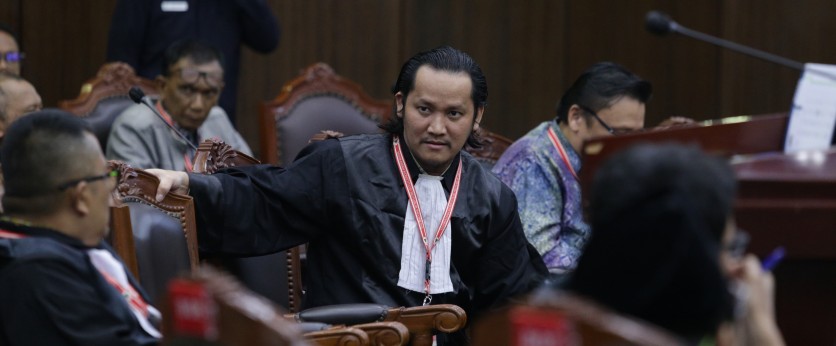
The Petitioner’s legal counsel at the ruling hearing for the judicial review of the Law on the Committee for State Receivables Management (PUPN) for case No. 128/PUU-XXII/2024, Thursday (8/14/2025). Photo by MKRI/Bayu.
JAKARTA (MKRI) — The Constitutional Court (MK) rejected the entire material judicial petition of the Government Regulation in Lieu of Law No. 49 of 1960 on the Committee of State Receivables Management (PUPN Perppu) filed by Andri Tedjadharma, a shareholder of Bank Centris Internasional (BCI). The Decision No. 128/PUU-XXII/2024 was delivered at a ruling hearing on Thursday, August 14, 2025 in the plenary courtroom.
In his petition, Tedjadharma alleged that Article 4 point 3, Article 8, Article 9 paragraphs (1) and (2), and Article 11 letter f of the PUPN Perppu had conferred excessive authority upon the State Receivables Management Committee (PUPN), leading to criminalization and the unilateral designation of the PUPN as a state debtor.
However, the Court found the Petitioner’s arguments without legal merit. In its legal considerations, the Court stated that the Petitioner’s assumption—that the PUPN could manage state receivables without ascertaining the existence and amount of such receivables—was incorrect. According to the Court, Article 4 paragraph (3) of the PUPN Law could not be separated from Article 4 paragraph (1), which forms the basis for the effective management of state receivables. This provision serves as a preventive measure to safeguard state finances from losses, while still binding the PUPN to the principles of legally sound verification and validation.
“Thus, it is clear and unequivocal that in carrying out its duties of resolving state receivables, the PUPN is already constrained by strong legal safeguards to ensure it does not act beyond matters that could potentially infringe upon the rights of debtors and third parties who claim to have been harmed, as part of the right to obtain protection and fair legal certainty,” said Constitutional Justice M. Guntur Hamzah when delivering the Court’s legal considerations.
Accordingly, based on the foregoing legal reasoning, the Petitioner’s request that the management of state receivables be conducted in the same manner as court proceedings would, in the Court’s view, would strip away the unique characteristics of state receivable matters that fall under the PUPN’s authority, as regulated in Law No. 49 of 1960. This law contains specific procedures that have been equated to final and binding (inkracht) court judgments.
With regard to the phrase “for any reason” in Article 8, the Court held that the phrase was intended to broaden the scope of the provision to prevent legal loopholes that could be exploited by parties seeking to evade their obligations to the state. The Court emphasized that the phrase was not open to multiple interpretations, as its meaning was clear: to protect state finances from receivables arising from various causes, whether based on regulations, agreements, or other legally recognized grounds.
The Court also holds that Article 9 paragraphs (1) and (2) indeed allow for the exception to the principle of limited liability in certain circumstances, as a consequence of the legal relationship involving debts owed to the state. The Court considered this an important instrument to prevent manipulative actions detrimental to state finances, including the application of joint and several liability to ensure the effectiveness of debt recovery.
Meanwhile, Article 11 letter f of the PUPN Law was deemed to provide protection for state finances against irresponsible debtors. The Court affirmed that the PUPN Law does not preclude aggrieved parties from pursuing civil or administrative lawsuits. However, it rejected the notion that all state receivable management must proceed through the courts, as such a requirement could be exploited by bad-faith debtors to delay the process.
Based on all the above legal considerations, the provisions of Article 4 point 3, Article 8, Article 9 paragraphs (1) and (2), and Article 11 letter f of Law No. 49 of 1960 were found not to violate the rights to protection and fair legal certainty; the rights to personal, family, honor, and dignity, including control over one’s property; and the right to private ownership that shall not be arbitrarily taken by anyone, as guaranteed under Article 28D paragraph (1), Article 28G paragraph (1), and Article 28H paragraph (4) of the 1945 Constitution. Accordingly, the Petitioner’s arguments were entirely without legal merit.
Also read:
BCI Shareholder Challenges State Receivables Committee Law
BCI Shareholder Revises Petition on State Receivables Management Committee Law
Govt: PUPN Law Protects State Finances
PUPN’s Execution of State Receivables Provides Legal Certainty
At the preliminary hearing, the Petitioner argued that the transfer of receivables management was legally flawed, because it did not meet the requirements of legal certainty as stipulated in Article 4 paragraph (2) and Article 12 paragraph (1) of Perppu No. 49 of 1960 on the State Receivables Management Committee. He also highlighted the PUPN’s far-reaching authority, as stated in Article 4 paragraph (3), which stipulates that the PUPN can “manage state receivables without having to wait for their transfer.” This authority, the Petitioner argued, has led to arbitrary actions by the PUPN, who determines the amounts of receivables and guarantor without a clear legal basis. He feels that his constitutional rights have been violated when he was declared a guarantor and his property confiscated without due process of the law.
He has suffered a constitutional loss as a result of the PUPN’s unlimited authority as referred to in Article 4 paragraph (3), especially the phrase “manage state receivables without having to wait for the transfer if there is a strong enough reason.” The receivables must be managed immediately. This phrase means that the PUPN overrides large state receivables according to the law.
The Petitioner alleged that the confiscation of his property had nothing to do with the agreement between PT BCI and the Bank of Indonesia, as set out in notarial deeds No. 75 and No. 76 dated October 17, 1997. He asserted that as a shareholder of PT BCI, he was not registered in the settlement of shareholders’ obligation (PKPS) as stated in the BPK report on the implementation of the duties of the Indonesian Banking Restructuring Agency (BPPN) dated November 30, 2006.
Author : Utami Argawati
Editor : N. Rosi
PR : Andhini S.F.
Translator : Yuniar Widiastuti (NL)
Disclaimer: The original version of the news is in Indonesian. In case of any differences between the English and the Indonesian versions, the Indonesian version will prevail.
Thursday, August 14, 2025 | 16:10 WIB 194