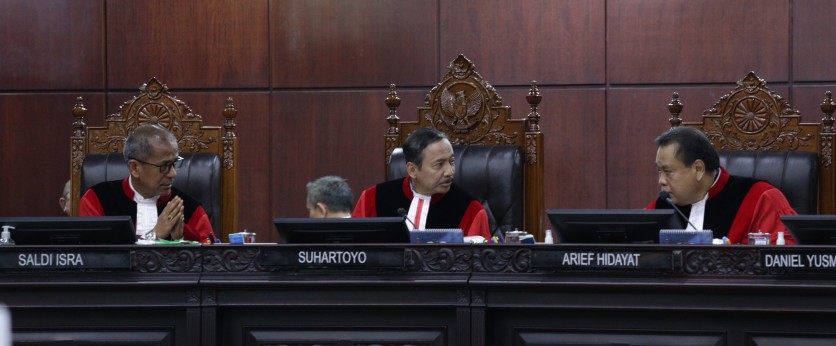
Hearing for the pronouncement of the decision in case number 117/PUU-XXIII/2025, the material review of Law Number 12 of 2011 concerning the Formation of Statutory Regulations, Thursday (08/14/2025). Photo by MKRI/Bay
JAKARTA (MKRI) – The Constitutional Court (MK) has declared the petition in Case No. 117/PUU-XXIII/2025, concerning the judicial review of Law No. 12 of 2011 on the Formation of Laws and Regulations (UU P3), inadmissible. The ruling came after the applicants—who identified themselves as the Preparatory Committee for the Constitutional Congress, represented by Trijono Hardjono (chairperson), Salyo Kinasih Bumi (secretary), and Zulkifli (treasurer)—failed to attend the preliminary hearing on Tuesday (07/29/2025).
Chief Justice Suhartoyo stated that the Court, through the Registrar’s Office, had issued a lawful and proper summons. Even moments before the hearing was scheduled to begin, the Court attempted to confirm attendance by placing a telephone call to the applicants. However, they stated they were not ready to proceed.
“Yet the applicants’ response indicated that they were not prepared for the hearing,” Suhartoyo said during the pronouncement of the ruling/order on Thursday (08/14/2025).
Suhartoyo further noted that such conduct demonstrated the applicants’ lack of seriousness in pursuing their petition, as there was no valid reason for their absence despite being duly summoned.
“The petition in Case No. 117/PUU-XXIII/2025 is hereby declared inadmissible,” he concluded.
As background, several citizens calling themselves the Preparatory Committee for the Constitutional Congress had filed a petition for judicial review of the UU P3 with the Constitutional Court. In their application, the petitioners challenged the legal standing of Decrees of the People’s Consultative Assembly (TAP MPR RI) in Indonesia’s constitutional legal system.
The petitioners argued that the existence of TAP MPR RI as a legal product was intended to be abolished under the post-reform legal framework, consistent with the removal of the MPR RI’s authority as the highest body holding full sovereignty on behalf of the people.
On one hand, TAP MPR RI remains recognized within the hierarchy of laws and regulations under Article 7(1)(b) of the UU P3, which lists MPR Decrees as one of the types of legislation. On the other hand, its validity is restricted under the Explanation of Article 7(1)(b) of the UU P3, which formed the object of this judicial review.
This provision stipulates that “MPR Decrees” refer to Temporary MPR Decrees and those still in force as set forth in Articles 2 and 4 of MPR Decree No. I/MPR/2003 on the Review of the Content and Legal Status of Temporary MPR Decrees and MPR Decrees from 1960 to 2002, dated 7 August 2003. However, Articles 2 and 4 of that MPR Decree are only conditionally applicable, subject to certain provisions or until the enactment of a law. Thus, their continued application on a permanent basis would lose legal relevance once those conditions have been fulfilled.
In their petitum, the petitioners asked the Court to declare that the provision limiting the validity of Temporary/Permanent MPR Decrees in the Explanation of Article 7(1)(b) of the UU P3 is inconsistent with Article 1(2) of the 1945 Constitution of the Republic of Indonesia (UUD NRI) and/or contrary to Article 1(3) and Article 3(1) and (2) of the UUD NRI, and therefore has no binding legal force. They also requested the Court to annul the Explanation of Article 7(1)(b) of the UU P3.
Author : Mimi Kartika
Editor : N Rosi.
PR : Andhini SF.
Translator : Agusweka Poltak Siregar
Disclaimer: The original version of the news is in Indonesian. In case of any differences between the English and the Indonesian versions, the Indonesian version prevails.
The full decision can be seen at the following link: Decision in Case Number 117/PUU-XXIII/2025
Thursday, August 14, 2025 | 15:56 WIB 342