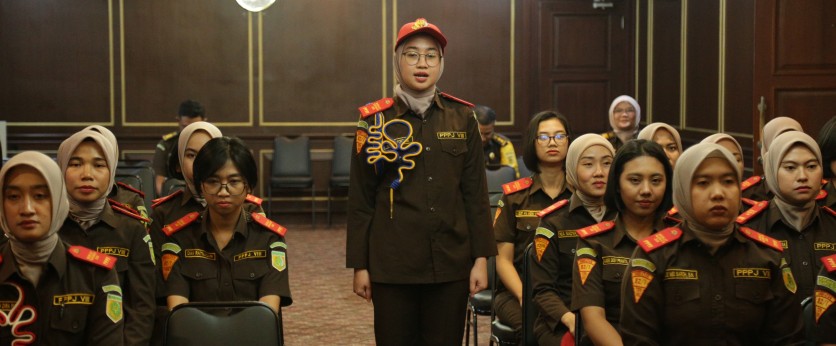
Students of the 82nd Class, Batch VIII, Wave I of the Prosecutorial Education and Training Program (PPPJ) 2025 visited the Constitutional Court of the Republic of Indonesia (MKRI) on Tuesday, 08/12/2025. (MKRI/Bay)
JAKARTA, MKRI – Approximately 39 students of the 82nd Class, Batch VIII, Wave I of the Prosecutorial Education and Training Program (PPPJ) 2025 conducted an educational visit to the Constitutional Court (MK) on Tuesday, 08/12/2025. The delegation was formally received by the Head of the Bureau of Public Relations and Protocol, Pan Mohamad Faiz, together with the Inspector of the Constitutional Court, Sigit Purnomo, at the Nine Pillars of the Constitutional Court Building I.
The prospective prosecutors were then given a tour of the Constitutional Court premises, including the Panel Courtroom and the Plenary Courtroom. As part of their field practice program, they also received a lecture on the Constitution and the role of the Constitutional Court, delivered by Aditya Yuniarti, First Expert Legal Analyst of the Constitutional Court.
Aditya commenced the presentation by explaining that the idea of establishing a Constitutional Court had emerged since the drafting of the nation’s foundation, specifically during the sessions of the Investigating Committee for Preparatory Work for Independence (BPUPKI). At that time, Mohammad Yamin proposed the creation of an institution authorized to review laws against the Constitution.
He further explained that the Founding Fathers considered it necessary to have a judicial body, apart from the Supreme Court, that would be competent to conduct judicial review of laws against the Constitution. When a law, as a legal product enacted by the Government and the House of Representatives, potentially infringes upon the constitutional rights of citizens, such a judicial body must exist to safeguard the Constitution and ensure that laws and governmental policies remain in compliance with the 1945 Constitution of the Republic of Indonesia.
“Laws are products of the House of Representatives and the Government as the lawmakers. When such laws contain problems, to which institution should they be brought?” Aditya stated during his lecture at the Delegation Room, 4th Floor, Constitutional Court Building I, Jakarta.
At present, the Constitutional Court exercises five powers as stipulated in the 1945 Constitution: judicial review of laws against the Constitution, settlement of disputes over constitutional authority among state institutions, adjudication of the dissolution of political parties, resolution of electoral disputes, and adjudication of the House of Representatives’ opinion regarding alleged violations committed by the President or Vice President. The Court will commemorate its 22nd anniversary on August, 13th, 2025.
Aditya also explained that the Court is composed of nine Constitutional Justices, each nominated respectively by the DPR, the President, and the Supreme Court. Every Justice must relinquish their prior office and is prohibited from holding concurrent positions. Their conduct is subject to ethical oversight by the Constitutional Court’s Honorary Council (MKMK).
He further emphasized that the Constitutional Court upholds the principle of transparency in judicial proceedings. Every case must be examined and cannot be refused, and hearings are open to the public. Court proceedings can also be observed online.
“The Constitutional Court adheres to the principle of audi et alteram partem, namely that all parties must be heard, as well as the principle of constitutional presumption, meaning that a law is presumed valid until otherwise declared unconstitutional by the Court,” Aditya explained.
Since its establishment in 2003, the Constitutional Court has adjudicated approximately 4,500 cases, excluding several applications that are still under examination. The majority of cases involve judicial review of laws and disputes over regional election results. The Election Law remains the most frequently challenged legislation.
Following the lecture, the students had the opportunity to visit the Constitutional History Center (Puskon), located on the 5th and 6th floors of the Constitutional Court Building. The Puskon serves as a documentation and learning center on the historical development of Indonesia’s Constitution and the establishment of the Constitutional Court, presented engagingly. Since its inauguration, the Puskon has frequently hosted visits from various institutions and segments of society. It is open to the public and accessible free of charge.
Author : Mimi Kartika
Editor : N. Rosi
Translator : Nies Lindy
Disclaimer: The original version of the news is in Indonesian. In case of any differences between the English and the Indonesian versions, the Indonesian version will prevail.
Tuesday, August 12, 2025 | 14:33 WIB 127