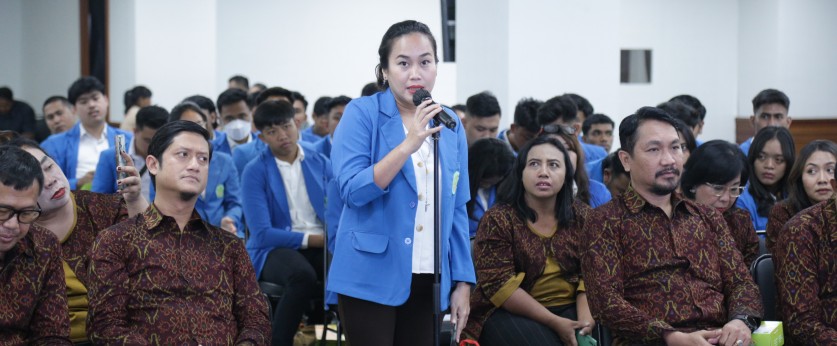
The Constitutional Court received a visit from the Faculty of Law Dwijendra University, Denpasar, Bali, on Monday (August 11, 2025). Public Relations/Bay
JAKARTA (MKRI) - Dozens of law students from Dwijendra University, Denpasar, Bali, visited the Constitutional Court (MK) of the Republic of Indonesia on Monday as part of an educational tour to deepen their understanding of constitutional law and the Court's role in upholding justice.
The students were welcomed at the Constitutional Court’s Auditorium (Building 1, Jakarta) and engaged in an interactive discussion with MK Legal Analyst Arinta Sulistyo, popularly known as Tyo. In her presentation, Tyo emphasized that Constitutional Court decision go far beyond the final ruling, it built on comprehensive legal considerations that carry significant weight.
“Constitutional Court decisions are not just about the verdict; they are a unified whole with the legal reasoning that underpins them,” Tyo explained. He urged students to help educate the public on this point, as the broader implications of these decisions affect not only individual cases but also legal interpretation and the national legal system.
Tyo cited Decision No. 56/PUU-XV/2017 as a key example. Although the Court rejected the petition to revoke Article 1 of the 1965 Law on the Prevention of Abuse and/or Blasphemy of Religion, it nonetheless ordered the government to take specific actions based on the legal considerations in the decision. While upholding the contested article, the Court also outlined the state’s responsibility to ensure that religious freedoms do not conflict with one another, distinguishing between internal beliefs (forum internum) and public religious expression (forum externum).
He also reminded the students of the principle of ius curia novit—that justices are presumed to know the law. “Constitutional Justices cannot simply reject a petition because of legal shortcomings. They are obligated to examine, hear, and rule on every case submitted,” Tyo said.
Tyo further stressed the importance of judicial independence and impartiality. “Justices must maintain neutrality and remain free from any influence, pressure, or vested interests. This is essential to uphold public trust,” he noted. He added that all Constitutional Court operations, including justices’ work, are publicly funded through the State Budget, and any form of gratuity is strictly prohibited.
Following the discussion, the students toured the Constitutional History Center (Puskon), located on the 5th and 6th floors of Building 1. There, they explored an array of archival materials, including the Constitutional Court’s first ruling, presented through an interactive blend of information, art, and digital technology.
This visit offered students a firsthand look at the judicial process and the foundational role of legal reasoning in shaping constitutional law, an experience that left many inspired to further their studies and contribute meaningfully to Indonesia’s legal landscape.
Author : Mimi Kartika
Editor : Lulu Anjarsari P.
Translator : SO
Disclaimer: The original version of the news is in Indonesian. In case of any differences between the English and the Indonesian versions, the Indonesian version will prevail.
Monday, August 11, 2025 | 15:15 WIB 156