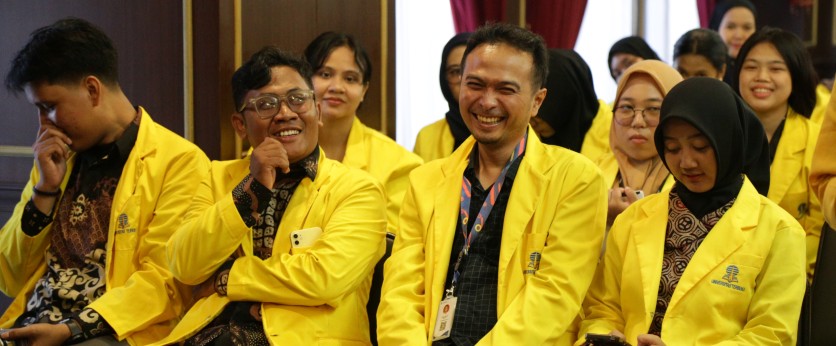
Law students of the Open University visiting the Constitutional Court. Wednesday (8/6/2025). Photo by MKRI/Bayu.
JAKARTA (MKRI) — Seventy law students of the Open University currently undergoing professional placement listened to a presentation on “The Constitutional Court” by legal counselor Achmad Junaedi on Wednesday, August 6, 2025 in the delegation room.
Junaedi explained that the Court’s establishment was driven by various factors, including problematic laws and conflicts among state institutions. As a result, the Constitutional Court was established as a judicial body specializing in constitutional matters and entrusted with several key authorities. These include judicial review of laws against the 1945 Constitution, adjudication of disputes concerning the results of general and regional elections, resolution of authority disputes between state institutions whose powers are granted by the Constitution, and dissolution of political parties.
Junaedi highlighted that, in carrying out these roles, the Court is composed of nine constitutional justices tasked with safeguarding the constitutional rights of citizens against potentially unconstitutional legislation enacted by lawmakers. He further explained the qualifications required to become a constitutional justice.
“One of the minimum requirements to apply as a constitutional justice is holding at least a bachelor’s degree (S1) in law. Additionally, the candidate must be at least 55 years old and have completed education up to the doctoral level (S3). So, for those of you currently studying law, you could someday become a candidate for constitutional justice,” Junaedi said, encouraging students to take their legal studies seriously.
He added that the conduct of constitutional justices is overseen by the Constitutional Court’s Ethics Council (Majelis Kehormatan Mahkamah Konstitusi, or MKMK), which is tasked with upholding judicial ethics. In this regard, all citizens may play a role in safeguarding the ethical conduct of justices. As is known, several public complaints alleging ethical violations have been submitted to, and adjudicated by, the MKMK.
On this occasion, Junaedi also elaborated on various aspects of the Court’s procedures and stages of hearings, the use of courtroom technology, and additional facilities such as the library and the Constitution History Center (Puskon). He also mentioned support services available for students writing theses or other academic works, the Court’s active presence on social media to disseminate up-to-date information to younger generations, and the website www.mkri.id, which is accessible to the public and provides comprehensive information about the Court’s activities.
Author : Sri Pujianti
Editor : N. Rosi
Translator : Yuniar Widiastuti (NL)
Disclaimer: The original version of the news is in Indonesian. In case of any differences between the English and the Indonesian versions, the Indonesian version will prevail.
Wednesday, August 06, 2025 | 15:36 WIB 280