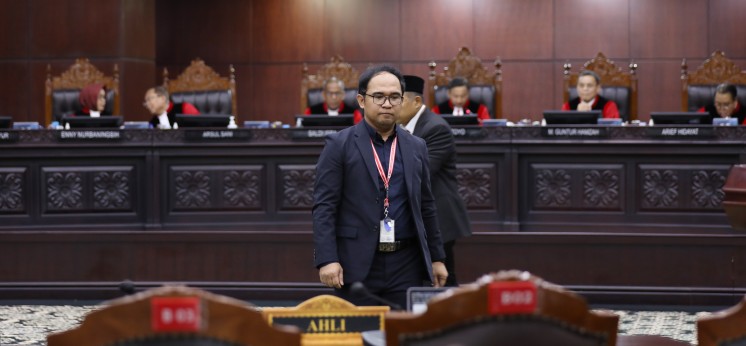
Oce Madril, appearing as the Government’s Expert Witness, took an oath before the panel of justices prior to delivering his testimony during the follow-up hearing on the judicial review of Law Number 2 of 2022 concerning the Police, held on Wednesday (06/08/2025) at the Courtroom of the Constitutional Court. Photo by MKRI/Ifa.
JAKARTA, MKRI – Lecturer at the Faculty of Law, Universitas Gadjah Mada, and Director of the Center for Constitutional and Government Law Studies, Oce Madril, stated that the House of Representatives' (DPR) approval in the appointment of the Chief of the Indonesian National Police (Kapolri) by the President is part of the constitutional application of the President’s prerogative power and therefore does not conflict with the 1945 Constitution. The President's prerogative in appointing or dismissing the National Police Chief must still comply with Law Number 2 of 2022 concerning the Indonesian National Police (the Police Law).
“The appointment of the National Police Chief by the President with the approval of the DPR is part of the constitutional application of the President’s prerogative power,” said Oce, who appeared as an expert presented by the President/Government during the judicial review hearing of Article 11 paragraph (2) and its Elucidation in the Police Law, Case Number 19/PUU-XXIII/2025, on Wednesday (06/08/2025) at the Constitutional Court’s Plenary Session Room in Jakarta.
Oce further explained that DPR approval represents the exercise of the DPR’s oversight function over political appointments of public officials. He emphasized that the position of National Police Chief is a structural career position. Aside from meeting rank and career requirements, a key qualification for Kapolri is active duty status as a high-ranking officer in the National Police. This differs from the position of Attorney General, which does not require active status as a public prosecutor.
The National Police Chief is not part of the Cabinet. Therefore, the position cannot be subjected to a fixed term. Thus, the phrase “end of term of office” must be read in conjunction with the other phrases in the Elucidation of Article 11 paragraph (2) of the Police Law.
He explained that there are both subjective and objective requirements for the appointment or dismissal of the National Police Chief. The subjective requirement refers to the “end of term” which is determined by the President at their discretion. Meanwhile, the objective requirements include resignation, reaching retirement age, permanent disability, or being convicted with a legally binding verdict.
In addition, the Government also presented Professor Bayu Dwi Anggono, a Professor of Legislative Law at the Faculty of Law, Universitas Jember, as an expert. He explained that the phrases “valid reasons” and “among others” in the Elucidation of Article 11 paragraph (2) indicate that it does not constitute a binding legal norm because it does not contain prescriptive legal elements (such as commands, prohibitions, or authorizations).
Instead, the Elucidation provides clarification of terms, phrases, or sentences with examples to explain the content of the main provision. It is intended to prevent legal ambiguity and does not create uncertainty. According to Bayu, if the provisions regarding the term of office of the National Police Chief were changed through a Constitutional Court decision, it would create disparities with other positions in the same category.
“Therefore, the structure of the Elucidation to Article 11 paragraph (2) of Law 2/2002 is not legally binding as a norm, but serves as an official interpretation in connection with other provisions,” said Bayu.
Also Read:
Petitioners: Proposal for Appointment and Dismissal of National Police Chief Must Be Accompanied by Valid Reason
Judicial Review Filed over National Police Chief's Tenure and Dismissal
House: Police Chief's Term Cannot Be Equated with President's Term
President’s Proxy Absent, Hearing on Police Law Postponed
This petition was filed by Syukur Destieli Gulo, Christian Adrianus Sihite, and Devita Analisandra, who are students. They challenged Article 11 paragraph (2) and its Elucidation in Law Number 2 of 2022 concerning the Indonesian National Police. Article 11 paragraph (2) reads, “The proposal for the appointment and dismissal of the National Police Chief is submitted by the President to the House of Representatives along with the reasons.” The Elucidation adds: “The DPR’s approval for the proposed appointment and dismissal of the Police Chief shall follow the prevailing procedures of the House. The President’s proposal for dismissal must be accompanied by valid reasons, including the end of the Police Chief’s term, resignation, retirement, permanent incapacity, or a criminal conviction with permanent legal force. If the DPR rejects the proposal, the President must withdraw and may resubmit it in the next session.”
The Petitioners argued that the phrase “along with the reasons” is not clearly defined in the law and has created a real and tangible problem, particularly in the case of the current Police Chief, Listyo Sigit Prabowo, who they claim is no longer validly in office as he has not been reappointed by the incoming President, Prabowo Subianto.
Under Article 8 paragraph (2) of Law 2/2002, the National Police is led by a Chief who reports to the President in accordance with the law. While the proposal to appoint or dismiss the Police Chief is a presidential prerogative, it requires DPR approval as part of a check-and-balance mechanism.
Since the appointment and dismissal of the Police Chief are the prerogative of the President, every President should have the same authority for the duration of their term. Therefore, with the end of the term of the President who appointed the current Police Chief, the latter’s term should also end.
The Petitioners requested that the Court declare Article 11 paragraph (2) of the Police Law unconstitutional and non-binding unless interpreted to mean that the President must provide valid reasons such as: (a) expiration of the presidential term; (b) dismissal during the President’s term with DPR approval; (c) resignation; (d) retirement; (e) permanent incapacity; or (f) criminal conviction with permanent legal force. They also requested the Elucidation of Article 11 paragraph (2) be declared unconstitutional and non-binding.
Author : Mimi Kartika
Editor : Lulu Anjarsari
PR : Andhini S.F.
Translator : Agusweka Poltak Siregar
Disclaimer: The original version of the news is in Indonesian. In case of any differences between the English and the Indonesian versions, the Indonesian version prevails.
Wednesday, August 06, 2025 | 13:19 WIB 894