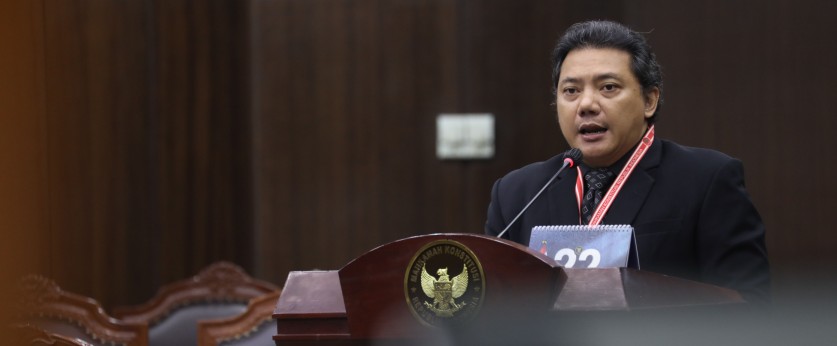
Expert witness Taufik Basari delivering his testimony at the judicial review hearing of the Corruption Eradication Law at the plenary courtroom of the Constitutional Court, Tuesday (8/5/2025). Photo by MKRI/Panji
JAKARTA (MKRI) — Former member of Commission III of the House of Representatives (DPR) Taufik Basari emphasized the need to guarantee protection for non-litigation advocacy by lawyers, asserting that it constitutes a legitimate form of legal defense. He contended that such protection must include safeguards from potential criminalization stemming from the phrase “or indirectly” in Article 21 of Law No. 31 of 1999 on the Eradication of Criminal Acts of Corruption as amended by Law No. 20 of 2001.
“It is crucial to ensure that the interpretation of Article 21 of the Corruption Eradication Law does not result in an overly elastic reading, particularly due to the phrase ‘or indirectly,’” said Taufik, who appeared as an expert for Case No. 71/PUU-XXIII/2025 at the plenary hearing of the Constitutional Court (MK) on Tuesday, August 5, 2025.
Taufik, who also previously served as a public defender at the Jakarta Legal Aid Institute (LBH), explained that LBH figures consistently emphasized the use of constitutionally protected and lawful means to advocate for justice. In addition to litigation advocacy, pro bono lawyers are often compelled to pursue non-litigation efforts to challenge systemic injustice.
He stressed that such efforts aim to shape public opinion on ongoing legal proceedings through various platforms, including media publications, public discussions, whether independently organized or in collaboration with academics, and by inviting broader public scrutiny and oversight of the legal process.
In the context of criminal cases, Taufik added, non-litigation advocacy frequently serves as a form of critique against ongoing legal processes to promote adherence to the principle of fair trial. However, this often places such advocacy in tension with law enforcement officials.
This conflict, he argued, becomes especially problematic when the phrase “or indirectly” in Article 21 is interpreted too broadly, as it allows law enforcement to potentially criminalize lawyers performing their duties, particularly in non-litigation contexts. Such interpretive flexibility could also lead to a lack of objectivity from law enforcement, especially since Article 21 positions officers themselves as the aggrieved party, while also granting them the authority to determine whether an act warrants legal action.
Furthermore, Taufik, currently serving as Chair of the Constitutional Affairs Committee at the People’s Consultative Assembly (MPR), explained that Article 21, which encompasses obstruction of justice, was among the provisions considered for revision during the drafting of the new Criminal Code (RKUHP). He stated that this provision could be reformulated by either removing or restructuring the phrase or by breaking it down into multiple articles to eliminate its ambiguity. Thus, he argued, it is relevant to contextualize the current provision within the broader framework of the nation’s evolving criminal law policy.
At the end of the hearing, Chief Justice Suhartoyo announced that the proceedings would resume on Tuesday, August 12, 2025, at 1:30 PM. He expressed concern over the executive’s lack of readiness, noting that this marked the second time the President’s statement was not yet available.
Also read:
Lawyer Challenges Anti-Corruption Law for Potentially Restricting Public Participation
Lawyer Challenges Anti-Corruption Law over Clause on Obstruction of Investigation
House: Arbitrary Prosecution Under Article 21 of Anti-Corruption Law Unjustifiable
Meanwhile, Petitioner Hermawanto, an advocate, submitted a revised petition for the judicial review of Article 21 and its elucidation under the same Corruption Eradication Law. He argued that the provision contradicts Article 28D(1) of the 1945 Constitution.
The Petitioner challenged the phrase “or indirectly” in the article and its explanation, asserting that it opens the door to the criminalization of any citizen engaging in public discourse or social oversight through various forms such as media, campus discussions, seminars, demonstrations, or press conferences. If law enforcement were to interpret such public expression as “obstructing investigation, prosecution, or trial” based solely on their subjective judgment, it could endanger the fundamental freedoms of expression and security.
The Petitioner contended that the law’s vagueness leaves excessive room for subjective enforcement, which poses a significant threat to civil liberties and may deter public involvement in legal reform and justice monitoring in a democratic society.
Given this potential for abuse, the Petitioner requested that the Court declare the phrase “or indirectly” in Article 21 and its elucidation unconstitutional and thus legally unenforceable.
Author: Mimi Kartika
Editor: Lulu Anjarsari P.
PR: Andhini S. F.
Translator: Yuanna Sisilia
Disclaimer: The original version of this news article is in Indonesian. In case of any differences between the English and Indonesian versions, the Indonesian version shall prevail.
Tuesday, August 05, 2025 | 15:38 WIB 241