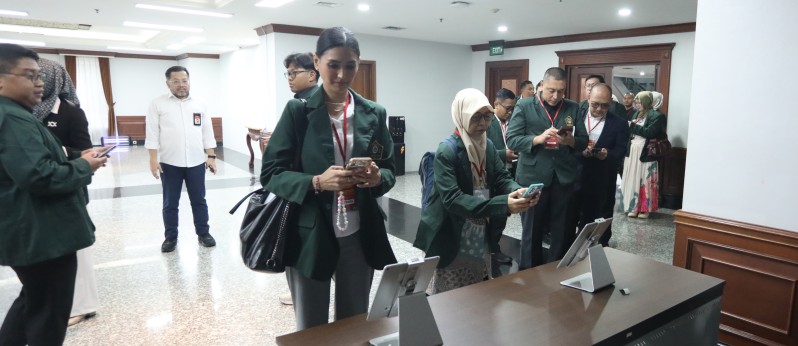
The Constitutional Court received a Field Study Visit from the Faculty of Law students of Sultan Agung Islamic University (Unissula) Semarang on Monday, (08/04/2025). In the photo, students participating in the visit are seen scanning a QR code to fill in the attendance list. (Photo: MKRI/Ilham WM)
JAKARTA, MKRI — A total of 160 students from the Faculty of Law of Sultan Agung Islamic University (FH Unissula) Semarang visited the Constitutional Court as part of their field study program on Monday, (4/8/2025). The delegation was welcomed by Constitutional Court Legal Analyst, Arinta Sulistiyo, in the Ground Floor Hall, Building I of the Court. In his presentation entitled “The Constitutional Court”, Tiyo elaborated on the urgency behind the establishment of the Constitutional Court of the Republic of Indonesia.
He explained that long before the 1998 Reform era, there were numerous problematic laws without any mechanism for constitutional review. In addition, there had been an instance of presidential impeachment for political reasons, as well as frequent conflicts between state institutions that were resolved solely under the authority of the President. At that time, there was also no clear forum for resolving electoral disputes, and the dissolution of political parties was handled by the Supreme Court through a process that lacked clarity.
Tiyo further stated that the authority of the Constitutional Court is enshrined in Article 24C paragraphs (1) and (2) of the 1945 Constitution of the Republic of Indonesia, Law Number 48 of 2009 concerning Judicial Power, and Law Number 24 of 2003 concerning the Constitutional Court, as last amended by Law Number 7 of 2020. These powers include: reviewing statutes against the Constitution; deciding disputes over constitutional authority between state institutions whose powers are granted by the 1945 Constitution; deciding on the dissolution of political parties; resolving disputes over the results of general elections; and rendering a decision on the opinion of the House of Representatives regarding presidential impeachment.
After the presentation, the students posed questions enthusiastically. One student, Adrian Kurnia, inquired about the intersection between the authority of the Supreme Court and that of the Constitutional Court in judicial review matters. Tiyo explained that in Indonesia, there are two institutions with judicial review authority, but each has its specific scope.
“The Constitutional Court has the specific authority to review provisions contained in statutes using the 1945 Constitution of the Republic of Indonesia as the sole standard of review. If there is a judicial review of a statutory norm before the Constitutional Court, the Supreme Court shall postpone the review of regulations below the statute until a decision is rendered by the Constitutional Court.” He answered the student’s question.
For information, Unissula was established by the Sultan Agung Waqf Foundation (YBWSA) on May 20, 1962. The name “Sultan Agung” is taken from one of Indonesia’s national heroes who made significant contributions to the nation. Through the legacy of this prominent figure, Unissula is expected to uphold the spirit of national development in education based on Islamic values. To date, Unissula has grown into one of Indonesia’s leading universities, holding an excellent accreditation rating from the National Accreditation Board for Higher Education (BAN-PT), with 13 faculties and 45 study programs spanning Diploma (D3), Bachelor (S1), Master (S2), and Doctoral (S3) degrees.
Author : Sri Pujianti
Editor : Lulu Anjarsari P.
Translator : Nies Lindy
Disclaimer: The original version of the news is in Indonesian. In case of any differences between the English and the Indonesian versions, the Indonesian version will prevail.
Monday, August 04, 2025 | 14:56 WIB 212