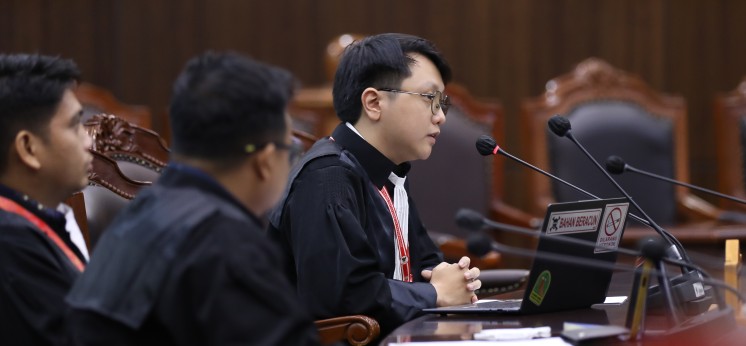
The Petitioner’s legal counsel Deni Daniel conveying the petition at the preliminary hearing for the material judicial review of the Anti-Corruption Law, Friday (8/1/2025). Photo by MKRI/Ifa.
JAKARTA (MKRI) — The Constitutional Court (MK) held the preliminary hearing for the material judicial review of Article 14 of Law No. 31 of 1999 on the Eradication of the Criminal Acts of Corruption (Anti-Corruption Law) on Friday, August 1, 2025 in a panel courtroom. The hearing for case No. 123/PUU-XXIII/2025 was presided over by Chief Justice Suhartoyo and two panel members.
Article 14 of the Anti-Corruption Law reads, “Any person violating the provision of the law which clearly states that violations against the provisions of the aforementioned law shall be regarded as corruption shall be liable to the provisions of this law.”
Representing Petitioner Adelin Lis, legal counsel Deni Daniel said in a concrete case, the Petitioner contested the constitutionality of article, particularly as applied to his conviction under Supreme Court Decision No. 68 K/PID.SUS/2008, especially its consideration regarding Article 2 paragraph (1) of the Anti-Corruption Law. He was found guilty of corruption despite the alleged offense arising from conduct governed primarily by Law No. 41 of 1999 on Forestry, which does not categorize such conduct as a corruption offense.
According to the Petitioner, the Supreme Court’s reasoning, particularly its interpretation of the element of “causing state financial loss” under Article 2 paragraph (1) of the Anti-Corruption Law, was rooted in the Petitioner’s failure to fulfill obligations in the forestry sector, including payment of forest resource provision, reforestation funds, and administrative fines. These obligations, however, fall solely under the Forestry Law, which does not classify violations of such provisions as corruption offenses. Therefore, applying the Anti-Corruption Law in this context, the Petitioner argued, was inappropriate.
The Petitioner further argued that under the principle of systematische specialiteit, Article 14 of the Anti-Corruption Law should only apply where the substantive offense is explicitly designated as a corruption offense in another statute. This interpretive bridge, referred as a “bridging clause,” is necessary to ensure that a more general corruption statute is not applied arbitrarily to conduct regulated under a sector-specific regime such as the Forestry Law. The absence of such a clause in the Forestry Law renders the application of the Anti-Corruption Law in this case legally unsound.
The Petitioner maintained that without a bridging clause, Article 14 fails both in legal certainty and in fulfilling its teleological function as an instrument of systematische specialiteit. The provision becomes overly broad and unpredictable, potentially allowing any statutory violation to be prosecuted as corruption, regardless of legislative intent.
Accordingly, the Petitioner requested the Constitutional Court to declare Article 14 of the Anti-Corruption Law unconstitutional and not legally binding unless interpreted to mean: “This provision shall only apply to violations of other statutory provisions if those provisions explicitly classify the offense as a corruption crime. It shall not apply to violations of laws that do not include such a classification.”
Justices’ Advice
In response, Constitutional Justice Daniel Yusmic P. Foekh emphasized the need for the Petitioner to strengthen his legal argument and provide comparative jurisprudence from Indonesia or other jurisdictions. “This should not do, that [an offense is punishable under] provisions in the Forestry Law, but the Anti-Corruption Law was applied in parallel. So, detail it in the reason for the petition,” Justice Foekh said.
Chief Justice Suhartoyo also underscored the importance of distinguishing whether the legal issue lies with the constitutionality of Article 14 itself or rather with its improper implementation by law enforcement. “We need a ‘second opinion’ from the Petitioner, to determine whether the problem stems from the text of Article 14 or from its application, or noncompliance by those enforcing [it],” he said.
At the end of the hearing, Chief Justice Suhartoyo announced that the Petitioner would have 14 days to revise the petition and must submit it no later than Thursday, August 14 to the Registrar’s Office. The Court will then schedule another hearing to examine the revisions to the petition.
Author : Sri Pujianti
Editor : Lulu Anjarsari P.
PR : Fauzan Febriyan
Translator : Yuniar Widiastuti (NL)
Disclaimer: The original version of the news is in Indonesian. In case of any differences between the English and the Indonesian versions, the Indonesian version will prevail.
Friday, August 01, 2025 | 11:18 WIB 240