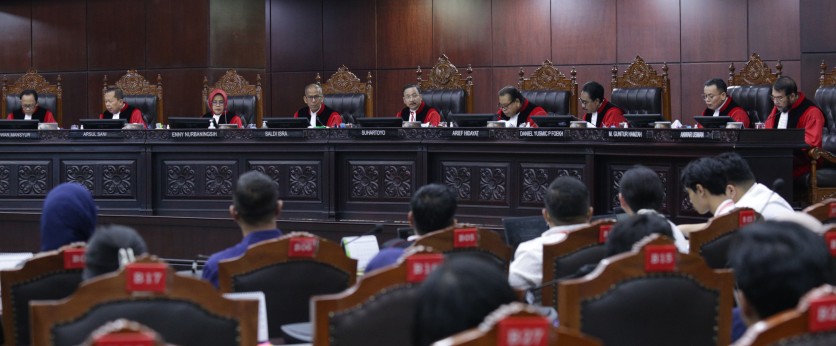
The ruling hearing for the material judicial review of Law No. 2 of 2003 on the National Police for case No. 101/PUU-XXIII/2025, Wednesday (7/30/2025). Photo by MKRI/Bayu.
JAKARTA (MKRI) — Chief Justice Suhartoyo delivered a Decree No. 101/PUU-XXIII/2025 on the material judicial review of Article 18 paragraph (1) of Law No. 2 of 2002 on the National Police. The ruling hearing took place in the plenary courtroom on Wednesday, July 30, 2025. The Court stated that on Monday, July 14, its Registrar’s Office had received a letter by Christian Adrianus Sihite, Idon Setiawan, and Yondi Jonathan Hasibuan (Petitioners I-III) requesting the withdrawal of petition No. 101/PUU-XXIII/2025.
Then, on Wednesday, July 16, it held a preliminary hearing to review the revisions to the petition and asked for confirmation of the request for withdrawal, which Petitioners I and II provided, citing similarities with the petition for case No. 84/PUU-XXIII/2025, ruled on July 3.
“[The Court] approves the withdrawal of the Petitioners’ petition; declares Petition for Case No. 101/PUU-XXIII/2025 withdrawn; declares the Petitioners unable to re-file the petition a quo; orders the Chief Registrar of the Constitutional Court to record the withdrawal of petition No. 101/PUU-XXIII/2025 in the electronic constitutional case registration book (e-BRPK) and to return the petition’s copy to the Petitioners,” said Chief Justice Suhartoyo delivering the verdict.
Also read:
Phrase ‘According to Their Own Judgment’ in Police Law Challenged Again
Petition to Review Phrase “Own Judgement” in Police Law Withdrawn
The Petitioners believe that Article 18 paragraph (1) of the Police Law, which reads: “For public interest, officials of the Indonesian National Police, in carrying out their duties and authority, may act according to their own judgment,” contradicts Article 1 paragraph (3) and Article 28D paragraph (1) of the 1945 Constitution. They argued that as law enforcement officials, the authority vested in the Police must serve the public interest and the Police’s institutional functions. Therefore, they have a vested interest in ensuring that the power of police officers remains subject to oversight, including imposing limits on the duties and authority of individual police officers who act based on their own judgment.
However, they argued, the legal norm in Article 18 paragraph (1) and its elucidation creates legal uncertainty regarding what constitutes an act taken “according to their own judgment” by a police officer. This uncertainty, in their view, undermines legal oversight over police officers. Without clear limits on their duties, a police officer could abuse their authority, using their own assessment as a pretext under the guise of serving the public interest.
Accordingly, in their petitums, the Petitioners requested that the Court declare Article 18 paragraph (1) of the Police Law unconstitutional and without binding legal force. They also request that the Court declare the Elucidation to Article 18 paragraph (1) of Law No. 2 of 2002 on the Indonesian National Police, which reads, “What is meant by ‘may act according to their own judgment’ refers to acts that may be carried out by members of the Indonesian National Police, who in doing so must consider the benefits and risks of their actions and purely in the public interest,” unconstitutional and has no binding legal force.
Author : Sri Pujianti
Editor : Lulu Anjarsari P.
PR : Andhini S.F.
Translator : Yuniar Widiastuti (NL)
Disclaimer: The original version of the news is in Indonesian. In case of any differences between the English and the Indonesian versions, the Indonesian version will prevail.
Wednesday, July 30, 2025 | 14:46 WIB 148