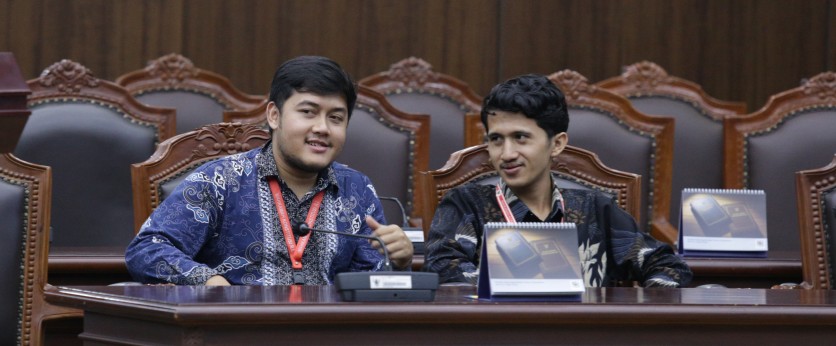
The Petitioner attending the ruling hearing of case No. 105/PUU-XXIII/2025 on the material judicial review of Law No. 28 of 1999 on State Administration Free from Corruption, Collusion, and Nepotism, Wednesday (7/30/2025). Photo by MKRI/Bay.
JAKARTA (MKRI) — The Constitutional Court dismissed the judicial review petition of Law No. 28 of 1999 on State Administration Free from Corruption, Collusion, and Nepotism (Anti-KKN Law) for Petitioners I and II, and rejected the petition in its entirety for Petitioner III. The ruling on case No. 105/PUU-XXIII/2025 was announced during a plenary session on Wednesday, July 30, 2025.
The petition was filed by Leonardo Olefins Hamonangan (Petitioner I), Frans Yudistira Sembiring (Petitioner II), and Martin Maurer (Petitioner III), who challenged the constitutionality of the phrase “or civil sanctions” in Article 20 paragraph (2) of the Anti-KKN Law. They argued that the phrase is vague and potentially ambiguous, opening the door to multiple interpretations in law enforcement against state officials.
Delivering the Court’s legal considerations, Constitutional Justice Enny Nurbaningsih stated that the provision is part of the sanctions regime for violations of obligations by state officials, particularly as set forth in Article 5 items 4 and 7. These articles stipulate that such violations may be subject to criminal and/or civil sanctions in accordance with prevailing laws and regulations.
The Court viewed the inclusion of such sanctions as meaningful guidance within the law. The phrase “or civil sanctions” in Article 20 paragraph (2) is not intended to replace criminal sanctions, but rather to serve as an alternative mechanism for achieving state asset recovery in corruption cases. In practice, civil lawsuits often become essential when criminal processes fall short of restoring financial losses to the state.
Therefore, the Petitioners’ claim that civil sanctions obstruct criminal prosecution or hinder deterrence could not be substantiated, either normatively or empirically. In contrast, civil sanctions in this context expand the accountability mechanisms available to the state. Accepting the Petitioners’ request to annul the phrase would fundamentally alter the architecture of sanction enforcement against public officials involved in corruption.
Furthermore, Enny emphasized that this provision aligns with Article 28D paragraph (1) of the 1945 Constitution, which guarantees legal certainty as part of efforts to uphold clean governance. For this reason, the Petitioners’ arguments regarding the unconstitutionality of the provision were deemed legally groundless. The phrase in question does not conflict with the principle of legal certainty guaranteed by the Constitution.
Earlier, the Petitioners contended that the phrase allows public officials proven to have committed acts of corruption, collusion, or nepotism to receive only civil sanctions, instead of criminal ones, potentially weakening legal enforcement and undermining anti-KKN efforts.
They further argued that the ambiguous wording could create uncertainty in judicial proceedings, as there is no clear elaboration on the types of violations and corresponding legal consequences. According to the Petitioners, Article 5 items 4 and 7 merely outline officials’ obligations without specifying the nature of violations or their legal ramifications. This ambiguity, they claimed, leaves room for arbitrary interpretation by law enforcers, which could lead to abuse of power and contravenes the principle of clear and unambiguous legal drafting.
Author: Utami Argawati
Editor: Lulu Anjarsari P.
PR: Andhini S.F.
Translator: Yuanna Sisilia
Disclaimer: The original version of this news is in Indonesian. In case of any discrepancies, the Indonesian version shall prevail.
The full text of the ruling is available at the following link: Ruling of Case No. 105/PUU-XXIII/2025
Wednesday, July 30, 2025 | 15:48 WIB 239