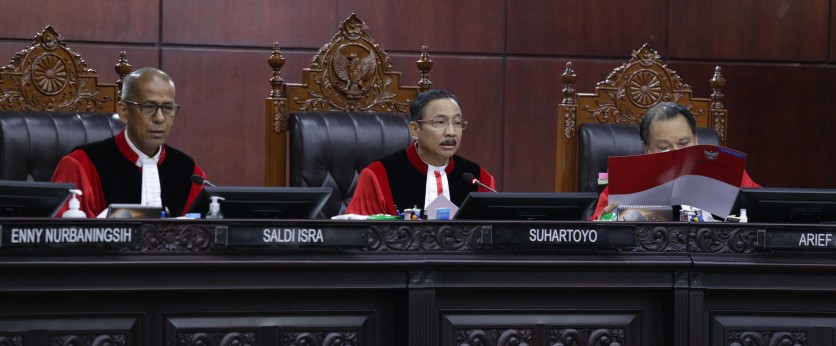
Chief Justice Suhartoyo (center) at the ruling hearing for case No. 107/PUU-XXIII/2025 on Law No. 4 of 1996 on Mortgage Rights over Land and Objects Related to the Land, Wednesday (7/30/2025). Photo by MKRI/Bayu.
JAKARTA (MKRI) — The Constitutional Court (MK) held that in elaborating their legal standing, the Petitioners had not provided a sound argument on the presumed constitutional impairment and the enforcement of the norms petitioned for review, nor had they explained the context in which they had not obtained fair legal certainty, personal protection, opportunity to obtain personal property, or respect of their rights, thus leading to the impairment of their constitutional rights, which are guaranteed under Article 28D paragraph (1), Article 28G paragraph (1), and Article 28J paragraph (1) of the 1945 Constitution due to the enforcement of Article 6 and Article 7 of the Mortgage Law.
The legal consideration was delivered by Deputy Chief Justice Saldi Isra at the ruling hearing for Decision No. 107/PUU-XXIII/2025 on Wednesday, July 30, 2025. The Court stated that, instead, the Petitioners had elaborated on their constitutional rights where they should have presented their posita or reasons for filing the petition for the material judicial review of Article 6 and Article 7 of Law No. 4 of 1996 on Mortgage Rights over Land and Objects Related to the Land (Mortgage Law).
Not to mention, in the revised petition, Deputy Chief Justice Saldi Isra added, instead of elaborating their constitutional impairment, the Petitioners added theories irrelevant to their presumed constitutional impairment. Therefore, their posita and petitums (the requests) became contradictory, and the petitums were unusual and not in line with the provision of Article 10 paragraph (2) letter b point 3 and letter d of the Constitutional Court Regulation (PMK) No. 2 of 2021. As such, the Court held that the petition was vague.
“[The Court] declares the petition by Petitioners No. 107/PUU-XXIII/2025 inadmissible,” said Chief Justice Suhartoyo delivering the verdict for the petition filed by R. Lella Karmila, Rejeki Putri, and Sri Ayu Suryati (Petitioners I-III).
Also read:
Devious Creditors and Debtors Conspiracy Harms the First Buyer of Mortgaged Property
Petitioners Revise Potential Loss Due to Conspiring Creditor-Debtor
At the preliminary hearing on Friday, July 11, legal counsel Lalu Zulkifli said the Petitioners challenge the articles against Article 28G paragraph (1) of the 1945 Constitution. In this petition, the argument is focused on the parties harmed by conspiracy between creditor (recipient of the Mortgage Right object) and debtor (who handed over the Mortgage Right object) who took advantage of the loophole in the elucidation of the norm. This resulted in losses for the first buyer of the Mortgage Right object and has led to the occupation of the physical Mortgage Right object legally.
Fundamentally, the elucidation to the articles under review confer authority upon creditors that is inconsistent with the 1945 Constitution. Specifically, it allows creditors to interpret two legal errors: first, the alleged bad faith of debtors in default when pledging an object as collateral under a mortgage right; and second, the negligence of creditors in accepting the collateral object, which violates the principle of prudential banking. This includes failing to conduct prior due diligence, such as studying, physically inspecting, and directly verifying the collateral object before executing a foreclosure sale.
In concrete terms, many individuals in society have suffered harm due to debtors who had previously sold their collateral objects to third-party buyers but later, without disclosing this fact, used the same property as collateral to secure loans from creditors. These original buyers reasonably believed that the property they had purchased was free of encumbrances, as evidenced by a binding sale and purchase agreement. In such situations, both the original buyers and the creditors are, in essence, injured parties. However, even when creditors are aware that the collateral object has already been sold and is under the possession of the first buyer, they still proceed with foreclosure sales, relying on the provisions set forth in Articles 6 and 7 of the Mortgage Law.
The Petitioners acknowledge that in Indonesia, there are numerous unscrupulous actors, including bad-faith debtors and corrupt individuals within financial institutions acting as creditors, who seek to gain personal profit through improper means. These devious creditors are often enticed by large illicit payments offered by dishonest debtors and therefore approve credit applications without conducting direct inspections or verifying the collateral used for the mortgage right. What matters to these creditors is merely the formal credit agreement between creditor and debtor and the provisions of Articles 6 and 7 of the Mortgage Law. Even though the physical object of the mortgage right has already been sold and is in the possession of the first buyer, they proceed with foreclosure and execution regardless.
The collusive, corrupt, and nepotistic actions of bad-faith debtors and devious creditors have caused substantial harm to the Indonesian public, including the Petitioners. The exploitation of the elucidation to Articles 6 and 7 of the Mortgage Law by such actors, in furtherance of acts of collusion, corruption, and nepotism, constitutes a violation of Article 28G paragraph (1) of the 1945 Constitution.
Author : Sri Pujianti
Editor : N. Rosi
PR : Fauzan F.
Translators : Yuniar Widiastuti (NL)
Disclaimer: The original version of the news is in Indonesian. In case of any differences between the English and the Indonesian versions, the Indonesian version will prevail.
Wednesday, July 30, 2025 | 14:39 WIB 215