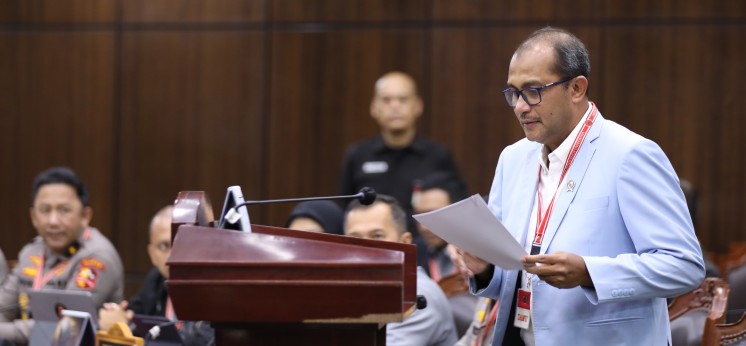
Eddy Hiariej, Deputy Minister of Law and Human Rights of Indonesia, representing the Government, delivered a statement at the judicial review hearing of Law Number 2 of 2022 concerning the Indonesian National Police on Tuesday (29/07/2025), in the Constitutional Court courtroom. Photo by MKRI/Ifa.
JAKARTA, MKRI – Deputy Minister of Law and Human Rights Edward Omar Sharif Hiariej stated that the position of the Chief of the Indonesian National Police (Kapolri) is a career-based position within the organizational structure of the police, subject to retirement age and personnel development mechanisms. The position of Kapolri, he said, cannot be equated with that of a minister in the presidential cabinet, whose tenure follows the president’s term or can be dismissed at any time.
“The Chief of Police is a career post within the police structure, governed by retirement age and staffing regulations, and is not a political office like a minister whose term aligns with the president’s,” said Eddy, as he is familiarly called, during the continued judicial review hearing of Article 11 paragraph (2) and its elucidation in Law Number 2 of 2022 concerning the Indonesian National Police (UU Polri), Case Number 19/PUU-XXIII/2025, on Tuesday (29/7/2025) at the Constitutional Court plenary courtroom in Jakarta.
Eddy elaborated that the difference between the positions of Kapolri and minister lies not only in their functional roles but also in their legal basis for appointment. Ministers are appointed and dismissed entirely at the president’s discretion, whereas the Kapolri is appointed and dismissed by the president with the approval of the House of Representatives (DPR).
Regarding term of office, Eddy noted that the Police Law clearly stipulates that the retirement age for police officers—including the Chief of Police—is 58 years old, extendable to 60 years depending on organizational needs. Thus, the tenure of the Chief of Police is not determined by the presidential term.
“There is no provision in the Police Law that states the Kapolri’s term follows the president’s term. Such an interpretation lacks legal grounding and can cause uncertainty in police organizational management,” he stated.
Furthermore, Eddy argued that the Petitioners lack legal standing to file the petition because they failed to demonstrate actual, specific, and concrete constitutional harm caused by the challenged provisions. They have no direct relationship as parties harmed constitutionally. There is no evidence that the law's enforcement affects their constitutional rights.
This argument was echoed by Aan Eko Widiarto, a Constitutional and Legislative Law Lecturer at the Faculty of Law, Universitas Brawijaya, who testified as an expert on behalf of the President/Government in the hearing. He stated that the Kapolri is a public official appointed by the president with the DPR’s approval, creating a check and balance mechanism, unlike ministers who are presidential aides and can be appointed or dismissed directly without other institutional approval.
“Although the appointment of the Kapolri involves a political process, it is not a political office. In other words, the Kapolri is not part of the cabinet whose position automatically aligns with the president's term,” said Aan, who joined the hearing virtually.
He further noted that, unlike ministers whose term ends explicitly with the end of the president’s tenure, the Kapolri is bound by the mandatory retirement age as regulated by the Police Law. However, he highlighted the ambiguity in the elucidation of Article 11 paragraph (2), particularly the provision mentioning “the term of office has ended” as one of the grounds for dismissal. He believes this presents a constitutional problem, as the main text of the law does not define the Kapolri’s term.
“Explanatory notes should not contain new norms that are absent in the main body of the law. This violates the principles of statutory drafting,” said Aan.
He emphasized that including a norm in the elucidation that does not interpret any provision from the main body can lead to double interpretation and legal uncertainty. In a rule-of-law state, all limitations on power, including public office terms, must adhere to the principles of legality and legal certainty.
Also read:
Petition Details
The petition was filed by Syukur Destieli Gulo, Christian Adrianus Sihite, and Devita Analisandra, all students, challenging Article 11 paragraph (2) and its elucidation in Law Number 2 of 2022 concerning the Indonesian National Police. Article 11 paragraph (2) states, “The proposal for appointment and dismissal of the Chief of Police shall be submitted by the President to the House of Representatives with reasons.” The elucidation states, “The DPR's approval of the proposal for the dismissal and appointment of the Chief of Police shall be carried out according to DPR’s applicable procedures. The President shall submit the proposal for dismissal of the Chief of Police with valid reasons, including: term of office has ended, voluntary resignation, retirement, permanent disability, or final conviction. If the DPR rejects the proposal, the President may withdraw and resubmit the proposal in the next parliamentary session.”
The Petitioners argued that the phrase “with reasons” is not further regulated or clearly formulated in the law. They believe this provision not only presents normative issues but also causes real problems. In their view, the current Chief of Police, Listyo Sigit Prabowo, is illegitimate because he was not reappointed by the newly elected President, Prabowo Subianto.
According to Article 8 paragraph (2) of Law 2/2002, the National Police is led by the Kapolri, who is responsible to the President in accordance with prevailing laws. The proposal for the appointment and dismissal of the Kapolri is a presidential prerogative, even though it requires DPR approval as a check and balance mechanism.
The President holds the prerogative to appoint other highly strategic posts that significantly impact the achievement of national goals, including the Kapolri. Therefore, since the Kapolri’s appointment and dismissal fall under the president's prerogative, each president should have the same authority corresponding to their term. As such, the Kapolri's term should end along with the term of the president who appointed them.
The Petitioners requested the Court to declare that Article 11 paragraph (2) of the Police Law is unconstitutional and has no binding legal force unless interpreted as follows: “The proposal for the appointment and dismissal of the Chief of Police shall be submitted by the President to the House of Representatives with valid reasons, including: a. the end of the President's term coinciding with the cabinet’s term; b. dismissal during their term by the President with DPR approval; c. voluntary resignation; d. retirement; e. permanent disability; f. final criminal conviction.” They also asked the Court to declare the elucidation of Article 11 paragraph (2) unconstitutional and without binding legal force.
Author : Mimi Kartika
Editor : Lulu Anjarsari P.
PR : Andhini S.F.
Translator : Agusweka Poltak Siregar
Disclaimer: The original version of the news is in Indonesian. In case of any differences between the English and the Indonesian versions, the Indonesian version prevails.
Tuesday, July 29, 2025 | 14:34 WIB 2193