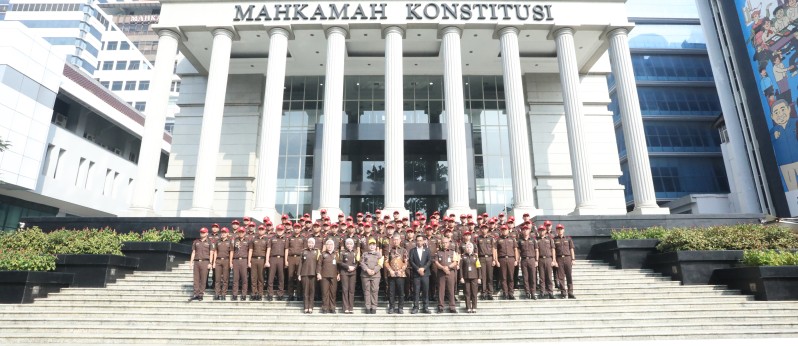
Participants of the Prosecutor Training and Education Program (PPPJ) Class LXXXII visiting the Constitutional Court on Thursday (7/24/2025). Photo by MKRI/IlhamWM.
JAKARTA (MKRI) — Participants of the Prosecutor Training and Education Program (PPPJ) Class LXXXII visited the Constitutional Court (MK) on Thursday, July 24, 2025, to gain insights into constitutional law and the Constitutional Court’s judicial mechanisms.
“The Constitutional Court was established as mandated by the 1945 Constitution,” Heru stated.
He went on to encourage the participants to remain enthusiastic throughout their training. He also reminded them, as future law enforcers, not to neglect their spiritual obligations.
Following the visit, the participants held a discussion with the Court’s First Expert Legal Analyst, Aditya Yuniarti. Aditya explained that the idea of establishing the Constitutional Court was not sudden, but had existed since the early days of the Republic, particularly during the sessions of the Investigating Committee for Preparatory Work for Independence (BPUPKI). The notion of a judicial body with the authority to review laws against the Constitution was first proposed by Mohamad Yamin during the BPUPKI deliberations.
She elaborated that the Court has five constitutional authorities: judicial review of laws against the 1945 Constitution; resolution of authority disputes between state institutions; dissolution of political parties; resolution of disputes over general election results; and adjudication of the House of Representatives’ opinion regarding alleged constitutional violations by the President and/or Vice President.
She also elaborated on the composition of the Constitutional Justices: nine justices in total, with three appointed respectively by the House of Representatives (DPR), the President, and the Supreme Court (MA). The justices are supported in their work by the Registrar’s Office and the Secretariat-General of the Court. A Constitutional Justice must not hold any concurrent office and is required to resign from any prior position upon appointment. Furthermore, their daily conduct is subject to oversight by the Court’s Honorary Council.
Aditya emphasized that as a judicial institution, the Court may not refuse to hear any petition. Court hearings are open to the public and adhere to the principle of audi et alteram partem, meaning that all relevant parties to a case must be given the opportunity to be heard. Another principle upheld by the Court is the presumption of constitutionality, which stands until the Court rules otherwise. These principles are also adopted by general courts under the Supreme Court. However, unlike the Supreme Court, the Constitutional Court does not enforce its rulings, and compliance depends on the constitutional awareness of the concerned parties.
She further explained the two types of judicial review at the Court: formal review and substantive review. A formal review examines whether the legislative process was conducted in accordance with applicable procedures, and it must be filed within 45 days from the promulgation of the law in the State Gazette. Meanwhile, a substantive review evaluates the content of a law and may be filed at any time.
Any Indonesian citizen who believes their constitutional rights have been infringed by the enactment of a legal norm may submit a petition for judicial review. According to Aditya, petitioners in such cases do not confront the DPR or the President as adversaries. The DPR and President attend hearings solely in their capacity as the lawmakers, to provide clarifications.
“Petitioners are not opposing the government or the DPR, they are asserting that their constitutional rights have been harmed,” Aditya affirmed.
Author: Mimi Kartika
Editor: N. Rosi
Translator: Yuanna Sisilia
Disclaimer: The original version of the news is in Indonesian. In case of any differences between the English and the Indonesian versions, the Indonesian version shall prevail.
Thursday, July 24, 2025 | 14:14 WIB 259