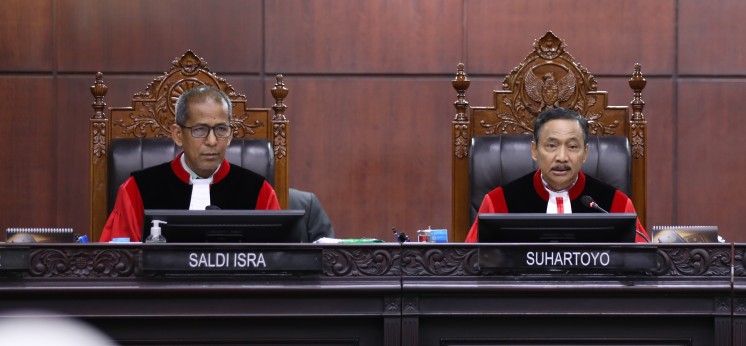
Chief Justice Suhartoyo and Deputy Chief Justice Saldi Isra chairing the judicial review hearing of Law No. 31 of 1999 on the Eradication of Corruption Crimes, Thursday (7/24/2025) in the Courtroom. Photo by MKRI/Ifa.
JAKARTA (MKRI) — The Constitutional Court (MK) postponed the evidentiary hearing of case No. 71/PUU-XXIII/2025 concerning the judicial review of Article 21 and its elucidation of Law No. 31 of 1999 on the Eradication of Corruption Crimes (Corruption Law), as amended by Law No. 20 of 2001, due to the absence of the Petitioner. The hearing, which was scheduled for Thursday, July 24, 2025, was set to hear the Government’s testimony as well as the Petitioner’s expert or witness.
As a result, the Court adjourned the hearing and rescheduled it for Tuesday, August 5, 2025, at 1:30 PM WIB with the same agenda.
“If the Petitioner does not appear again, we will take it as an indication of whether or not they are serious about this petition,” said Chief Justice Suhartoyo in the plenary courtroom.
He explained that the Registrar’s Office had tried to contact the Petitioner before the hearing commenced, but the Petitioner stated they were still en route. However, according to Suhartoyo, the Court could not afford to wait as there were other cases on the docket for the day that needed to proceed on schedule.
Also read:
Lawyer Challenges Anti-Corruption Law for Potentially Restricting Public Participation
Lawyer Challenges Anti-Corruption Law over Clause on Obstruction of Investigation
House: Arbitrary Prosecution Under Article 21 of Anti-Corruption Law Unjustifiable
Previously, advocate Hermawanto, serving as the Petitioner, filed a revised petition challenging Article 21 and its elucidation of the Corruption Law. He argued that the provisions contravene Article 28D paragraph (1) of the 1945 Constitution.
“It violates the right to legal certainty and the principle of rule of law as enshrined in Article 28D paragraph (1),” he said at the petition revision hearing on Monday, June 2, 2025.
Article 21 of the Corruption Law stipulates: “Anyone who deliberately prevents, hinders, or obstructs, directly or indirectly, an investigation, prosecution, or court hearing involving a suspect, defendant, or witness in a corruption case, shall be sentenced to imprisonment of between 3 (three) and 12 (twelve) years and/or a fine ranging from IDR 150,000,000 to IDR 600,000,000.” The elucidation of this article simply states: "Sufficiently clear."
The Petitioner asserted that the phrase “or indirectly” is vague and poses a risk of criminalizing citizens who express public opinion or conduct social oversight through media, seminars, campus discussions, demonstrations, press conferences, and the like. If such expressions are subjectively deemed by investigators to “obstruct investigation, prosecution, or trial,” they could be used to curtail the freedom and security of expression, both of which are essential elements of a democratic state as guaranteed by the Constitution.
Moreover, the Petitioner argued that the phrase’s ambiguity leaves room for broad and subjective interpretations by law enforcement officers, thus endangering public participation in upholding justice and potentially stifling critical voices.
This broad interpretation of Article 21, said the Petitioner, could enable its misuse by law enforcement to suppress or criminalize certain individuals or groups without a clear legal basis. Therefore, the Petitioner requested that the Court declare the phrase “or indirectly” in Article 21 and its elucidation unconstitutional and not legally binding.
Author: Mimi Kartika
Editor: Lulu Anjarsari P.
Translator: Yuanna Sisilia
Disclaimer: The original version of this news article is in Indonesian. In the event of discrepancies, the Indonesian version shall prevail.
Thursday, July 24, 2025 | 14:49 WIB 156