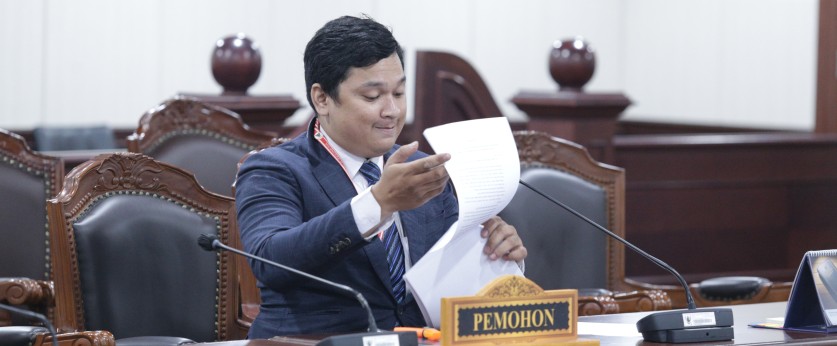
The Petitioners attending the petition revision hearing of case No. 105/PUU-XXIII/2025 on the judicial review of Law No. 28 of 1999 on State Administrators Free from Corruption, Collusion, and Nepotism, Wednesday (7/23/2025). Photo by MKRI/Bayu
JAKARTA (MKRI) — The Constitutional Court (MK) held a petition revision hearing of case No. 105/PUU-XXIII/2025 on the judicial review of Article 20 paragraph (2) of Law No. 28 of 1999 on State Administrators Free from Corruption, Collusion, and Nepotism (“the Anticorruption Law”) on Wednesday, July 23, 2025. The Petitioners in this case are Leonardo Olefins Hamonangan, Frans Yudistira Sembiring, and Martin Maurer, who challenge the constitutionality of the phrase “or civil sanctions” in the said provision.
At the hearing, Petitioner Martin Maurer stated that the petition had been revised in accordance with the justices’ advice in the previous hearing. He clarified that the revision concerned the addition of State Gazette of the Republic of Indonesia of 1999 Number 75 and its supplement. “There is no change in the Petitioners’ identities, Your Honors,” he said.
He added that the section on the Court’s authority had also been supplemented. “In Roman numeral I, pages 7 and 8, I cited Decision No. 132/PUU-XIII/2015, which relates to the Court’s authority as a negative legislator, supported by several other decisions, namely No. 46/PUU-VIII/2010, No. 4/PUU-IX/2011, No. 100/PUU-XIV/2016, No. 65/PUU-XVII/2019, No. 77/PUU-XVIII/2020, No. 1/PUU-XIX/2021, and No. 93/PUU-XX/2022,” he explained before the panel chaired by Constitutional Justice Arief Hidayat.
Martin also elaborated on the revised section on constitutional loss. “The Petitioners refer to Praktis Bahasa Indonesia Volume 2 (2007), which states that the use of the conjunctive phrase dan/atau (and/or) is often incorrectly written as dan atau without a slash. This form of writing is unacceptable. The error is likely due to the misconception that spoken and written forms of Indonesian are interchangeable. As a result, people tend to write what they hear, not what should be written—which is dan/atau with a slash,” he said.
Previously, Petitioner II Frans Sembiring asserted that the contested phrase opened the possibility for state officials proven to have engaged in corruption, collusion, or nepotism to receive only civil sanctions instead of criminal penalties. This, he argued, could blur the law enforcement process and weaken the government’s commitment to eradicating corrupt practices.
Frans further emphasized that the ambiguous wording of the norm could cause confusion in the judicial process, as there is no clear explanation regarding the forms of violations or the specific types of sanctions that may be imposed. He noted that Article 5 points 4 and 7 of the Anticorruption Law only stipulate state officials’ obligations without clearly outlining the corresponding violations or legal consequences. Such vagueness, he said, allows for overly broad interpretations by law enforcement officers, which could lead to abuse of power. The formulation also falls short of the legal drafting principle of clear and unambiguous norms, which is an essential requirement in the making of laws.
On these grounds, the Petitioners request that the Court declare the phrase “or civil sanctions” in Article 20 paragraph (2) of Law No. 28 of 1999 unconstitutional and not legally binding.
Author: Utami Argawati
Editor: Lulu Anjarsari P.
PR: Andhini S.F.
Translator: Yuanna Sisilia
Disclaimer: The original version of the news is in Indonesian. In case of any differences between the English and the Indonesian versions, the Indonesian version will prevail.
Wednesday, July 23, 2025 | 17:00 WIB 211