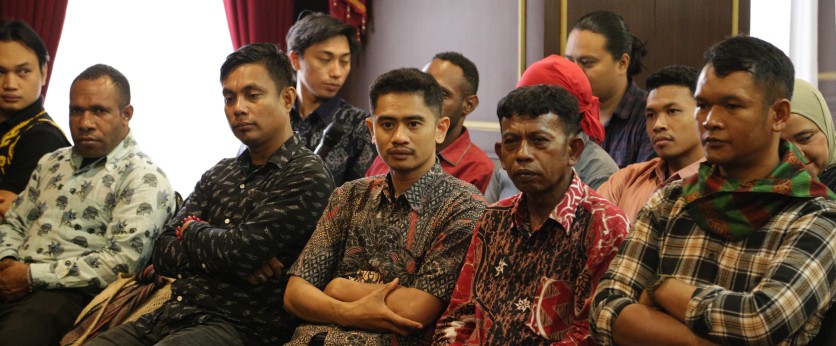
Visit from the 4th Special Education for Advocates Profession (PKPA) for the Indigenous Peoples’ Defenders and the Indonesian Indigenous Peoples’ Defenders Association (PPMAN), Thursday (7/17/2025). Photo by MKRI/Bay.
Syams—as he is known—explained that indigenous legal communities could become petitioner for judicial review of laws at the Court as long as they clearly articulate their legal standing in the petition. "If you can establish legal standing, these can direct the concept that indigenous legal communities, as long as they still exist, can be recognized by the state," Syams said during the discussion.
In addition, Syams mentioned in Article 51 paragraph (1) of the Law on the Constitutional Court, the Petitioner or party who considers that their constitutional rights and/or authority have been harmed by the enactment of the law, one of which is the customary law community unit as long as it is still alive and in accordance with the development of society and the principles of the Unitary State of the Republic of Indonesia as regulated in the law.
In relation to the authority to review laws against the Constitution (UUD) with the existence of indigenous peoples, the Constitutional Court issued Decision No. 35/PUU-X/2012 which was pronounced on May 16, 2013. The case concerned the Judicial Review of Law No. 41 of 1999 on Forestry filed by the Indonesian Indigenous Peoples’ Alliance (AMAN) along with two indigenous communities. In the decision, the Court emphasized that Customary Forests are forests located in customary territories and are no longer State Forests.
Furthermore, he stated that the Court uses the term "petition" rather than "lawsuit." The presence of a Petitioner does not necessarily imply a Respondent. The President/Government and the House of Representatives (DPR) are not parties confronting the Petitioner, but rather acting as information providers.
In essence, Syam said that the Court is a high state institution that exercises judicial power which was established based on the amendment to the 1945 Constitution as stated in Article 24C of the 1945 Constitution. The Court is tasked with maintaining the constitutionality of the law, being the final interpreter of the constitution, safeguarding democracy, and protecting the constitutional rights of citizens.
The Constitutional Court's authorities include judicial review of laws against the Constitution; deciding disputes over the authority of state institutions granted by the Constitution; deciding on the dissolution of political parties; and resolving disputes regarding general election results.(*)
Author : Mimi Kartika
Editor : Lulu Anjarsari P.
Translator : Donny Yuniarto
Disclaimer: The original version of the news is in Indonesian. In case of any differences between the English and the Indonesian versions, the Indonesian version will prevail.
Thursday, July 17, 2025 | 15:45 WIB 342