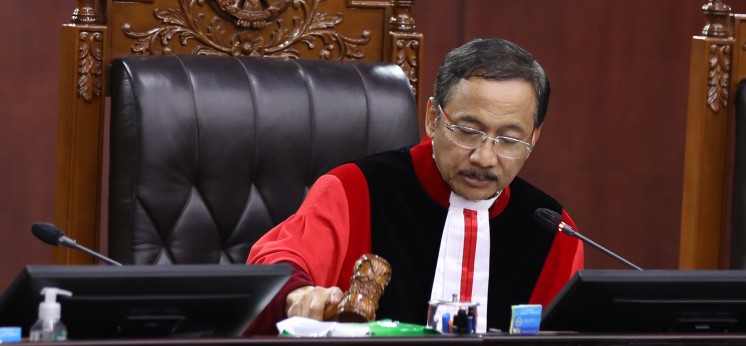
Chief Justice Suhartoyo chairing the ruling hearing for the judicial review of the Police Law, Thursday (7/17/2025) in the plenary courtroom. Photo by MKRI/Ifa.
JAKARTA (MKRI) — The Constitutional Court (MK) has decided to reject 93/PUU-XXIII/2025 on the material judicial review of Article 18 paragraph (1) of Law No. 2 of 2003 on the National Police and its elucidation, filed by Arista Hidayatul Rahmansyah. The ruling hearing for Decision No. 84/PUU-XXIII/2025 took place on Thursday, July 17, 2025 in the plenary courtroom.
Delivering the Court’s legal opinion, Constitutional Justice Asrul Sani said that upon reviewing the Petitioner’s claim, the Court was of the opinion that the constitutional issue asserted by the Petitioner shares the same essence as the constitutional matter concerning Article 18 paragraph (1) of Law No. 2 of 2002 as adjudicated in Decision No. 84/PUU-XXIII/2025.
Although the Petitioner submitted different arguments from those presented in the previously decided case, the substance of the current petition is essentially the same. Therefore, the Court found no compelling or fundamental legal grounds to depart from its established legal reasoning in that prior decision.
“Accordingly, the legal considerations in that decision shall apply mutatis mutandis in evaluating the arguments in the present petition. Consequently, the Petitioner’s claim in the present case must be declared legally unfounded,” stated Justice Arsul.
Also read:
Police Officer’s Acts ‘According to Their Own Judgment’ Prone to Abuse
Petitioner Revises Judicial Review Petition on Police Officer’s Discretionary Acts
At the preliminary hearing on Wednesday, June 18, 2025, the Petitioner argued that Article 18 paragraph (1) of the Police Law is highly prone to abuse by certain police officers. He contended that the provision could be misused as a justification for arbitrary actions under the pretext of having complied with legal procedures and the article in question.
“The phrase ‘according to their own judgment’ in the norm a quo grants police officers legal grounds to exercise authority as they please. Moreover, this article can be exploited to silence those perceived to threaten the institution’s image or by ruling elites to suppress political opponents,” he elaborated during the hearing in the Constitutional Court’s panel courtroom.
He further highlighted the lack of clarification—both in the article and its elucidation—on what constitutes “public interest,” thereby leaving the term vulnerable to subjective interpretation by officers in the field. This, he argued, contravenes the lex certa principle, which mandates that laws must be clearly worded and formulated, a key tenet of the rule of law as enshrined in Article 1 paragraph (3) of the 1945 Constitution.
Without clear normative limits, officers can claim an act serves the ‘public interest’ based solely on fear, assumptions, or subjective assessments rather than legal parameters that can be objectively verified. This creates a power imbalance between the state and its citizens, where restrictions on civil rights cannot be legally contested due to the absence of clear standards.
To that end, the Petitioner requested that the Court declare Article 18 paragraph (1) of the Police Law conditionally unconstitutional and not legally binding unless interpreted to mean: “The phrase ‘act according to their own judgment’ refers to actions taken by members of the National Police of the Republic of Indonesia who, in exercising their authority, must carefully weigh the benefits and risks of their actions, ensuring that such actions are genuinely in the public interest.”
Author : Sri Pujianti
Editor : N. Rosi
PR : Raisa Ayuditha Marsaulina
Translator : Yuniar Widiastuti (NL)
Disclaimer: The original version of the news is in Indonesian. In case of any differences between the English and the Indonesian versions, the Indonesian version will prevail.
Thursday, July 17, 2025 | 16:11 WIB 179