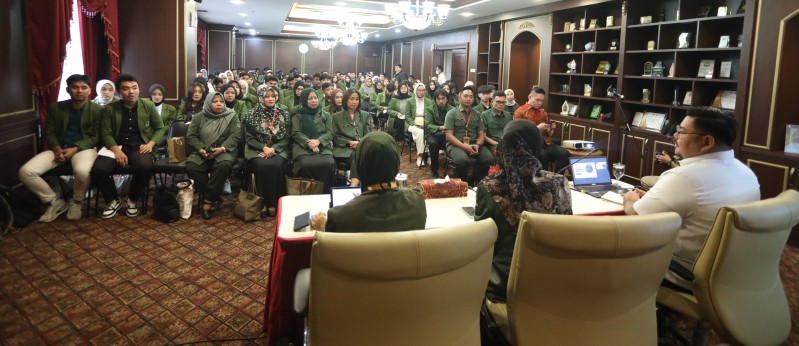
JAKARTA, MKRI — The Constitutional Court (MK) welcomed a group of students from Jenderal Ahmad Yani University (Unjani) on Wednesday (16/7/2025) at the Delegation Room, Building I of the Court in Jakarta. This visit was part of the Court’s institutional education program aimed at strengthening students’ understanding of the Constitution and the role of the Constitutional Court within Indonesia’s state system.
The students were received by Constitutional Court Legal Analyst Arinta Sulistiyo Eko Prabowo, who delivered a presentation on the history, authority, and strategic position of the Court. In his explanation, Arinta stated that the Constitutional Court was not part of Indonesia’s legal system prior to the reform era. The institution was established following the amendment of the 1945 Constitution in response to the need for a constitutional guardian.
"After the constitutional amendments, Indonesia’s state structure underwent major changes. The Constitutional Court and the Supreme Court now both form part of the judicial power. Each is an independent judicial body with distinct authorities," said Tiyo.
He further explained that the Constitutional Court holds five main authorities: reviewing laws against the 1945 Constitution, resolving disputes over constitutional authority between state institutions, deciding on the dissolution of political parties, settling disputes over general election results, and issuing judgments on the House of Representatives’ opinion concerning alleged legal violations by the President or Vice President.
“The most common and routine task is judicial review. Recently, the Court also handled election result disputes. As for other authorities, such as political party dissolution and impeachment, those have yet to be exercised,” he added.
Tiyo also emphasized that in line with the Court’s vision of becoming a modern and trustworthy judiciary, it has taken concrete steps to build public trust. This includes ensuring openness in almost every aspect of its judicial process. “The only part that remains confidential is the Judges’ Deliberation Meeting. Although it’s called a ‘meeting,’ the law considers it a formal hearing to determine the outcome of a case. From the moment a petition is filed, all documents are accessible on the Court’s website, and hearings can be watched live,” Tiyo explained.
In addition to the interactive discussion, the students were also invited to visit the Constitutional Court’s Center for Constitutional History (Puskon), located on the 5th floor of Building I. During the tour, students gained insights into Indonesia’s constitutional development, the founding of the Court, and documentation of important decisions issued by the Constitutional Court.
Author : Utami Argawati
Editor : Tiara Agustina
Translator : Agusweka Poltak Siregar
Disclaimer: The original version of the news is in Indonesian. In case of any differences between the English and the Indonesian versions, the Indonesian version prevails.
Wednesday, July 16, 2025 | 14:39 WIB 276