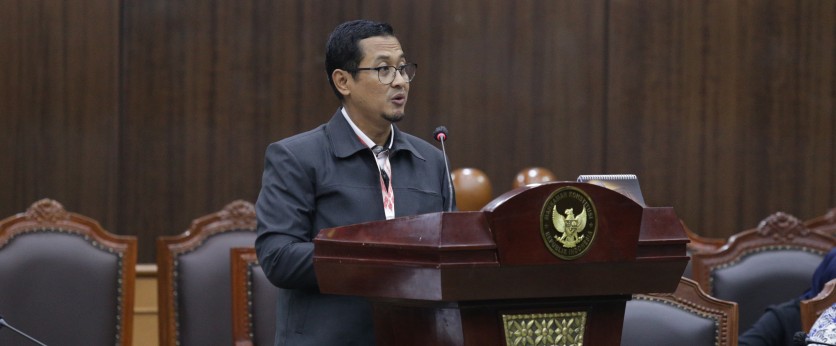
The Supreme Court, National Police, and Corruption Eradication Commission testifying as Relevant Parties at a judicial review hearing of Law No. 31 of 1999 on Corruption Eradication, Wednesday (7/16/2025). Photo by MKRI/Bayu.
JAKARTA (MKRI) — On Wednesday, July 16, 2025 in the plenary courtroom, the Constitutional Court (MK) held another hearing for the material judicial review of Article 2 paragraph (1) and Article 3 of Law No. 31 of 1999 on the Eradication of the Criminal Acts of Corruption as amended by Law No. 20 of 2001 (Anti-Corruption Law) to hear the Supreme Court, the National Police, and the KPK (Corruption Eradication Commission) as Relevant Parties as well as witnesses for the Petitioner of case No. 161/PUU-XXII/2024.
Head of the KPK’s Legal Bureau Iskandar Marwanto said at the hearing that cases of corruption resulting in state financial losses and harm to the national economy, prosecuted under Article 2 paragraph (1) and/or Article 3 of the Anti-Corruption Law, have significantly increased each year. He explained that, doctrinally, these offenses may be grouped into seven categories based on the methods or modus operandi employed: (1) corruption related to state financial losses, (2) bribery, (3) extortion, (4) embezzlement in office, (5) fraudulent acts, (6) conflicts of interest in procurement, and (7) gratuity.
“This demonstrates that corruption causing losses to the state’s finances occurs in real terms every year,” said Iskandar.
He further noted that the addition of new prerequisites to the elements of the articles under judicial review, as proposed by the Petitioner, would create a duplication of prohibited acts within a single provision. This duplication would conflate elements such as unlawful conduct or abuse of authority with bribery, abuse of office, extortion, fraud, conflicts of interest in procurement, and the receipt of gratuity. Yet these forms of conduct are already distinct criminal offenses under the Anti-Corruption Law, each subject to their own criminal sanctions.
Circumstances involving bribery, abuse of office, extortion, fraud, conflicts of interest in procurement, and the receipt of gratuity, when linked to acts of corruption causing state financial or economic losses, merely serve as methods or concrete manifestations of unlawful acts or abuse of authority in such offenses. Since these are only methods or modus operandi, they need not be independently proven as separate elements of the crime; rather, they are inherently included within the evidentiary framework for establishing the elements of unlawfulness or abuse of power.
In addition, Iskandar emphasized that the significance and urgency of regulating corruption that causes losses to state finances or the national economy is not only normative but also empirically relevant. This is evidenced by the actual amount of loss incurred and the prevalence of such cases. He cited an analysis of Indonesia Corruption Watch (ICW) research reports titled Trends in Corruption Case Verdicts from 2014 to 2023, which found that the total state losses resulting from corruption cases nationwide during that period exceeded IDR 291.5 trillion.
Iskandar also revealed that the KPK has handled 310 cases of corruption causing state financial or economic losses under Articles 2 and 3 of the Anti-Corruption Law from 2014 to May 2025. The total value of losses from these cases, as handled by the KPK between 2018 and 2025, exceeded IDR 25.1 trillion.
Vague Legal Norms
On the other hand, Alexander Marwata—who previously served as an ad hoc judge at the Corruption Court from 2012 to 2015 and as KPK deputy chairman from 2016 to 2024—asserted that Article 2 paragraph (1) and Article 3 of the Anti-Corruption Law frequently spark debate due to differing interpretations and the lack of clear criteria for their application. He delivered this testimony as a witness presented by the Petitioner in case No. 161/PUU-XXII/2024.
“One key point to note is the increasing frequency of convictions where a person’s actions are arranged in such a way as to appear unlawful, solely to meet the elements of Article 2 paragraph (1) or Article 3 of the Anti-Corruption Law. In reality, however, there is often no causal link between the act in question and the alleged state financial loss,” Marwata stated.
He cited a concrete example from his own experience as an ad hoc judge in case No. 35/Pid.B/TPK/2012/PN.JKT.PST, in which the defendant was Hotasi Nababan—the same individual who is now the Petitioner in the present constitutional review—then serving as director of the state-owned enterprise PT Merpati Nusantara Airlines (PT MNA).
In that case, the Petitioner was charged under Article 2 paragraph (1) and Article 3 of the Anti-Corruption Law for a business decision that was deemed to have caused financial loss to the state and to have benefited a third party, Thirdstone Aircraft Leasing Group (TALG), in an aircraft leasing agreement with PT MNA. As part of the agreement, PT MNA paid a security deposit of USD 1 million. However, TALG failed to deliver the aircraft and did not return the deposit, resulting in a loss for PT MNA.
At the trial court level, the Petitioner was acquitted on the grounds that the decision had been made professionally, had received Board approval, involved no mens rea, resulted in no personal gain, and showed no affiliation with TALG. However, upon appeal to the Supreme Court, the Petitioner was found guilty solely because a financial loss had occurred and a third party had been “enriched,” without consideration of the Petitioner’s intent or any causal link between his actions and the financial loss.
The stark contrast between the acquittal and the conviction illustrates the vagueness of the legal norms in Article 2 paragraph (1) and Article 3 of the Anti-Corruption Law. These provisions allow overly broad interpretations and lack clear limitations concerning mens rea, thereby making it easy to reconstruct administrative or policy decisions into actions that meet the elements of a criminal offense.
According to Alexander, several problems arise from these provisions. For instance, individuals may be prosecuted despite lacking any criminal intent, as Article 2 of the Anti-Corruption Law does not require a specific mens rea element. In practice, what is proven is merely the act itself—without the need to prove criminal intent or malice—thereby eliminating distinctions between administrative, civil, and criminal errors, and channeling all financial losses into criminal proceedings.
Moreover, the line between general criminal offenses and corruption crimes becomes blurred within the context of Articles 2 and 3 of the Anti-Corruption Law, particularly when it involves state financial losses. Such issues arise from the ambiguity of Article 2 paragraph (1) and Article 3, especially Article 2 paragraph (1), which entirely omits the requirement of intent (mens rea) in its normative content. Consequently, in practice, law enforcement authorities do not prove deliberate intent, resulting in individuals being convicted despite lacking any conscious desire to cause financial loss to the state—where the loss is merely a consequence of a decision or policy taken without criminal intent to misuse state funds.
Also read:
Ex-Director of PT Merpati Airlines Challenges Anti-Corruption Catchall Articles
Petitioner Asks Catchall Anti-Corruption Articles Be Reinterpreted
The Petitioner of case No. 161/PUU-XXII/2024 was a defendant in a corruption case and, after trials, was acquitted by the anti-corruption court in 2013. However, a cassation decision in 2014/2015 declared him guilty of corruption on the primary charge of Article 2 paragraph (1) in conjunction with Article 18 of the Anti-Corruption Law in conjunction with Article 55 paragraph (1) point 1 of the Criminal Code (KUHP), so he was sentenced to four years and punished with a fine of Rp200,000,000.
He claimed that it had been proven that he had run the state-owned company PT Merpati Nusantara Airline as director in good faith and there was no mens rea or malicious intent to harm state finances. He alleged that the legal application of these articles has raised problems because Article 2 and Article 3 of the Anti-Corruption Law had been used to criminalize individuals relating to state losses when in fact, the financial or economic losses of the state that had arisen were not caused by his actions.
The Petitioner said evidence for the case was only drawn from separate and incompatible facts in such a way as to show the fulfillment of the elements in Article 2 paragraph (1) of the Anti-Corruption Law and that the perpetrator’s actions were interpreted in very broadly. He argued that Article 2 paragraph (1) of the Anti-Corruption Law must explicitly state intent, so it must read “every person with the intention....”
As Article 2 paragraph (1) of the Anti-Corruption Law does not mention the intent of harming state finances or economy, the Petitioner had been convicted even though it could not be proven that he had intentionally/with malicious intent harmed the state finances or economy and benefited. The cooperation he made was purely a business decision to save PT MNA’s finances, done in good faith in accordance with the procedures and principles of the business judgement rules (BJR), without conflicts of interest or kick-backs.
In his petitums, the Petitioner requested the Court to declare the phrase “unlawfully enriching himself and/or other persons or a corporation in such a way as to be detrimental to the finances of the state” in Article 2 paragraph (1) of the Anti-Corruption Law unconstitutional and not legally binding if not interpreted as, “with the intention of harming state finances and enriching oneself or other persons or a corporation by unlawful means.” He also requested the Court to declare the phrase “with the aim of benefiting oneself or other persons or a corporation, abusing the authority, facilities, or other means at their disposal due to rank or position to the detriment of state finances or state economy” in Article 3 of the Anti-Corruption Law unconstitutional and not legally binding if not interpreted, “with the intention of harming state finances or state economy and benefiting oneself or other persons or a corporation by abusing the authority, facilities, or other means at their disposal due to rank or position.”
Also read:
Former President Director and Former Governor to Test Anti-Corruption Law
Petitioners Request Conditions for Imposing Defendant Sanction in Anti-Corruption Law
The hearing also concerned case No. 142/PUU-XXII/2024, petitioned by former president director of Perum Perikanan Indonesia for 2016-2017 Syahril Japarin, a former employee of PT Chevron Pacific Indonesia Kukuh Kertasafari, and former governor of Southeast Sulawesi Nur Alam (Petitioner I-III). They request the Court to require conditions for suspects or defendants who are subject to criminal sanctions/fines in the provisions of the norms.
In their petitums, the Petitioners request the Court to declare that Article 2 paragraph (1) and Article 3 of the Anti-Corruption Law unconstitutional and not legally binding. Alternatively, they ask the Court to declare the phrase “enriching oneself or another person or a corporation” in Article 2 paragraph (1) of the Anti-Corruption Law unconstitutional and not legally binding if not interpreted as “enrich oneself or another person or a corporation as a result of or in relation to bribery, embezzlement in office, extortion, fraudulent acts, conflict of interest in procurement, and receipt of gratuities as regulated in the Anti-Corruption Law,” or “enriching oneself or another person or a corporation as a result of or in relation to bribery,” or “enriching oneself, directly or indirectly, or another person or a corporation.”
They also request that the Court declare phrase “with the aim of enriching oneself or another person or a corporation” in Article 3 of the Anti-Corruption Law unconstitutional and not legally binding unless it is interpreted to mean: “with the aim of enriching oneself or another person or a corporation as a result of or in relation to bribery, embezzlement in office, extortion, fraudulent acts, conflict of interest in procurement, and receipt of gratuities as regulated in the Anti-Corruption Law,” or “with the aim of enriching oneself, directly or indirectly, and others, and a corporation.” Finally, the Petitioners also request the Court to declare that the phrase “which harms the state’s finances or economy” in Article 2 paragraph (1) and Article 3 of the Anti-Corruption Law unconstitutional and not legally binding.
Also read:
Anti-Corruption Law Hearing Postponed, Will Be Merged to Similar Cases
Petitioner Asks Catchall Anti-Corruption Articles Be Reinterpreted
Scope of Anti-Corruption Law Questioned: Could Street Vendors Be Prosecuted
Read more:
Petition for Case No. 142/PUU-XXII/2024
Petition for Case No. 161/PUU-XXII/2024
Author : Mimi Kartika
Editor : N. Rosi
PR : Fauzan F.
Translator : Yuniar Widiastuti (NL)
Disclaimer: The original version of the news is in Indonesian. In case of any differences between the English and the Indonesian versions, the Indonesian version will prevail.
Wednesday, July 16, 2025 | 16:28 WIB 11130