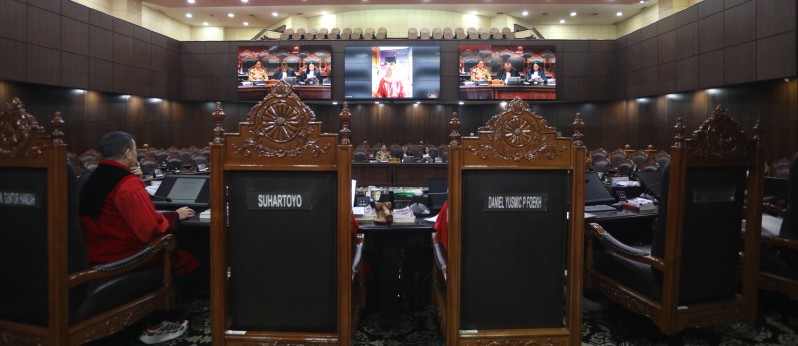
JAKARTA, MKRI – The Constitutional Court (MK) resumed the judicial review hearing of Article 37 paragraph (2) of Law Number 2 of 2002 on the Indonesian National Police (Polri Law) against Article 1 paragraph (3) and Article 28D paragraph (1) of the 1945 Constitution, on Tuesday (15/7/2025). Petitioners Syamsul Jahidin (Petitioner I) and Ernawati (Petitioner II) presented key revisions in the second hearing of Case Number 103/PUU-XXIII/2025.
Before the Panel of Justices—chaired by Chief Justice Suhartoyo and consisting of Constitutional Justices Daniel Yusmic P. Foekh and M. Guntur Hamzah—Syamsul explained that the petition had been amended to include a third petitioner, Cindy Alissa, along with a clearer narrative of her personal case relating to the role of the National Police Commission (Kompolnas).
“Kompolnas today functions merely as a public relations unit. Its role does not align with its intended function, as it fails to protect victims, lacks transparency in internal mechanisms, and is ineffective in mediating public conflict. Kompolnas has failed in fulfilling its constitutional mandate as an external oversight body over the National Police. Without effectiveness or accountability, it is no longer appropriate for Kompolnas to operate in its current form. It acts more like an event organizer, with no clear indicators for how it conducts oversight,” Syamsul asserted.
The petitioners have since refined the petition’s requests (petitum), asking the Court to declare Article 37 paragraph (2) of the Polri Law unconstitutional and therefore no longer legally binding. Alternatively, they request the Court to declare it conditionally unconstitutional unless it is interpreted to mean that Kompolnas, as referred to in paragraph (1), must be established by a Presidential Decree.
Also read:
Petitioners Challenge National Police Commission
For context, Petitioners Syamsul Jahidin, Ernawati, and Cindy Alissa are seeking a judicial review of Article 37 paragraph (2) of Law Number 2 of 2002 concerning the Indonesian National Police (Polri Law), as it relates to Article 1 paragraph (3) and Article 28D paragraph (1) of the 1945 Constitution. Article 37 paragraph (2) states: “The National Police Commission as referred to in paragraph (1) shall be established by Presidential Decree.”
According to the petitioners, this provision fails to ensure legal control and certainty regarding the functional oversight of the police. “Supervision of the National Police should be conducted by Kompolnas, particularly to monitor and ensure professionalism and independence within the force. However, in reality, it only adds to the state’s burden by acting as a spokesperson or extension of the police institution. This creates legal uncertainty and weakens accountability mechanisms. Without clear oversight functions, public trust in the Indonesian National Police may continue to decline,” Syamsul stated during the initial hearing on Wednesday (2/7/2025).
The petitioners also pointed out that the weak oversight from Kompolnas may open the door for law enforcement officers to act repressively toward individuals or groups based on suspicion or subjective judgment, without objective evidence. This contradicts the principle of presumption of innocence guaranteed under the 1945 Constitution and undermines human rights protections.
For that reason, the petitioners request the Court to declare Article 37 paragraph (2) of the Polri Law unconstitutional and no longer binding. Alternatively, they ask the Court to declare it conditionally unconstitutional unless interpreted to mean that Kompolnas, as referred to in paragraph (1), is established by Presidential Decree.
Author : Sri Pujianti.
Editor : N. Rosi.
PR : Andhini SF.
Translator : Agusweka Poltak Siregar
Disclaimer: The original version of the news is in Indonesian. In case of any differences between the English and the Indonesian versions, the Indonesian version prevails.
Tuesday, July 15, 2025 | 16:29 WIB 359