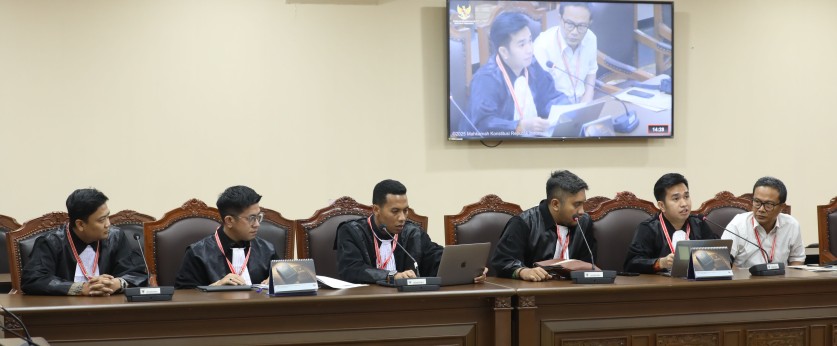
Rusnawi (Petitioner) presenting his claims against the Job Creation Law and the State Administrative Court Law alongside his legal counsels, Tuesday (7/15/2025). Photo by MKRI/Panji.
JAKARTA (MKRI) — The Constitutional Court (MK) held the preliminary hearing for the material judicial review of Article 64 paragraph (1) and Article 66 paragraph (1) of Law No. 30 of 2014 on the State Administrative Court (PTUN) as amended by Law No. 6 of 2023 on the Stipulation of Government Regulation in Lieu of Law No. 2 of 2022 on Job Creation into Law, as well as Article 97 paragraph (8) of Law No. 5 of 1986 on the State Administrative Court on Tuesday, July 15, 2025 in the plenary courtroom. The petition for case No. 109/PUU-XXIII/2025 was filed by Rusnawi.
The hearing, presided over by Deputy Chief Justice Saldi Isra, was convened to hear the substance of the Petitioners’ request. legal counsel Junanda Wahid argued that Rusnawi had suffered losses following the annulment of his appointment as a public official by the National Population and Family Planning Agency (BKKBN). This annulment occurred despite him having resigned from the Indonesian Air Force (TNI AU) as required for the appointment.
Previously, the Petitioner participated in the 2020 open selection for the main high leadership position within BKKBN. Prior to applying, Rusnawi stated that he had sought clarification from the selection committee regarding his status as an active member of the military. The committee verbally indicated that active service members could participate in the selection, provided they resigned should they pass.
On the basis of this assurance, Rusnawi applied and completed all stages of selection. He subsequently resigned from the Air Force in February 2020 and was officially retired by May 2020. He was appointed and inaugurated as head of the BKKBN Provincial Representative Office for West Nusa Tenggara in April 2020.
However, on January 13, 2021, BKKBN revoked his appointment by Decree No. 95/KP.11.02/B2/2021, citing the absence of a transfer approval from the National Civil Service Agency (BKN). The Petitioner felt aggrieved by this cancellation, as it was carried out without any fault on his part and after him dutifully following all lawful procedures in good faith.
Eliadi Hulu, another member of the legal team, argued that the implementation of Article 64 paragraph (1) and Article 66 paragraph (1) of Law No. 30 of 2014 on Government Administration was inconsistent with Article 1 paragraph (3) of the 1945 Constitution. According to him, if these provisions were applied in absolute terms, the Government would be able to revoke or annul any decision already issued, regardless of the grounds for such revocation or annulment. This, he contended, contravenes the principles of justice and legal protection guaranteed by Article 28D paragraph (1) of the Constitution.
“As a state governed by law, there are principles of protection afforded by the state to its citizens. There are two types of protection granted: from authorities and from stronger economic forces. In this matter, the Government has acted arbitrarily, not as a protector but as an oppressor of its citizens,” he stated.
The Petitioner further asserted that, in instances such as this, the party deserving of sanction due to defect should be the government agency or official responsible, as a form of accountability—not the citizen who has complied both legally and procedurally. This is the ratio legis that should apply: punishment or sanctions should only be imposed if a person or citizen is proven to have committed a violation. If the annulment or revocation results from defects attributable to the Government, it is unjust for accountability to be shifted onto the citizen. This aligns with the legal maxim that errors committed by administrative officials in issuing decisions that harm justice seekers or society should not be borne by the affected party. This principle manifests the doctrine of nullus commodum capere potest de injuria sua propria (no one should benefit from their own wrong, and no one should suffer for the wrong of another).
He also submitted that, if the provision were to be applied absolutely and without limitation, it would violate Article 5 letter b of Law No. 30 of 2014, which prioritizes the principle of human rights protection in the conduct of government administration. The elucidation to Article 5 letter b clarifies, “The principle of human rights protection means that in the administration of government, agencies and/or government officials may not infringe upon the fundamental rights of community members as guaranteed by the 1945 Constitution.” However, according to the Petitioner, the norms challenged in this review give legitimacy to arbitrary actions by officials who annul or revoke decisions without due regard for the origin of the defect.
Therefore, in his petitums, the Petitioner requested the Court to declare Article 64 paragraph (1) of the Government Administration Law, as amended by Article 175 of the Omnibus Law on Job Creation, unconstitutional and without binding force to the extent that the term “defect” is not interpreted to mean: “revocation of decisions due to defects caused by government agencies or officials may only be carried out if compensation is provided to the party stipulated in the decision for rights that would have accrued if the decision had remained valid through its designated period, or if revocation was ordered by a court ruling.” He also requested a similar interpretation for Article 66 paragraph (1), and additionally sought a ruling that Article 97 paragraph (8) of the Government Administrative Court Law is unconstitutional and not legally binding unless interpreted to mean: “If the claim is granted, the Court may impose binding obligations upon all State Administrative Agencies or Officials until the Decision is fully executed.”
Constitutional Losses Explained
Responding to the petition, Constitutional Justice Ridwan Mansyur advised the Petitioner to elaborate on the constitutional losses suffered by explaining the causal link between the alleged losses and the provisions being challenged, as well as the grounds for review.
“Although this brief is quite substantial—forty pages—it still lacks a strong explanation of the causal relationship between your losses and these provisions, which you claim have caused you harm. Moreover, you have included the phrase compensation as part of the petitums resulting from this judicial review,” he observed.
At the end of the session, the panel gave the Petitioner until Tuesday, July 28, 2025 at 12:00 WIB to submit the revised petition.
Author : Utami Argawati
Editor : N. Rosi
PR : Raisa Ayuditha M.
Translator : Yuniar Widiastuti (NL)
Disclaimer: The original version of the news is in Indonesian. In case of any differences between the English and the Indonesian versions, the Indonesian version will prevail.
Tuesday, July 15, 2025 | 18:22 WIB 247