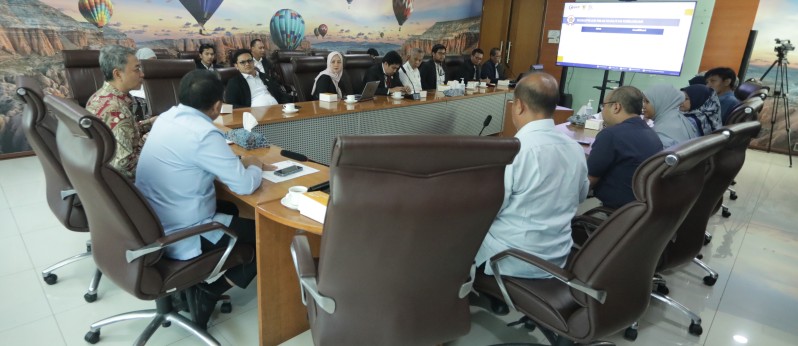
Secretary General of the Constitutional Court, Heru Setiawan, accompanied by Head of the Legal and Registry Administration Bureau, Fajar Laksono, along with several MK officials, held a meeting with LAN RI on Tuesday (8/7/2025). Photo by MKRI/Ilham WM
JAKARTA, MKRI – The Secretary General of the Constitutional Court (MK), Heru Setiawan, together with the Head of the Legal and Registry Administration Bureau, Fajar Laksono, and several other structural officials, visited the National Institute of Public Administration (LAN RI) on Tuesday (8/7/2025). The meeting was held in connection with the 2025 Policy Quality Index (IKK) measurement for the Constitutional Court. The delegation was welcomed by LAN’s Principal Secretary, Andi Taufik, and the Director for Strategy on Improving Policy Quality, Widhi Novianto.
In his opening remarks, Heru explained that the visit was intended to learn more about the standardization of policy quality — something he considers very important for the Constitutional Court. “We need to reach a level of policy quality that meets LAN’s standards,” he said.
Heru mentioned that in previous years, MK was granted a special dispensation by LAN, given that the Court is only permitted to issue legal products in the form of final and binding decisions. As a result, MK doesn’t have policy products that can be evaluated through the IKK framework.
“So far, MK only has internal rules and procedural instruments for litigants, such as Constitutional Court Regulations, Decrees of the Chief Justice, and other administrative decisions,” Heru explained.
However, with LAN no longer granting dispensations this year, MK will begin to present its internal regulations for assessment — as a way to demonstrate measurable quality and show that MK is committed to delivering excellent public service.
LAN RI’s Principal Secretary, Andi Taufik, noted that this visit is part of a follow-up discussion to the Court’s previous letter. He emphasized the importance of such forums as a space for institutional learning and collaboration.
“Sharing knowledge, combining experiences, exchanging ideas — this kind of collaboration is essential. We see time and time again that collaborative efforts generate positive energy and lead to real improvement,” said Andi.
Meanwhile, Director Widhi Novianto explained that the Policy Quality Index (IKK) is an instrument used to evaluate the quality of public policies, especially those that have a strategic impact on development. It uses an evidence-based approach and encourages self-assessment to improve policy outcomes.
According to him, the IKK looks at four main areas: policy planning, implementation, evaluation and sustainability, and transparency. For institutions like the Secretariat General of the Constitutional Court or the Parliament, which don’t directly serve the general public, the policies assessed will involve the internal stakeholders or parties who interact closely with the institution.
The policies must also have a clear impact on strategic development, affect public interest, have been officially enacted, and implemented within the past three years. For 2025, a maximum of three policies can be submitted for assessment.
Widhi also shared that the IKK tool has been simplified — from 39 statements to just 11 focused questions. Each policy being assessed must be backed by a legal basis, and the final scoring categories are: Excellent, Very Good, Good, Fair, and Poor. (*)
Author : Ilham W.M.
Editor : Lulu Anjarsari P.
Translator : Agusweka Poltak Siregar
Disclaimer: The original version of the news is in Indonesian. In case of any differences between the English and the Indonesian versions, the Indonesian version prevails.
Tuesday, July 08, 2025 | 17:47 WIB 547