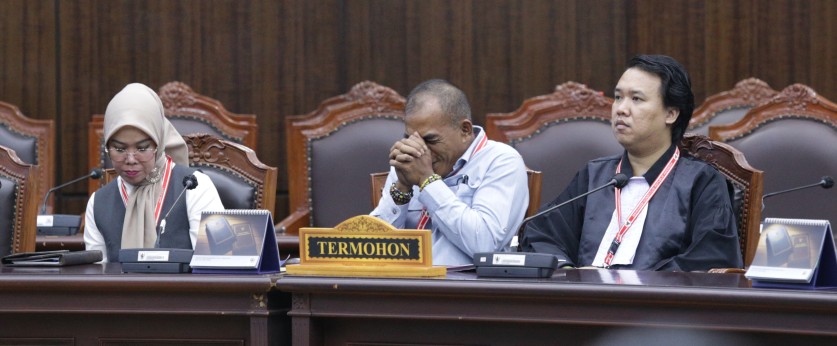
The Respondent (General Elections Commission) while delivering their statement during the hearing of Case Number 327/PHPU.BUP-XXIII/2025 concerning the Regent Election Result Dispute in Mahakam Ulu Regency, held in the Plenary Courtroom on Tuesday (8/7/2025). Photo by MKRI/Teguh
JAKARTA, MKRI – The Constitutional Court (MK) has decided its decision on the Regional election result dispute for the 2024 Mahakam Ulu Regent and Deputy Regent, filed by candidate pair Novita Bulan and Artya Fathra Marthin (Novita–Artya). The Court ruled that the petition was inadmissible due to the Petitioners’ lack of legal standing, as they failed to meet the requirements stipulated in Article 158(2)(a) of Law No. 10 of 2016 on Regional Head Election.
Under the provision, the difference in vote count between the petitioning candidate pair and the winning candidate pair—identified as Candidate Pair Number 3, Angela Idang Belawan and Suhuk—must not exceed 416 votes. However, in the Re Vote for the Mahakam Ulu Regent Election , the Petitioners trailed by 2,302 votes, far surpassing the permissible margin.
“The Petitioner does not fulfill the legal standing requirements as provided in Article 158(2)(a) of Law No. 10 of 2016. Even if the Court were to set aside this provision—which it has not—the core arguments presented by the Petitioner remain legally unfounded,” stated Constitutional Justice Arsul Sani during the ruling hearing, held on Tuesday (8/7/2025) in the Plenary courtroom of the Constitutional Court in Jakarta.
Although the Court temporarily deferred the application of Article 158(2) to allow for a substantive review, including evidentiary proceedings, it concluded that the Petitioners’ main allegations—particularly claims of vote-buying involving Candidate Pair Number 3—were not supported by sufficient legal grounds.
In its ruling, the Constitutional Court found that the Election Supervisory Body (Bawaslu) had conducted factual supervision in the field and found no evidence of money distribution by the Campaign Team of Candidate Pair Number 3, either during the campaign period or on election day. Furthermore, Bawaslu issued no recommendation for a re-election due to vote-buying. Accordingly, the Court concluded that the Petitioner’s allegation of vote-buying, including claims of vote purchasing, was unproven.
The Court further noted that the political contract that previously led to the disqualification of Candidate Pair Owena Mayang Shari and Stanislaus Liah, as established in Constitutional Court Decision No. 224/PHPU.BUP-XXIII/2025, constituted a written agreement between the candidate pair and village heads. In contrast, the Petitioner in the current dispute claimed that the continuation of the “Manis” program by Candidate Pair Angela Idang Belawan and Suhuk resembled a similar political contract. However, the Petitioner also explicitly acknowledged in their submission that no written political contract existed in the present case.
The Court observed that a video presented during the proceedings, which depicted the campaign manager of Candidate Pair Number 3 explaining the allocation of village funds, family resilience funds, and neighborhood unit (RT) funds—components of the previous Owena-Stanius program—reflected political promises rather than binding contracts. The Court emphasized that such promises, when articulated as part of a candidate pair's vision, mission, and work programs, are permissible campaign practices and do not constitute violations of electoral law.
In its legal reasoning, the Court reaffirmed that political pledges concerning programs, assistance, or fund allocations are lawful so long as they are integrated into the candidate pair’s official platform and do not amount to contractual obligations with voters. This view aligns with the principles set forth in Decision No. 224/PHPU.BUP-XXIII/2025.The testimony of witness Marthinus Miing, a campaign coordinator for Candidate Pair Number 2, further reinforced this position. Miing testified that Candidate Pair Number 2 had similarly promised development assistance and operational funding for RTs, amounting to IDR 250 million per neighborhood unit per year.
Additionally, campaign activities held in Batu Majang Village were monitored by the District Election Supervisory Committee (Panwascam), which reported no violations during the campaign. Based on these considerations, the Court concluded that the Petitioner’s claims of vote-buying in the form of a political contract by Candidate Pair Number 3 were unsubstantiated and legally unfounded.
Also read:
Mahulu Revote: Alleged Violations in the “Children First” Regional Election, Volume Two
Angela-Suhuk Denies “Children First Vol. II” Revote Rumors in Mahakam Hulu Election
Witness Admits Receiving Rp1 Million During Mahakam Ulu Revote
For your information, the Petitioner asserted in the petition that, through the active involvement of her father, Candidate Pair Angela Idang Belawan and Suhuk continued to uphold political contracts with neighborhood unit (RT) leaders and allegedly engaged in vote-buying practices, offering payments ranging from Rp1 million to Rp2 million per voter. This approach, the Petitioner claimed, had previously been used in support of Angela’s son, whose candidacy was later disqualified.
According to the Petitioner, Angela-Suhuk promised that RT chairpersons would each receive Rp200–300 million, neighborhood groups would receive Rp5–10 million, and village heads would be allocated village funds amounting to Rp4–8 billion per year. The distribution of money allegedly extended to voters in Long Hubung, Long Bagun, and Long Pahangai Subdistricts, with cash payments ranging from Rp1 million to Rp2 million per person.
The Petitioner further claimed that this political contract strategy was concealed by no longer using written agreements with RT chairpersons. Instead, during campaign events, Angela-Suhuk repeatedly announced that the ‘sweet’ program—previously associated with the disqualified candidate pair—would be continued under their leadership. Prior to implementing this political contract scheme, the Regent of Mahakam Ulu was also accused of making provocative remarks during official events and campaign activities, including declaring that the Constitutional Court’s decision disqualifying his son’s candidacy was flawed and asserting that there was nothing wrong with political contracts.
In their petition, the Petitioner requested the Court to annul Mahakam Ulu Regency General Election Commission Decision Number 145 of 2025 dated 27 May 2025, which confirmed the vote tally in favor of Candidate Pair Number 3, Angela Idang Belawan and Suhuk. Furthermore, the Petitioner asked the Court to disqualify Angela-Suhuk. In the alternative, the Petitioner requested a re-vote to be held at all polling stations in Long Bagun and Long Hubung Subdistricts.
Also read:
Mahakam Ulu Regent Under Spotlight in Election Dispute
Mahakam Ulu Regent Refutes Involvement in Owena-Stanislaus Election
Court Spots Incumbent’s Involvement in Mahakam Ulu Regent Election
Political Contract Leads to Revote, Regent Candidate Disqualification in Mahakam Ulu Election
Previously, through Decision Number 224/PHPU.BUP-XXIII/2025, the Court ordered the Mahakam Ulu Elections Commission to conduct a re-vote for the 2024 Regent and Deputy Regent Election in Mahakam Ulu Regency, excluding Candidate Pair Number 3, Owena Mayang Sari and Stanislaus Liah. In the legal considerations delivered by Deputy Chief Justice Saldi Isra, the Court concluded that the 2024 Mahakam Ulu Election was tainted by structured, systematic, and massive violations involving political contracts that promised financial incentives across all subdistricts in Mahakam Ulu Regency.
The Court found sufficient evidence in the form of signed political contract documents between village heads and the disqualified candidate pair Number 3 as related party. A total of 28 village heads from 18 villages across five subdistricts were found to have signed such agreements.
According to the Court, while political promises—such as program pledges, assistance, or material support—are generally permissible when included in the vision, mission, and action program of a candidate, the political contracts in question went beyond acceptable political commitments. The Court emphasized that these contracts were not merely “ordinary political promises” but represented a systematic mobilization effort. The contracts explicitly outlined the role of the First Party—identified as a resident of Mahakam Ulu Regency with no legal restrictions on political support—to act as part of a campaign team responsible for promoting the candidate’s programs and promises to voters.
Also read:
Petition Number 327/PHPU.BUP-XXIII/2025
Author : Mimi Kartika
Editor : N. Rosi
PR : Fauzan Febriyan
Translator : Fuad Subhan
Disclaimer: The original version of the news is in Indonesian. In case of any differences between the English and the Indonesian versions, the Indonesian version will prevail.
Tuesday, July 08, 2025 | 19:08 WIB 268