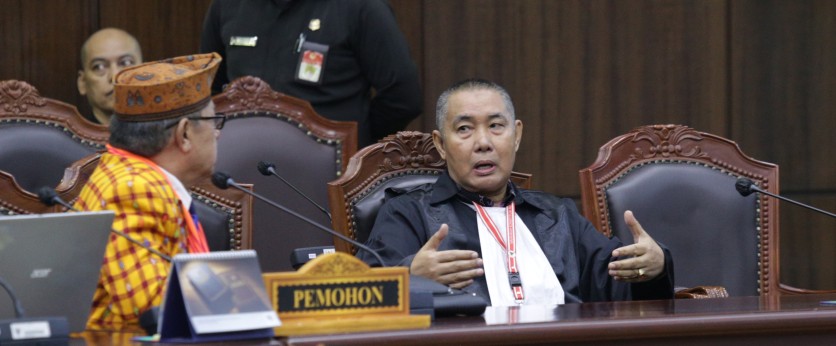
The ruling hearing for the judicial review of the State Administrative Court Law and the General Court Law for case No. 77/PUU-XXIII/2025, Thursday (7/3/2025). Photo by MKRI/Bayu.
JAKARTA (MKRI) — The Constitutional Court (MK) rejected the material judicial review petition of Articles 47 and 50 of Law No. 5 of 1986 on the General Court in conjunction with Law No. 9 of 2004 in conjunction with Law No. 51 of 2009 on the State Administrative Court (PTUN). The Decision No. 77/PUU-XXIII/2025 was delivered at a ruling hearing on Thursday, July 3, 2025 in the plenary courtroom. “[The Court] rejected the Petitioner’s petition in its entirety,” said Chief Justice Suhartoyo alongside the other constitutional justices.
In its legal consideration, delivered by Constitutional Justice Ridwan Mansyur, the Court held that Bahrul Ilmi Yakup and Iwan Kurniawan (Petitioners) had challenged the constitutionality of the words “court assigned and authorized” in Article 47 and “exception” in Article 77 of Law No. 5 of 1986, arguing that they had led to legal uncertainty regarding the absolute authority of the general court and the state administrative court.
In relation to that, the Court emphasized that land titles issued by authorized officials are state administrative decisions (KTUN). As such, an aggrieved party may file a lawsuit over any maladministration to the state administrative court, as per Article 53 of Law No. 9 of 2004. However, the lawsuit must be filed within 90 days since the decision is handed down.
The Court also explained that disputes over land ownership, not the validity of certificate issuance, are the domain of the general court (district court), in accordance with the Supreme Court’s jurisprudence, including Supreme Court Decisions No. 1341/K/Sip/1974 and No. 93 KTUN/1996, which state that state administrative decisions do not cover civil disputes over land ownership.
Leading to Legal Uncertainty
The Court argued that the Petitioners’ request that the reviewed phrases be interpreted differently could potentially lead to legal uncertainty. The request that state administrative courts be considered to have absolute authority in all cases related to land certificates, the Court held, would lead to new interpretations of these norms.
“The Petitioners’ claim that the phrases ‘the court shall have the duty and authority’ and ‘the district court shall have the duty and authority’ has caused legal uncertainty is unreasonable according to law,” Justice Ridwan said reading out the Court’s legal reasoning.
Term “Exception”
Responding to the Petitioners’ claim that the term “exception” in Article 77 had led to drawn-out and inefficient examination of cases, the Court explained that legal remedies against state administrative court decisions, including cassation to the Supreme Court, are part of a judicial system that guarantees justice.
The Court mentioned that cassation is regulated in Article 131 of the State Administrative Court Law and Article 28 paragraph (1) letter a of the Supreme Court Law, which state that the Supreme Court has the authority to examine and decide on cassation petitions as a legal remedy against the final decision of the courts under it. Restrictions on this authority, including restrictions on the filing of exceptions, the Court argued, are contrary to the principle of access to justice.
“Therefore, the Petitioners’ claim regarding the word ‘exception,’ which is considered to hinder the realization of the principle of simple, fast, and low-cost justice, is unreasonable according to the law,” Justice Ridwan said.
Also read:
Call to Broaden The State Administrative Court's Authority Over Land Title Certificates
Advocate Revises Petition in Review of State Administrative Court Law
At the preliminary hearing on Thursday, May 22, advocate Bahrul Ilmi Yakup delivered his material judicial review petition of Articles 47 and 50 of Law No. 5 of 1986 in conjunction with Law No. 9 of 2004 and Law No. 51 of 2009 on the State Administrative Court. He believes these provisions had failed to ensure legal certainty, particularly in resolving land certificate disputes.
He recounted that in July 2022, he was asked by PT Wahana Bara Sentosa to provide a legal opinion on a land ownership dispute. After examining the relevant documents, regulations, and jurisprudence, he concluded that the case fell under the absolute jurisdiction of the state administrative court. The lawsuit was accepted at both the first instance and appeal levels. However, upon cassation, the Supreme Court ruled the case inadmissible, stating it fell under the jurisdiction of the general court, not the administrative court. The same stance was maintained when the case was brought to a judicial review (PK).
This, Bahrul contended, demonstrated how Articles 47 and 50 of the State Administrative Court Law has created legal ambiguity regarding the authority of courts in settling disputes over land certificates. He argued that while both articles address jurisdictional matters, they lack harmony and coherence, causing confusion in judicial practice, particularly in cases involving disputes over absolute jurisdiction between general and administrative courts.
Author : Utami Argawati
Editor : Lulu Anjarsari P.
PR : Fauzan Febriyan
Translator : Yuniar Widiastuti, Yuanna Sisilia (NL)
Disclaimer: The original version of the news is in Indonesian. In case of any differences between the English and the Indonesian versions, the Indonesian version will prevail.
Thursday, July 03, 2025 | 10:47 WIB 267